

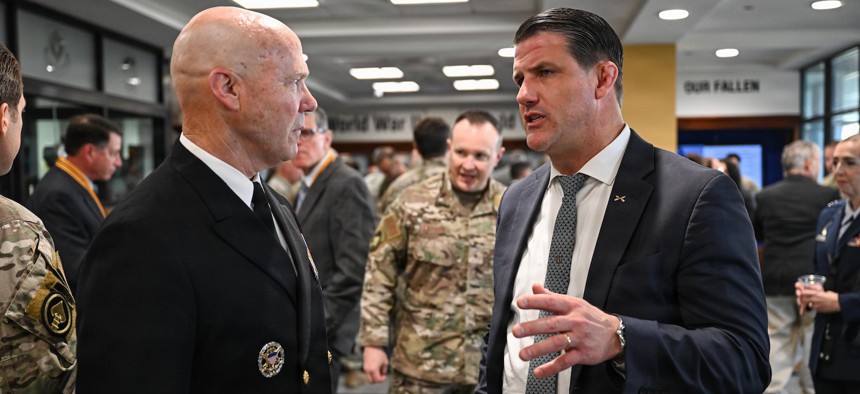
Adm. Frank “Mitch” Bradley, commander of U.S. Special Operations Command, speaks with Derrick Anderson, assistant secretary of defense for special operations and low intensity conflict, at MacDill Air Force Base, Fla., April 15, 2026. U.S. Air Force / Tech. Sgt. Marleah Miller


The civilian office overseeing special operations forces could get $45 million budget, 100 staffers
Hegseth’s proposed changes hinge on getting support from Congress.

Defense Secretary Pete Hegseth is pushing for an elevation of the civilian special operations chief and a name change for the office, while allocating $45 million and 100 staffers to man it—the latest of a series of moves to normalize administration of special operations forces on a level equivalent to a military service.
But whether the moves come to fruition and sticks for the long-term depends on Congress, at a time when Hegseth and his department have clashed repeatedly with the Republican-controlled legislature, and are looking at even more conflict when Democrats become the majority in January.
“I am concerned that the relationship between Congress and the Pentagon may prevent passage of the legislation required for implementation,” David Maxwell, vice president at the Center for Asia Pacific Strategy and a retired Army Special Forces officer, told Defense One.
A Nov. 2 memo laid out the new framework for the chief role, changing it from the assistant secretary of defense for special operations/low-intensity conflict to an under secretary job. Hegseth also moved to reimagine the office with a vintage name, bringing back the Office of Strategic Services moniker in a nod to the World War II-era organization that fielded the original U.S. special operations units.
“Special operations forces (SOF) remain the Joint Force's pathfinder and our Nation's vanguard in an era of global uncertainty and strategic competition. Despite this contribution to the Joint Force and our Nation, resourcing for SOF remains behind current operational and force posture,” Hegseth wrote. “It is time for a bold, foundational change.”
The memo fulfills a requirement from the 2025 National Defense Authorization Act to come up with a plan to resource ASD SO/LIC so it can function with the same man, train, and equip mission as the military departments.
“It must be codified in law to make it effective,” Michael Lumpkin, who served in the office twice during the Obama administration, told Defense One. “While I personally appreciate the nod to USSOCOM’s predecessor—the OSS—elevating ASD SO/LIC while changing its name to something very ambiguous could potentially result in many other tasks being bolted onto the new organization. This could have the effect of actually diluting the oversight of USSOCOM.”
Special operations experts had been opining for years that U.S. Special Operations Command needs civilian oversight on par with the military services.
“USSOCOM has a distinctive combination of combatant command responsibilities and service-like functions. Its civilian oversight structure needs to reflect that arrangement,” Maxwell said. “Giving SO/LIC standing comparable to the military department secretariats should help normalize its participation in budget, acquisition, personnel, and readiness decisions. Those decisions should routinely include the civilian official responsible for the special operations enterprise.”
This was years in the making, going back to the 2017 National Defense Authorization Act, which gave ASD SO/LIC its first authorities over manning, training, and equipping special operations forces
“Even this small step was challenged by the building’s entrenched bureaucracy,” Lumpkin said. “Office space and personnel to support the changes mandated by law were treated with disdain by many and were subsequently slowed or were never realized at all.”
In 2020, acting Defense Secretary Chris Miller ordered that the position be reorganized to report directly to his office, rather than to the under secretary for policy, effectively putting the job on par with the secretaries of the Army, Navy, and Air Force.
Hegseth took the effort a step further by rebanding the position and the office. In his memo, he authorizes the secondary title Assistant Secretary of War for the Office of Strategic Services, much as the way he has styled himself the secretary of war, “unless and until such time as” Congress decides to put the name change into law.
“The OSS name also offers an opportunity to reinforce a valuable tradition: integrating intelligence, influence, innovation, and work with indigenous partners in support of national objectives,” Maxwell said. “That heritage encompasses contributions to major combat operations and the broader strategic value of special warfare across competition and conflict.”
The new office will have a budget of at least $45 million, according to the memo, as well as 75 civilian positions and 25 military personnel, along with its own space in the Pentagon, like previous efforts.
“The additional staff and resources are especially important,” Maxwell said. “Effective civilian oversight requires expertise and independent analysis. A properly staffed office can assess requirements, scrutinize investment choices, resolve support problems, and hold the enterprise accountable.”
But Congress will need to be on board if Hegseth’s instructions are to be taken seriously, Lumpkin said.
“I see the directive as the first step in the negotiations with the Hill,” he said. “The details matter, and very specific legislative language is required to drive the desired outcome, because at the end of the day, the Congress cannot legislate culture at the Pentagon.”
Help us report on the future of national security. Contact Meghann Myers: mmyers@defenseone.com, meghannmyers.55 on Signal.
NEXT STORY: GOP tries to speed-walk search for GAO's next chief