

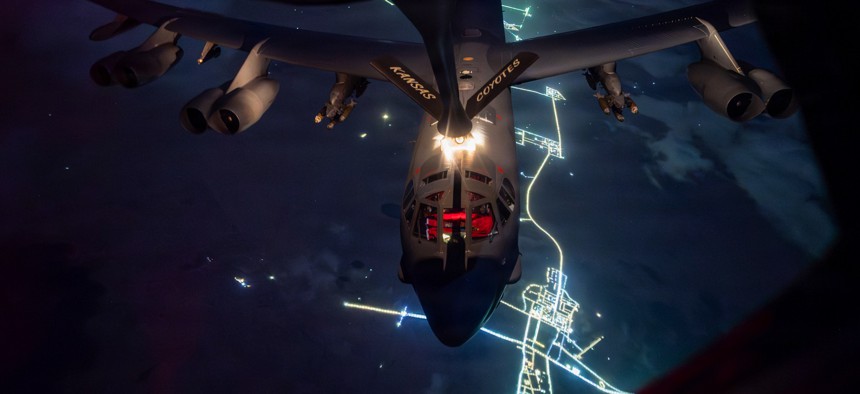
A U.S. Air Force B-52 Stratofortress aircraft refuels from a KC-135 Stratotanker aircraft over the U.S. Central Command area of responsibility during Operation Epic Fury, March 26, 2026. U.S. Air Force /


The Pentagon claims ‘we control the sky’ over Iran. Experts say the air war isn’t that simple.
Terms such as air superiority are being misapplied, obscuring the dangers that are downing and damaging U.S. aircraft.

To President Trump and his defense secretary, the herculean rescue of two downed airmen in hostile territory was further proof that the U.S. military has full control of the skies over Iran.
But the actual situation remains complicated and dangerous, according to former military officials and defense experts who said painting a simple picture overlooks the weapons that downed the F-15E—and that still hold vast swaths of airspace at risk.
On Easter Sunday, Trump said in a social media post that the daring recovery underscored that U.S. forces had “achieved overwhelming Air Dominance and Superiority over the Iranian skies.” The next day, Defense Secretary Pete Hegseth said much the same.
“We control the skies. You see we flew for seven hours in daylight over Iran to get the first pilot, and we flew seven hours in the middle of the night to get the second and Iran did nothing about it,” Hegseth said Monday at a White House press conference.
But airpower experts, including Joint Chiefs Chairman Gen. Dan Caine, have been more measured. At press conferences, the former F-16 pilot has declared that air superiority exists over only certain areas of Iran; on Wednesday, he acknowledged the ongoing dangers that aviators face.
"I've laid out the statistics, but it does not truly capture the nature of combat. This is gritty and unforgiving business," Caine said. "It's chaotic, it's hot, it's dark, it's unpredictable and there's always unknowns."
Air superiority is defined in Air Force doctrine as “the control of the air by one force that permits the conduct of its operations at a given time and place” without severe enemy action that would result in mission failure. A higher level of control, air supremacy, is established when the “opposing force is incapable of effective interference,” but this “may be difficult to achieve in a peer or near-peer conflict.” A state of air superiority or supremacy may be limited to a certain time, location, or altitude.
“Control of the skies” and “air dominance,” on the other hand, have no formal meaning.
“I understand why people use it, but, from a doctrinal perspective, to say you ‘control the sky’ doesn't really say anything, because control of the air is a spectrum,” said Kelly Greico, a senior fellow at the Stimson Center. “When President Trump and Secretary Hegseth are using these terms, they're not necessarily using them the doctrinal way, the way that you see Gen. Caine using them.”
Trump’s use of “air dominance” really “doesn't mean anything,” Greico said, and added it’s not a term used in the Air Force’s doctrine.
Gaining the ability to operate in hostile airspace is not just the Air Force’s responsibility, but “one of the first priorities of the joint force,” according to service doctrine. While heavy bombers have flown missions over parts of Iran and rescue helicopters can buzz in low and slow to the ground, other areas such as the Strait of Hormuz remain closed to ships due to air threats.
“I think that it's worth emphasizing that Air Force doctrine is clear: that air superiority is for the joint force,” Grieco said. “So, by that definition, we do not have air superiority near the Strait of Hormuz, because it's predominantly drones and missiles that are keeping the strait closed, and they’re keeping it closed to naval escort vessels.”
After the F-15E was shot down, an A-10 Thunderbolt II and multiple rescue helicopters and cargo planes were lost in the recovery mission, Caine said during the White House presser. Since the start of Operation Epic Fury in late February, Iran has destroyed or damaged multiple U.S. aircraft such as an F-35 which was forced to make an emergency landing after being hit during a combat mission.
Those mounting losses stand in contrast to the administration’s claims of total control of the Iranian skies, some former military officials say.
“I am somewhat surprised by the continued losses we were taking this deep into the conflict,” said Jack Shanahan, a retired Air Force three-star general, who thought the U.S. should have “more air supremacy” by this point.
But others said a state of air superiority or supremacy can exist even with heavy aircraft losses.
“Air supremacy doesn't mean that you're completely without risk,” a former military official said. “There are plenty of examples of how even with air supremacy and air superiority, you can still be challenged. I don't think you ever get to an environment where you're not completely without risk.”
This is particularly true at lower altitudes.
“When you're down below 5,000 feet, air supremacy and superiority feels a lot different than when you're up at 25,000 and 30,000 feet,” they said.
On Wednesday, Caine told reporters that 80 percent of Iran’s air defenses had been destroyed, but that anti-aircraft threats still persisted at lower altitudes. Trump had claimed days earlier that Iranian anti-aircraft and radar had been destroyed; that the F-15E was shot down by a shoulder-mounted, heat-seeking missile; and that other aircraft took small-arms fire.
Shanahan said the administration’s sweeping claims about air control have a parallel in its occasional reports about the number of targets struck in Iran. (More than 13,000, Caine said on Wednesday.) Neither is a direct measure of success, and may even be a distraction.
“We get caught up in the number of targets struck,” Shanahan said. “It’s back to almost Vietnam-era days when we started looking at body counts, number of tonnage of bombs dropped, but not understanding, maybe, the adversary has a different theory of victory in mind than you do. And if the regime survives, that may be their number-one criterion for success, whereas ours has seemed to be a little bit all over the map over the past 30 days.”