

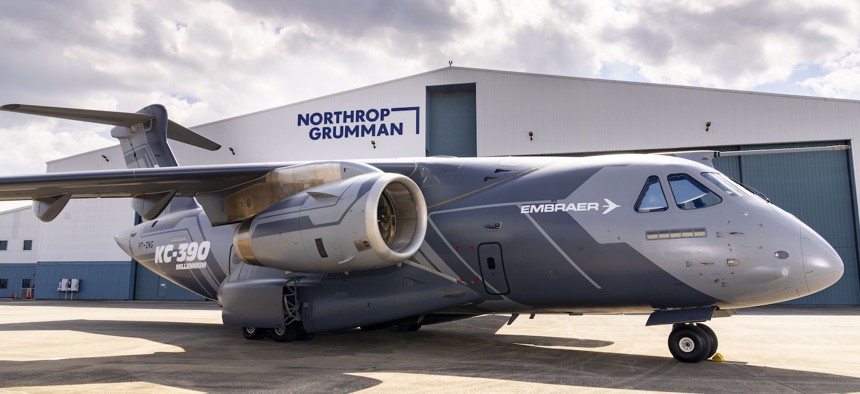
Courtesy Northrop Grumman


Embraer joins Northrop to devise autonomous boom system for KC-390 tanker
The deal aims to court international buyers and the Air Force as it sketches out its future refueling program.

MELBOURNE, Fla.—Brazilian aerospace giant Embraer is teaming up with Northrop Grumman to develop what could be the Air Force’s next tanker—and promises to spend a half-billion-dollars on infrastructure to make the KC-390 Millenium here.
“We have…almost 3,000 direct employees here in Melbourne,” said Bosco da Costa Junior, CEO of Embraer Defense & Security. “If we have the right business case, Embraer is eager to invest over $500 million to a dedicated facility for KC-390. By the way, the platform today is already compliant with [the] Buy American Act” and could be a “winning value proposition” for U.S. and international markets.
The companies are exploring options—and for Northrop, building on the company’s ongoing research and development in the area—to develop an autonomous boom that could be retrofitted for existing KC-390 aircraft.
“Key to this partnership is Northrop Grumman’s commitment to field a boom for the KC-390,” said Tim Walton, a senior fellow at Hudson Institute, told Defense One. “This commitment is bolstered by Northrop Grumman’s interest in also fielding fuel transfer systems for its other Next-Generation Air Refueling System offerings, an Northrop Grumman-designed low-observable aircraft and a Medium-sized Blended Wing Body design with JetZero.”
Northrop’s refueling technology efforts are part of a “metered investment” that could be demonstrated in the “low, single-digit years,” said Tom Jones, who leads the company’s aeronautics division.
KC-390s are already equipped with a probe-and-drogue refueling system, which is used for helicopters and some Navy aircraft. But adding a boom would allow it to refuel more types of aircraft, specifically U.S. Air Force planes.
“If Northrop is able to integrate a boom, the KC-390 would be able to refuel a broad range of receptacle receiver aircraft,” from the U.S. Air Force and worldwide, such as the F-35, Walton said.
KC-390s are already being flown by air forces in Brazil, Portugal, and Hungary with orders from Austria, the Czech Republic, Netherlands, Sweden, and South Korea, according to investor documents. It can seat about 80 troops, reconfigure for different missions—including stowing a folded Black Hawk—and does well with short runway takeoffs. And, for what it’s worth, the ride is better than a C-17.
The Embraer-Northrop deal comes as the Trump administration asks defense companies to produce weapons faster, spend their own money on developing new tech, and make products domestically.
It also follows Embraer’s failed partnership with L3Harris to develop aerial refueling capability. That coupling dissolved in 2024.
Still, Embraer has been persistent in its push to become a major player in the U.S. defense industry, even amid increased buy and build in America rhetoric since President Donald Trump took office in 2025. Other foreign-based defense contractors have also made known their interest in doing business with and in the U.S.
Embraer’s decadeslong presence in the U.S. is primarily with its executive jets—but the company wants to keep expanding its global defense business, which grew about 10 percent in 2025, according to an earnings release.
Last year, Air Force Special Operations Command agreed to buy three of Embraer’s A-29 Super Tucano, which are produced in a specialized facility in Jacksonville, Fla. Also, the Air Force is currently sketching out its Next Generation Air-refueling System program.
Executives wouldn’t say whether the new partnership hinged on U.S. Air Force buy-in, insisting instead there is enough demand regardless.
“Demand is there” for tankers globally, said Frederico Lemos, who leads Embraer’s international defense business. For example, nations with smaller air forces “want flexibility” and the ability to do “multiple missions” with a single aircraft, he said.
Editor’s note: This media trip was facilitated by Northrop Grumman and Embraer and included transportation via the KC-390.
NEXT STORY: Boeing moves its defense HQ back to St. Louis