

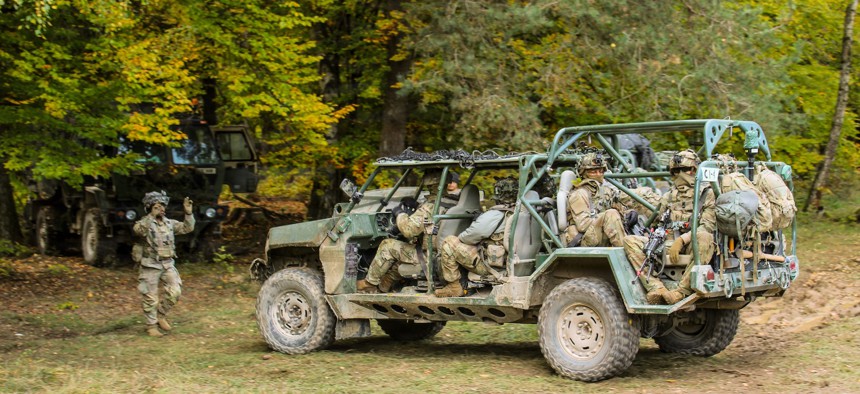
Soldiers conduct mounted patrols on their Infantry Squad Vehicles at Hohenfels Training Area, Germany on Oct. 19, 2025. U.S. Army / Maj. Brian Sutherland



The Army just launched an open call for industry ideas
A request for information invites potential partners to pitch the service on new ways to jointly fund and execute needed programs.

The Army is looking to stretch its limited research and development dollars by teaming up with private industry to develop projects that can be used by the service as well as commercial customers.
A request for information that went live Friday kicked off what the service is calling its Strategic Capital Initiative, seeking out private sector ideas for new operating models, public-private partnerships and contracting methods that can combine Army funding with private capital investment to tackle what the service estimates is a $150 billion backlog of needed infrastructure updates.
“The ask to industry is: Help us solve our problems. But in a way where they can get return on their investment that is not reliant solely on the Army as a customer, because then you ultimately come back to the appropriated funds issue,” Dave Fitzgerald, the Army’s chief operating officer, told reporters Tuesday.
Rather than figure out what it wants and then put out specific requests, the Army has a list of areas it wants to work on to help direct some of the pitches. They are:
- Energy resilience and dominance
- The organic industrial base
- Strengthening logistics and supply chains
- Real assets and facilities utilization
- Advanced and flexible manufacturing and technology adoption
- Critical minerals and research development
“What we're trying to do is let them see what we think we need across our entire footprint, and they may be able to come up with a model that kind of bundles some of that, or networks some of those things together in a way that we just haven't arrived at yet,” Fitzgerald said.
The Army has been trying to save money by using commercial parts in some of its programs, including the infantry squad vehicle, which is built off of the Chevy Colorado pick-up truck’s chassis and makes use of that existing commercial production line.
Now the service is looking for more of those types of partnerships, Fitzgerald said, where a contractor can put up much of the initial investment and then be able to sell the final product commercially as well as to the Army.
“So we're looking for models that present a diversified customer base, because I think that de-risks it for the taxpayer as well as it de-risks the investment for industry,” he said. “Certainly, we are looking to de-risk the initial investment, either by becoming a long-term partner through a co-investment model, or signing up as an anchor customer for things that we know that we need, that align to one of these six areas.”
This includes investing in securing supply chains for resources like rare-earth metals, which the Army needs in order to build things like brushless motors for unmanned aerial systems, but that have wide commercial use as well. The Army and a private investor could team up to source them.
“Heavy rare earths that go into small drones, but they also go into the motors that make your car window go up,” he said. “So that's, I think, how we kind of unlock the dual-use potential.”
The idea is that the Army can save some of its investment funds with these public-private partnerships, then use its appropriations for must-do projects that don’t have a commercial purpose, like building bigger hangars for its forthcoming MV-75 tiltrotor aircraft.
“I know for a fact that we're never going to be able to dig out of our current infrastructure backlog without a different approach,” Fitzgerald said. “I think how much remains to be seen. But I am optimistic.”
The RFI is open until April 2. From there, the goal is to review proposals and get to work on the best ones right away.
“I think we want shovels in the ground by summer,” Fitzgerald said. “I don't know what that looks like, if it's a [letter of intent] signed, if it's an actual shovel going in the ground—it's going to be different.”
Help us report on the future of national security. Contact Meghann Myers: mmyers@defenseone.com, meghannmyers.55 on Signal.
NEXT STORY: Pentagon’s war on Anthropic based on ‘dubious’ legal thinking and ideology—not real risk, sources say