

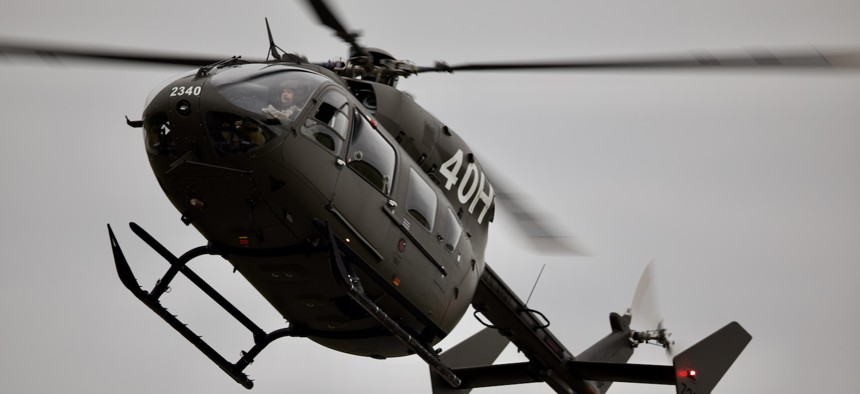
A UH-72 Lakota Helicopter over Fort Rucker, Ala,. November 8, 2019. U.S. Army Reserve / Staff Sgt. Austin Berner



Two firms picked as finalists for contract to outsource Army pilot training
Award still planned for September despite lawmakers’ qualms.

The Army has picked at least two finalists to take over the service’s entry-level helicopter training program, despite Congressional pushback on the plan last year. Service officials have said they plan to choose a winner by September.
Bell and M1 Support Services both confirmed in press releases this week that they were selected to move to the fourth and final stage of the competition.
Another competitor, Lockheed Martin, was not chosen to move on, a company spokesperson confirmed to Defense One.The Army did not immediately respond to a request for comment asking whether any other companies were selected.
Last month, it was reported that AAR Corp was also in the running for the competition. The Illinois-based company did not immediately respond to requests for comment.
Finalists will be asked to demonstrate how they could execute the service’s Initial Entry Rotary Wing training program more affordably and efficiently.
Funding for the effort to shift the in-house school to a contractor-owned and -operated model, dubbed Flight School Next, was paused by lawmakers in the most recent National Defense Authorization Act. The provision asked for a detailed report on the one-year pilot program and for Army Secretary Dan Driscoll to brief Congress on the cost-effectiveness and rationale before Congress would release funds for the contract.
An Army spokesperson did not immediately return a request for comment on Tuesday asking whether the service provided Congress with the results and briefing.
Despite the pushback and funding uncertainty, the competition is still marching on.
Bell is working with DigiFlight, Delaware Resource Group (DRG), V2X, Alpha 1 Aerospace, Semper Fly and TRU Simulation, the company said in a news release. The team’s bid is centered around Bell’s 505 helicopter as the trainer.
“Bell is proud to be selected for the fourth phase of the Flight School Next competition alongside our teammates,” John Novalis II, the company’s Flight School Next strategic director said in a press release. “Making it to this stage proves that Bell’s solution is strong and we look forward to demonstrating our ability to execute.”
M1’s team consists of General Dynamics Information Technology, Robinson Helicopter Company, Quantum Helicopters, and the University of North Dakota Aerospace Foundation. Its offering includes Robinson Helicopters’ R66 trainer.
A Robinson spokesperson confirmed to Defense One the company is working with multiple prime contractors for a Flight School Next offering.
“We are honored to advance to Phase IV,” George Krivo, M1’s CEO and chairman, said in a news release. “In this next phase, Team M1 will demonstrate our comprehensive, innovation-rich solution to produce more proficient Army Aviators on time and on budget.”
The Bell 505 and R66, both single-engine aircraft, are both departures from the Army’s current training helicopter, Airbus’ twin-engine UH-72 Lakota, which has been criticized by service leaders as being too expensive and restrictive for teaching aviation basics. An Airbus spokesperson referred questions to the Army when asked if the company was moving ahead in the competition.
A call-for-solutions document issued late last year says that the winner of the Flight School Next contract would produce 800 to 1,500 Army aviators annually for 26 years, with an award expected by September.