

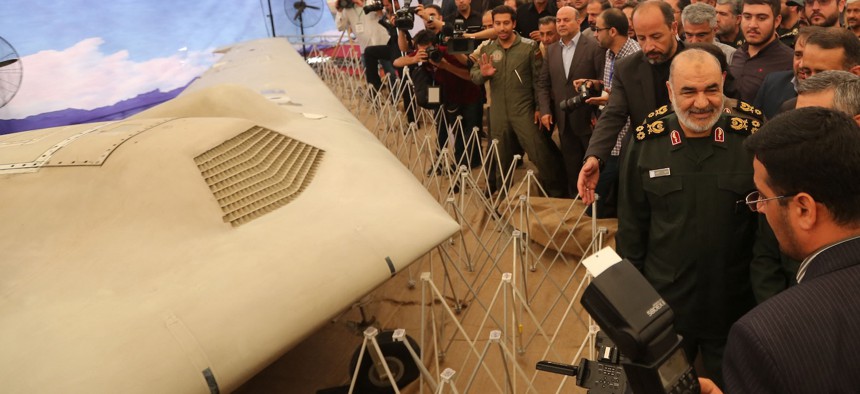
Iranian Revolutionary Guards commander Major General Hossein Salami (R) stands next to what Iran presented as an American RQ-170 Sentinel drone in Tehran, September 21, 2019. ATTA KENARE / AFP via Getty Images


Lockheed CEO: Air Force RQ-170 drones used in mission to capture Maduro
Missions for the “Beast of Kandahar” stealth drone are rarely acknowledged, experts say.

An extremely secretive Air Force spy drone was used in the U.S. military’s operation to capture Venezuelan President Nicolás Maduro this month, Lockheed Martin’s CEO confirmed, marking a rare disclosure of the aircraft’s operations.
James Taiclet confirmed that RQ-170 Sentinel stealth drones were part of the Jan. 3 Venezuelan mission, dubbed Operation Absolute Resolve, on a Thursday earnings call.
“Lockheed Martin products once again proved critical to the U.S. military's most demanding missions,” Taiclet said. “The recent Operation Absolute Resolve included F-35 and F-22 fighter jets, RQ-170 Sentinel stealth drones, and Sikorsky Black Hawk helicopters, which helped ensure mission success while bringing the men and women of our armed forces home safely.”
Joint Chiefs chairman Gen. Dan Caine confirmed during a press conference on Jan. 3 that 150 aircraft from roughly 20 bases, including “intelligence, reconnaissance, surveillance” assets, were used in the operation, but didn’t publicly name the stealth drones. Video footage purportedly showing two RQ-170s landing in Puerto Rico began circulating on social media following the operation. An Air Force spokesperson did not confirm the use of the RQ-170 in the Venezuela operation and pointed to Caine’s earlier comments.
Taiclet’s mention of the spy drone is the first disclosure of the aircraft’s operations in roughly half a decade. In 2021, the 432nd Wing at Creech Air Force Base in Nevada briefly mentioned the unit had “successfully deployed and redeployed RQ-170 Sentinel forces” in a news release. While the use of the surveillance drone in the Venezuela operations was not surprising to some Air Force analysts, one expert said the disclosure of the mission from Lockheed Martin was abnormal.
“I was a little surprised to see it acknowledged by someone who would know. But, then again, I do suspect that was something that had been vetted beforehand,” said Mark Gunzinger, the director of future concepts and capability assessments for the Mitchell Institute for Aerospace Studies.
The revelation of its use in Venezuela also marks one of its most high-profile missions since its reported surveillance of then-Al Qaeda leader Osama Bin Laden before his death in 2011. Later that year, an RQ-170 was captured by Iran and later used as a model for the country’s Shahed drones.
The RQ-170, developed by Lockheed’s secretive Skunk Works research arm, was first spotted in Afghanistan in the late 2000s and later nicknamed the “Beast of Kandahar.”
While the full capabilities of the stealth drone have not been disclosed by the U.S. military, the Air Force has acknowledged in a fact sheet that the aircraft is used for "intelligence, surveillance and reconnaissance to locate targets.” Gunzinger said it’s crucial for the U.S. military to keep the RQ-170’s technology a secret.
“The good thing is there were no specific capabilities attributed to it,” Gunzinger said. “I think that's pretty important that kind of information is not revealed.”
NEXT STORY: Army unveils new tank—five years early