

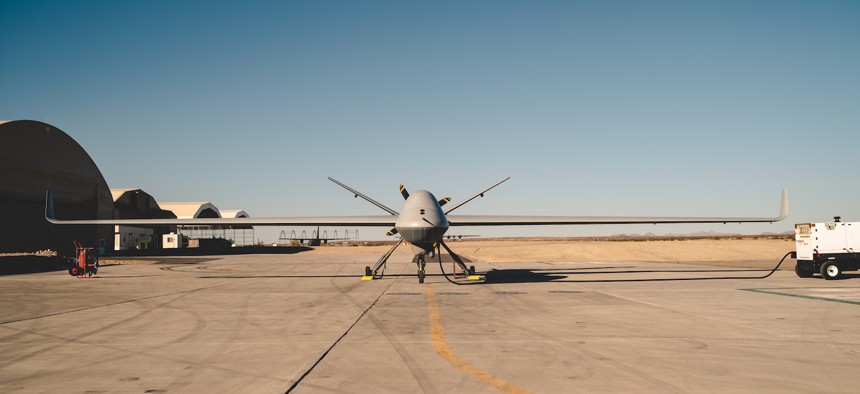
A General Atomics MQ-9 SkyGuardian Unmanned Aerial Vehicle at the U.S. Army Yuma Proving Grounds in Yuma, Ariz., Nov. 7, 2019. U.S. Marine Corps / Lance Cpl. Colton Brownlee


General Atomics plans upgrade so ground stations can fly newer MQ-9 drones
Upgrade package will enable current operators to fly MQ-9Bs with their existing terminals.

General Atomics is working to enable older MQ-9 ground stations to control the latest version of the drone, allowing longtime operators moving to newer models to buy the upgrade package instead of a whole new terminal.
The company is expected to announce this week that its Block 30 ground control stations, introduced in 2016 to control the MQ-9A Reaper, will be modified to also fly the MQ-9B SkyGuardian and SeaGuardian drones. General Atomics expects to begin flight testing with the new stations by the end of the year.
“We understand that [ground control station] compatibility is a concern for some current MQ-9A operators considering the MQ-9B, and we want to remove that issue for them,” C. Mark Brinkley, a General Atomics spokesperson, said in a statement. “This upfront investment of our own internal research and development funding is one way we hope to make the overall acquisition process smoother.”
The Air Force operates roughly 140 Block 30 stations to control its MQ-9As, which have seen heavy use, and losses, in the ongoing war on Iran. The Air Force’s top uniformed leader called the drone the “most valuable player” of Operation Epic Fury.
The Senate Armed Service Committee is also a fan of the aircraft. Provisions in the committee’s version of the pending 2027 National Defense Authorization Act would limit the service’s ability to retire MQ-9s and direct it to acquire more by 2028.
But the Air Force is looking to replace the venerable drone, and General Atomics has a pitch ready: the MQ-9B, with a larger wingspan, range, and endurance than its predecessor.
Brinkley said the upgraded ground stations will make it more affordable for militaries to buy the SkyGuardian and SeaGuardians.
Current Block 30 ground control station users include the U.S. military, the Italian Air Force, the French Air Force, the United Arab Emirates Armed Forces, the Spanish Air Force, and the Royal Netherlands Air Force, according to the company.
“The upgraded Block 30 GCS will allow existing Reaper customers to also operate MQ-9B from that same GCS,” Brinkley said. “Upgrading existing Block 30s will be significantly cheaper overall than purchasing new CGCS units, and delivery will be faster.”
The hardware upgrades for those ground control stations are focused on the datalink capability for the MQ-9B, which includes a new datalink rack and the company’s Interface Multiplexor Encryptor, General Atomics said in a statement. The software is also being modified to “interface with the unique capabilities” of the SkyGuardian and SeaGuardians.
General Atomics' certifiable ground control station, or CGCS, is meant specifically for the MQ-9B and can be used to fly the aircraft in military and civilian airspaces. The upgrades to the Block 30 ground control stations will still limit the MQ-9A and MQ-9B to military airspace, although the company did fly the SeaGuardians with the Block 30 before during development.
“The upgraded Block 30 will not be certifiable in the same way the CGCS has been developed to meet various global standards and the new GCS has a better, more modern human-machine interface,” Brinkley said. “But for customers looking to fly a mixed fleet, the Block 30 upgrade gets them there sooner.”