

Going hunting
What will it take to counter the smart mines of tomorrow? Welcome to the latest edition of Fictional Intelligence.
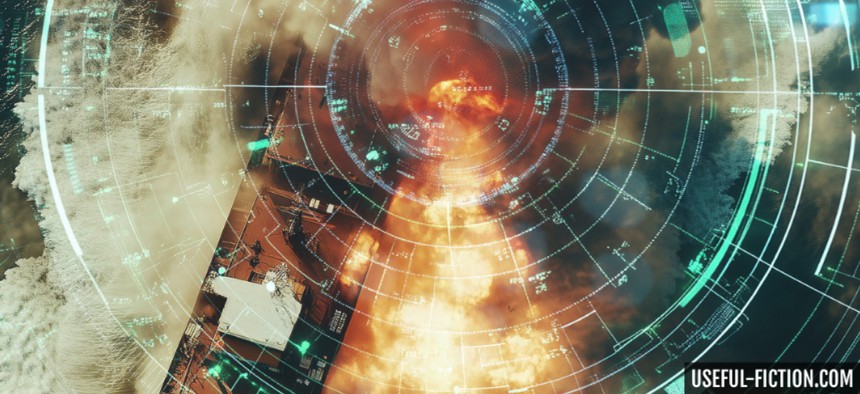
Even the simplest naval mines can strike fear into mariners or throttle traffic through a choke point, for no weapon has sunk more warships in the past 75 years. Yet the mines of the future will be far more capable and dangerous.
The integration of AI and robotic technologies will produce hybrid UUV-mines: versatile, intelligent,able to adapt to and overcome countermeasures. They will strike from the depths at targets on land, sea, and in the air.
To counter them, militaries will need an equally new set of tactics and technologies: autonomous platforms, heterogeneous swarms, advanced sensor arrays, and modular architectures.
The following is a “useful fiction” written in support of the NATO Centre for Maritime Research and Experimentation. The story blends non-fiction research on current and future trends and technologies with a fictionalized narrative scenario designed to promote reflection about the future of mine and countermine operations and autonomy in a maritime environment.
BRUSSELS—The Turkish-flagged cargo ship MV Golden Horizon ran aground in Romanian waters on Thursday, less than two hours after the 110-meter vessel was damaged by an underwater explosion. It was the latest of four vessels, all carrying Ukrainian agricultural products, to suffer similar damage in the Black Sea.
NATO officials here say the pattern of attacks indicate a suspected Russian operation intended to set back a Ukraine still recovering from years of war. They could not, however, specify what sort of weapon might have caused the explosions. MV Golden Horizon, which had been bound for an undisclosed West African nation, ran aground in shallow coastal waters in full view of the Romanian Black Sea resort town of Mamaia.
“Moscow wants to cut us off at the knees just as we are getting back on our feet,” said a Ukrainian military spokesman in Kyiv. “The Black Sea is a lifeline not just for our nation, but the world. Our agriculture exports feed people of all faiths and colors, and now we are all under attack again.”
A Russian spokesman denied that the Kremlin or its affiliated forces had any role in the incident. The spokesman said it was “a false-flag attack designed to besmirch Russia’s good name.”
Endangering this route poses profound challenges for Ukraine, which exports foodstuffs worth roughly $30 billion a year. Growing uncertainty around this supply line has also begun to reverberate across the global economy. Ukraine remains the world's seventh-largest exporter of wheat, fourth-largest exporter of barley, and the biggest exporter of sunflower seeds, which are used for sunflower oil and animal feed. Its products are shipped to more than 40 countries where food prices have surged.
After Russia’s full invasion of Ukraine in 2022, foreign-flagged cargo ships carrying Ukraine’s grain harvest began to use the protected corridor that hugs the western coastline of the Black Sea. The route, too shallow for submarines, passes through the territorial waters of Romania and Bulgaria, both of which are NATO countries. That this vital export lifeline is now a zone of renewed conflict raises immense questions for the NATO alliance and Ukraine, which have led alliance leaders to agree to deploy a Maritime Task Force to protect the shipping and NATO-member territorial waters.
“Commander, do not tell me this is the first time you’ve been to a spa?” Spanish Navy Capitán de Corbeta Carlos Echeverría spread his arms with a host’s sweeping welcome.
“My husband and I did an anniversary trip to one of Swansea’s finest last year. It was nice, but for some reason that one didn’t have the added option of a visit to a tactical operations center,” replied Cmdr. Heidi Bonner of the British Royal Navy.
Befitting a four-star resort, the Hotel Aqua’s two-story spa building was finished in mahogany and polished brass and overlooked the waters of the Black Sea. The luxurious setting was disturbed now by fiber cables, thick as an arm, snaking across the gravel paths. These cables linked to an Offset Antenna Farm hidden in the resort’s parking garage, providing connectivity back to Brussels, the capitals of the participant nations, and every ship and aerial asset deployed in nearby waters as part of the newly arrived NATO Maritime Task Force.
Bonner nodded complimentarily at her deputy, who stepped aside for her to enter first. “Very well done in getting this set up so quickly,” knowing how much work had gone into turning the off-season resort’s spa into a command center for their operation.
The hotel sat just outside Mamaia, a resort community on the Romanian seashore. It was a strange juxtaposition for the two officers, who were used to operating from crowded warships or cubicles at NATO’s Allied Maritime Command in Northwood, UK.
“To be honest, I would not have minded if they had assigned us to the casino,” Echeverría said.
“Our Task Force intel cell is already set up there on the top floor,” Bonner replied. “It fits. They all watch far too much James Bond.”
The two officers had an easy repartee, but both felt the tension of their mission. The NATO task force was charged with securing the nearby sea lanes, which meant identifying and neutralizing the undersea threat that had all but closed off Black Sea shipping. The operations also carried the risk that whatever Russia was doing could cross into an Article 5 violation if any of the member-states’ ships were disabled or sunk. On top of that, there was the risk of an accident or skirmish with the growing number of Russian aerial drones and fighters that pestered the NATO forces.
“Where did they put the crew from the MV Golden Horizon?” Echeverría asked.
“Also in the hotel wing linked to the casino,” Bonner said. “Wanted them near the intel folks.”
“Smart,” said Echeverría, tapping his temple. “We’re about to get the UUV live feed up from the Golden Horizon.”
“Let’s go,” she said, leaving him in her wake as they headed towards the spa’s dining area.
Floor-to-ceiling windows were covered with light-blocking ballistic blankets against the threat of drones. Echeverría motioned for a sailor to bring up footage of the MV Golden Horizon’s latest UUV-conducted hull inspection.
“Tell me what we know, Petty Officer Shanks,” Bonner said, arms crossed as she leaned forward to study the video.
“Commander, the blast pattern on the hull indicates an external explosion,” replied the sailor, a young Canadian Navy petty officer 2nd class wearing wire-frame glasses. “We’re still modeling the size or yield of the explosive involved and will have that in less than 30 minutes. In terms of the source or cause, it is still a mystery to us. The waters in the area are too shallow for a submarine. No minefields are in the area; we’ve reconfirmed that with space assets.”
“Could it be a limpet mine emplaced in port by a Russian diver or drone?” asked Bonner.
“Highly unlikely based on the hull damage,” Echeverría said. “Bring up the close-up.”
Shanks froze the feed and swiped back to earlier imagery. “The latest generation Russian limpet mines use a shaped charge and would punch a clean hole through the hull, targeting the fuel stores or something else that would set off secondary explosions. This rather large, jagged metal near the bow indicates something else. Notice also the size. It is much bigger than what a diver or small UUV could emplace.”
“Thank you to you both,” Bonner said.
She closed her eyes and nodded, as if conversing with herself. Shanks looked confused, while Echeverría raised his eyebrows in anticipation, knowing a decision was about to come. The two NATO officers had deployed together twice in the past five years, once as part of a three-month Baltic mission focused on undersea cable surveillance and defenses and before that in the Persian Gulf supporting a U.S. task force that monitored illicit shipments to Iran.
“Let’s not get overly focused on the Golden Horizon,” she said, gesturing through the blackout curtains at the unseen hulking ship looming off the coast. “I want to know everything about the waters she was in, instead. By that, I mean we want to pull in as much data as we can, from every sensor we can access. All-domain NATO assets. OSINT. Buy what you need. And please don’t forget that our Ukrainian friends have quite a bit they can offer. If you’re having any problems with access, come see me, and we’ll break down that wall. Let’s get to it. There have been four attacks so far. If we could bet at the casino on it, a fifth would get at least even odds.”*
“Es un misterio,” said Echeverría.
In the next few hours, the task force assembled as powerful a collection of data as Bonner had ever seen. In this AI-powered era of sensor fusion, she could bring together an array of NATO military surveillance sources –– from hyperspectral satellite sensors to surface and undersea sonar — and civilian sources like oceanographic data from environmental buoys, or the acoustic data picked up by fishing vessels hunting for their catch.
Yet Bonner and Echeverría frowned as they conferred in front of an oversized monitor that displayed a live tactical map of the Black Sea, with icons to mark current shipping and the four attack sites.
“There is no discernible pattern, " she said. "At all. No minefields that we detected. Moreover, the second and third explosions happened in specific lanes that had already been cleared or transited by multiple other ships.”
“And it cannot be a submarine, as there is no vessel that can deploy in such shallow waters, nor one that could be in so many places at once,” Echeverría replied, gesturing in frustration at the screen as if shaming it into revealing a conclusion the task force’s AI mission analysis systems had been holding back.
“It’s impressive work. Now, I need to get another look at the problem,” said Bonner, already on her way out of the operations center.
• • •
On her first deployment, aboard on HMS Somerset far too many years ago, Bonner had found that going on deck always helped clear her head. Breathing fresh sea air and feeling the wind on her face was the best tonic for a mind and body numbed by hours inside an ops center.
The resort was a far better setting to recharge than the heaving deck of a frigate, where a spray of icy North Sea water doused your face every few moments. Bonner walked along well-tended gravel pathways, taking in the view that had been the scene of many engagement proposals. The serenity of the mostly empty tourist beach and lapping waves, though, was broken by the sight of the disabled Ukrainian freighter ship only 200 meters away, its bow low in the water and the ship listing to port. She eyed the wrecked ship, wishing it would reveal the secret of what had struck it.
A hundred meters further, a small fishing boat puttered past. Even from afar, she could tell the two men on board were related by the way they moved so fluidly together. The fishermen ignored the Romanian Navy RHIB standing guard at the wreck. They cared little for the freighter or what had happened to it, only that it was in the way of their catch.
Life goes on, Bonner thought, even with war on their doorstep. This region’s history of conflict was something she had been thinking about a lot recently, and yet it was easy to lose sight of the simple fact that families like this had no choice but to live out their lives in the middle of that history. Sometimes, it was easier. Other times, it was more complicated. But time and life moved on as it did for everyone.
Horse mackerel, she thought. Common enough fish here and likely what they were going out for. She might eat some at a local cafe if they ever cracked whatever was going on in the waters. In the hands of an able chef, it could make half-decent sushi.
She found a recently painted bench and sat down. The fatigue of the rushed deployment and nonstop tempo nearly took her breath away. You had to face the fatigue head-on, acknowledge it, and know when it might be holding you back.
The small fishing boat set an anchor just beyond the RHIB, and the father and son unlimbered heavy-duty rods. They cast their jigs in increasingly wider arcs beyond their boat and out toward the Golden Horizon. By the way the light flashed off the silvery lures, Bonner suspected they were using feather rigs. The predatory mackerel devoured small fish and, in this wintery time of year, could be found closer to the coast hunting near the bottom.
As her mind drifted, almost relaxing for a moment as she watched the long casts, an idea burst out of the moment of calm.
Bait.
Bonner leapt up and ran across the cross-cut manicured lawn back to her operations center.
• • •
Less than 24 hours later, Bonner and Echeverría flew low above the now lake-flat Black Sea aboard a Romanian IAR 330 Puma Naval Helicopter. Out the port side, she could see the Romanian Type 22 frigate Regele Ferdinand and a pair of RHIBs setting out from its stern at high speed toward the horizon. She knew the vessel: it was the former Royal Navy HMS Coventry. Since becoming the Romanian flagship in 2004—a few years before she graduated from the Royal Naval Academy—it had regularly supported allied operations in the Mediterranean.
Bonner hunched over the ruggedized tablet in her lap, signaling to the crew chief that they were nearing the drop point for the pair of drones secured with stout tie-down straps.
The air suddenly shook around them and the Romanian helicopter banked left and down toward the ocean surface. Spray from the helicopter’s downdraft flew in every direction and created conditions that took Bonner back to a white-out she once experienced in the Barents Sea.
Amid the steep, lurching turn she dropped her tablet, and it went skittering across the floor of the helicopter before the crew chief stepped on it with his boot. The air around her vibrated and roared. It took a second to realize that the helicopter wasn’t disintegrating but rather being buffeted by the slipstream from a fighter jet’s high-speed pass.
“Russians,” one of the Romanian pilots called out over the radio, a declaration followed by what were a string of epithets recognizable even in a foreign language.
Bonner tightened her harness and cleared her throat. “Very well. Continue mission,” she said, extending a steady hand for her tablet.
A few minutes later, the crew chief nodded at Bonner, before opening the starboard door. Then he stepped back to make way for a pair of British sailors, who gingerly carried a 2-meter UUV towards the open door. Secured by safety lines, the sailors fought to stay on their feet as the helicopter slowed to hover a few meters above the sea's surface. The dart-like autonomous craft weighed not much more than a sonobuoy.
This was the second one they had deployed from the helicopter, but just one of dozens launched into the glassy waters from RHIBs, patrol vessels, and other aircraft.
“Delta Two is wet!” one of the sailors called over the helicopter’s internal communications net.
Bonner looked down as the drone slipped beneath the surface.
“Confirmed Delta Two underway,” said the other sailor.
“Well done. Now let’s let these robots dangle their lures.” Given the stakes of hundreds of sailors whose lives were on the line, it may have sounded like a flippant comment. Yet it was the most unambiguous expression of the tactics she wanted the wider NATO force to employ.
The crew chief moved to secure the helicopter’s door, but Bonner waved him off. She preferred to have a direct view of the hunt going on below.
The warships, RHIBs, autonomous aerial drones, space-based surveillance, and UUVs formed a web, controlled by a fusion of occasional human but mostly onboard AI guidance. In the helicopter, Bonner was in the center of their digital threads, nudging and tugging occasionally to orient them or assigning her team to reconcile technical setbacks, of which there were always a few. But far less with each deployment of the drones, she noted, because the mission-management software learned, as she did.
The composition of the UUV fleet beneath this 300-square-kilometer stretch of the Black Sea reflected the hard-won lessons of operations in the region during Russia’s war upon Ukraine and the hot peace that followed. It wasn’t just about numbers but the type. No one design could succeed at everything, and engineering was a discipline built around managing tradeoffs. One of the American 17-meter long-endurance surveillance drones carrying its own mini-UUVs looked everything like a miniature submarine ought to and outranged every other of its robotic peers. The lightweight British dart-shaped drones dropped from her helicopter were at the other end of the swarm, sprinting and drifting up and down thermoclines where they passively surveilled the area with acoustic sensors. By deploying undersea drones of different ranges, sonar and infrared sensor packages, and underlying operating systems –– as befitted the numerous platforms NATO member nations brought to the mission –– this heterogeneity became the swarm’s strength.
In the role of undersea hunters, this collection of UUVs could orient and pursue a larger goal as a pod or pack, coordinated semi-autonomously by Bonner and the onboard edge-AI mission computers that could receive limited guidance and reason the next steps they should take. Bonner thought of it like the way her own body and brain integrated her five senses – and the sixth of instinct or gut feeling that had proved her invaluable. This happened automatically, without focused thought in a manner that she had come to see as similar to how she conducted her missions today than when she first joined the Royal Navy. The basic laws of physics endured underwater: communications would remain a challenge until a quantum breakthrough arrived. Yet the creative application of AI and autonomy allowed undersea operations to work around it.
In this case, the swarm of UUVs were not just hunting, but acting as bait. They were alternatively blasting out the acoustic signature of the Golden Horizon—harvested from the data records of the ships it had passed during its many transits of the region—and listening for a response.
Unlike the normal experience of fishing, the hunt was short. A multicolor image arrived on Bonner’s tablet screen—shared with her at the same time the meshed network of NATO UUVs shared it among themselves, overcoming the difficulty of undersea data transmission by playing a machine-speed version of the classic game of telephone. That same image was also being shared across the entire NATO task force’s battle network.
The data attached to the image indicated that it was one of many being shared at low bandwidth among the underwater UUVs and the surface vessels. It was a mosaic tile that, when combined with thousands of other past and present data sets, began to reveal a striking picture of what had been threatening the Black Sea shipping.
The first sequence of data showed movement that had begun almost immediately after the sonic deception was initiated. Delta Three, a counterpart of the UUV deployed from their helicopter, was already closing in on the contact. It soon beamed back imagery of a cloudy swirl of dirt kicked up by something lifting from the seabed floor. A synthetic picture of the target began to fill in automatically by the visual models used by the battle management system to integrate all the other data being gathered by the UUV swarm’s varied sensors. It was like watching a digital sketch artist at work.
The display soon revealed a barrel-like shaped UUV, with a pair of ducted-propellor drive units on either side of its fuselage and a kind of tread on the bottom of its hull that apparently allowed it to creep along the seabed, much like those used by undersea pipeline inspection companies. A needle-like projection from its nose was clearly visible, and Bonner did not need the AI to tell her it was a contact-detonation device.
She opened a direct channel to Echeverría, who hunched over his tablet. “It’s a hybrid mine of sorts. Do you concur?”
“Yes. It seems that the Russians stole an idea from the Ukrainian maritime drone program and further blurred the lines between commercial gear, mines, and UUVs.”
Echeverría used his tablet pen to circle a part of the image and zoom in.
“Look at the growth on the drone’s fuselage; it has clearly been sitting on the seabed for some time.”
“Just waiting to deploy when the right freighter comes along,” Bonner said. “Or, at least, what sounds like a freighter.”
She closed her eyes and sought peace amid the helicopter's noise. She considered how this new form of robotic attack represented just the latest twist in the tit-for-tat contest between undersea attackers and defenders that had gone on for more than a century.
After less than a second, her eyes opened up with a decision.
“It is a good bet this isn’t the only one. Pass the initial profile of this weapons system around the task force. Between knowing what we are hunting for and the bait that will draw its ilk out, we should be able to find any of its friends. I’ll propose up the chain of command that once we locate the rest, we employ a coordinated layered depth charge attack at each location.”
“It looks like a full sweep may take up to eight hours, but I think we can mine the existing data from initial scans and halve that time by backcasting the target profile on that data,” said Echeverría, whose color had returned with the excitement of the hunt. “And using depth charges will generate a lot of noise.”
“It should, but I don’t think the Russians will complain. After all, that would be revealing they were the ones behind the attacks, wouldn’t it?” Bonner said as she tapped out updates to her real-time situation report.
She then let herself smile. NATO would soon bag a catch that would leave even those two fishermen jealous.
P.W. Singer is Strategist at New America and the author of multiple books on technology and security. August Cole is associate fellow at the Royal United Services Institute in London, non-resident senior fellow at the Atlantic Council. They are co-founders of Useful Fiction.