

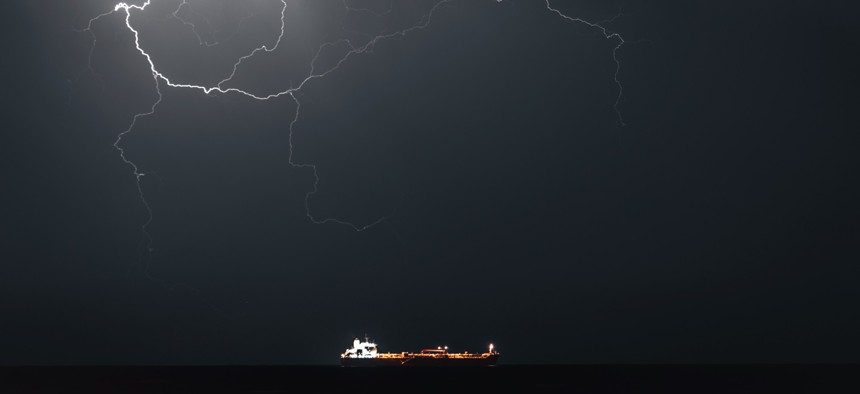
Lightning occurs when META 4, an Oil Products Tanker, sails into Muscat Anchorage on March 21, 2026 at Sultan Qaboos Port in Muscat, Oman. Elke Scholiers/Getty Images


Iran war shows the strategic limits of tactical strikes
A complex web of economic and geopolitical consequences are keeping victory out of reach.
The war in Iran is testing the strategic limits of tactical military success. Even as U.S. and Israeli airstrikes degrade Iranian capabilities, a complex web of global economic and strategic consequences are keeping victory out of reach.
On Monday, U.S. Central Command said that more than 9,000 targets had been struck, including more than 140 Iranian vessels damaged or destroyed in the war. Among them were mid-March strikes on Kharg Island, which produces most of Iran’s oil exports. CENTCOM said only military assets, including missile and mine storage facilities, were hit on the island. However, other strikes hit Iranian oil and energy infrastructure. Tehran retaliated by attacking oil facilities in Gulf countries, placing continued pressure on oil prices. Iran has also launched several cyberattacks, warning that major U.S. tech firms could be targeted, which could disrupt government networks, defense contractors and other civilian companies, and utilities.
U.S. and Israel continue to target senior members of the Iranian regime, which “appears to be intact but largely degraded,” U.S. Director of National Intelligence Tulsi Gabbard told senators on Wednesday. Last week, Israel’s defense minister announced the deaths of Iran’s top security official, Ali Larijani, and the head of the Islamic Revolutionary Guard Corps' Basij militia, Gen. Gholam Reza Soleimani. Larijani is a particularly significant loss for Iran, as he was believed to be spearheading military operations since the death of Supreme Leader Ayatollah Ali Khamenei. Iran’s intelligence minister, Esmail Khatib, was also killed on Wednesday, according to Israel.
A contingent of Marines is also on the way to the region—reportedly, aboard USS Tripoli, an America-class amphibious assault ship. Tripoli can carry F-35B fighters, MV-22 Osprey tiltrotor aircraft, MH-60S helicopters, and around 2,200 Marines. The administration hasn’t signaled how it plans to deploy the Marines. Seizing Kharg Island is one plausible mission for the Marines, albeit a risky one.
As of Monday, the Pentagon said that about 200 U.S. service members have been wounded in the war, and 13 have been killed, including the crew of a KC-135 tanker that crashed over western Iraq.
Hormuz standoff
One of the biggest strategic challenges is the Strait of Hormuz, whose closure has bottled up roughly one-fifth of the world’s crude oil. Iranian anti-ship missiles are the biggest threat. Iran can also employ small fast attack craft and unmanned surface vessels; the venerable A-10 Warthog has been pressed into service against them. And mines remain a concern even thought much of Iran’s minelaying capacity has been wiped out.
President Trump reportedly expected Iran to capitulate rather than block it, and his reactions to the closure have varied wildly. He initially suggested that U.S. Navy ships could escort commercial ships. Then he asked allies for help, but was rebuffed. “This is not our war; we did not start it,” said Germany’s defense minister, Boris Pistorius, who favored a diplomatic solution. Trump turned to threats, saying that NATO would face a “very bad” future if it didn't help. Then he said in a Truth Social post that “we no longer ‘need,’ or desire, the NATO Countries’ assistance — WE NEVER DID!” Then he amplified an opinion piece arguing that U.S. allies should help open the strait.
Still, a group of seven U.S. allies issued a joint statement Thursday indicating a willingness to contribute to reopening the Strait of Hormuz. The leaders of Canada, France, Germany, Italy, Japan, the Netherlands, and the United Kingdom condemned Iran’s closure of the strait and highlighted the need for freedom of navigation. “We express our readiness to contribute to appropriate efforts to ensure safe passage through the Strait,” the statement said. “We welcome the commitment of nations who are engaging in preparatory planning.” The joint statement left the specifics of “appropriate efforts” deliberately vague.
Escorting ships through the strait is a dangerous endeavor. Any ship transiting the strait is a potential target for Iranian missiles, airborne and maritime drones, and mines, meaning both civilian vessels and warships run the risk of being damaged or suffering casualties. Escort missions also carry a financial burden. In addition to the costs of an increased operational tempo, warships could end up further depleting interceptor inventories, as the U.S. Navy experienced while defending ships in the Red Sea from Houthi rebels.
Regarding the mine threat, the U.S. recently retired its Bahrain-based Avenger class mine countermeasures ships, which featured wood and fiberglass hulls to facilitate demining operations. That job now falls to the Independence class Littoral Combat Ship, which is outfitted with mine countermeasures equipment, including towed sonar, unmanned surface and underwater vehicles, and an airborne mine neutralization system carried by an MH-60S helicopter. However, two of the Navy’s three LCS outfitted with minesweeping gear were spotted in Malaysia earlier this week, far from the war in Iran. Even if the ships return to the Middle East soon, conducting demining operations in the contested strait carries its own set of risks.
Markets under pressure
Ongoing strikes against Iranian and regional oil infrastructure, combined with the lack of free navigation through the Strait of Hormuz, continue to disrupt energy markets. My colleague, Derek Bisaccio, recently addressed how rising energy prices are impacting Washington’s strategic approach to the war. He cited possible options like the U.S. releasing oil from the strategic reserves and even easing sanctions on Russian oil to help lower prices, even though doing so would give Moscow fresh resources to pour into its war in Ukraine. Both of those scenarios came to pass over the past week. Washington released 172 million barrels from the Strategic Petroleum Reserve, which will increase supply but puts pressure on dwindling reserves that were also utilized following the start of the war in Ukraine. It will take years to replenish these withdrawals, making this a longer-term security concern.
The U.S. also followed through on temporarily lifting sanctions on Russian oil, but Washington didn’t stop there. The U.S. has also temporarily eased sanctions on Venezuelan oil, and on Thursday the administration announced it planned to remove sanctions even on Iranian oil, highlighting the tug-of-war between increasing economic pressure on Iran and concern about rising gas prices at home. Notably, the recent joint statement released by the group of seven U.S. allies applauded Washington’s release of oil from the strategic reserves and said the allies would “take other steps to stabilize energy markets.”
Additional resources
We are now in the fourth week of a war that the White House originally said would last up to four to five weeks. The U.S. maintains there are still thousands of targets to hit, and Defense Secretary Pete Hegseth said Thursday that the “largest strike package yet” is in the works. Every level of Iranian leadership also remains a target. Tehran has shown no signs of conceding, despite the level of destruction, making the timeline of the war unclear. If the regime survives, it could still rebuild its missile and drone stockpiles and pose a continued threat. At the start of the war, Trump called on Iranians to revolt against the regime, which is a difficult task for an unarmed populace that has already faced deadly government crackdowns against dissent. The president later conceded that point, saying an Iranian revolution is “a very big hurdle.” The Trump administration has said it has no plans to send ground troops into Iran, while also refusing to rule out the possibility. A major ground incursion to topple the regime would take a significant amount of time and resources to stage and carry out, and it appears unlikely at this time. However, a narrower operation, such as trying to take Kharg Island, could be on the table. While speculative, this type of move would be intended to increase pressure on the regime, but it could have untold consequences on Iran’s oil infrastructure, its civilian population, and global energy prices.
The financial cost is another issue for Washington, as well as Israel and Gulf nations. The Washington Post reported Wednesday that the White House would seek a $200 billion supplemental to help pay for the Iran war, an amount that far exceeds earlier rumors of a $50 billion war request. Hegseth indicated the $200 billion number isn’t final and could be adjusted. It’s possible the supplemental could include items beyond the immediate cost of the war, but passage through Congress is far from guaranteed. The supplemental comes at a time when Trump has promised a $1.5 trillion defense budget, which would represent an increase of more than 50 percent above FY26 spending levels.
Taken together, the past week’s developments highlight a conflict that is tactically successful in degrading Iranian capabilities but strategically uncertain, with no clear off-ramp and mounting risks for both regional stability and U.S. interests.