

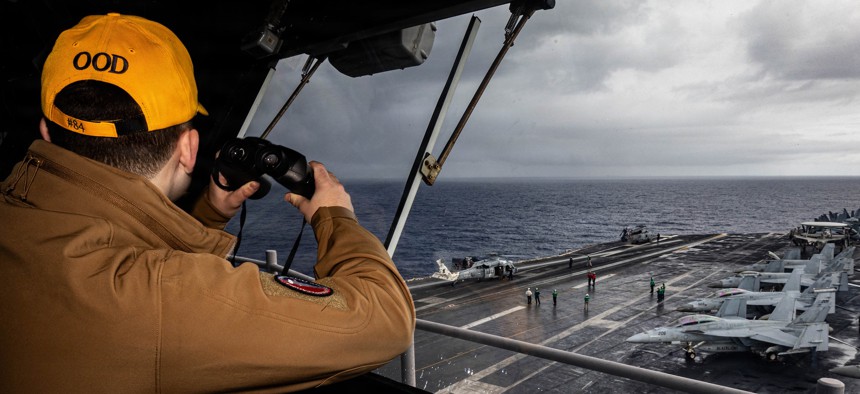
The officer of the deck watches the return of an MH-60S Sea Hawk helicopter to the aircraft carrier USS Gerald R. Ford (CVN 78) after a right-of-visit boarding operation in the Atlantic Ocean on Jan. 7, 2026. Seaman Spencer Staggs / U.S. Navy



CNO cautions against extending carrier’s deployment for Iran ops
Adm. Daryl Caudle said he is already concerned about Ford’s extra time in SOUTHCOM.

Correction: An earlier version of this story suggested that the CNO might caution against sending any carrier to the Mideast; he was speaking specifically about the Ford.
The Navy’s top admiral said he would “push back” if President Trump tries to send a long-deployed aircraft carrier from the Caribbean to the Middle East as part of a U.S. military response to Iran’s crackdown on protestors. But Adm. Daryl Caudle said the Navy is prepared to discuss options—and that the USS Gerald R. Ford would be honored to go if ordered.
On Tuesday, Trump posted on Truth Social that “Help is on the way” for protestors in Iran, as the Iranian government announced that police had killed 2,000 so far during violent clashes with demonstrators, the same day he was scheduled to receive a briefing on military options to respond.
The following day, Adm. Daryl Caudle said he hopes one of those options won’t be to send the Ford, which left its Virginia homeport for the Mediterranean Sea in June and is about to exceed its planned seven-month deployment, having been sent to U.S. Southern Command last fall in for what was described as counter-narcotics operations and possible military action against Venezuela.
“And so if the president needs options in the Middle East, we can go build out what that looks like for him,” Caudle told reporters during a Surface Navy Association event. “I think the Ford, you know, from its capability perspective, would be an invaluable option for any military thing the president wants to do—but if it requires an extension, you know, it's going to get some pushback from the office” of the CNO.
“Regardless, the greatest honor you can have as a person in the Navy is to think you're so valued that you need to be extended. So the sailors will rise to that occasion,” if need be, he said.”
The Navy is trying to balance the wellbeing of sailors and the maintenance of its ships, and deployment extensions throw a wrench in both.
“People want to have some type of certainty that they're going to do a seven-month deployment,” Caudle said. “When it goes past that, that disrupts lives…to the financial and readiness aspects, we have maintenance agreements and contracts that have been made with yards that are going to repair the ships that are in that strike group, including the carrier itself. And so when those are tied to a specific time, the planning, the yard is expecting it to be there, all that is highly disrupted, okay?”
The service has been for years trying to get on top of these maintenance delays, even releasing a strategy a year ago that aimed to get 80 percent of ships deployable by 2027. Caudle warned that delaying that maintenance now could extend its funding into the next budget cycle, and with continuing resolutions so common, increased wear requiring increased repairs might not get the commensurate increased funding.
“So the financial aspects of an extension can be quite disruptive when we burn the ships hotter,” he said. “When it goes eight, nine-plus months, those critical components that we weren't expecting to repair are now on the table, so the work package grows. So that's disruptive.”
Help us report on the future of national security. Contact Meghann Myers: mmyers@defenseone.com, meghannmyers.55 on Signal.
NEXT STORY: Grok is in, ethics are out in Pentagon’s new AI-acceleration strategy