

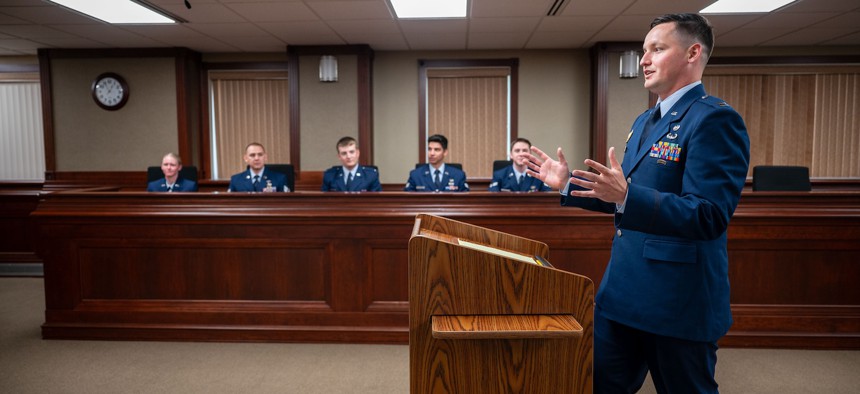
A judge advocate speaks to a judge July 3, 2025, at Malmstrom Air Force Base, Mont. U.S. Air Force / Airman 1st Class Jack Rodriguez Escamilla



JAGs are becoming federal prosecutors in Minneapolis. Experts warn it’s new territory
Military lawyers have served as special assistant U.S. attorneys before, but never like this.

Dozens of military lawyers have been temporarily assigned as federal prosecutors to support law-enforcement surges in Minneapolis and other cities, a novel arrangement that is stretching an overworked judge advocate general corps and drawing concern from legal experts.
This month alone, the Justice Department requested about 40 lawyers, a U.S. official told Defense One.
"As special assistant United States attorneys in Minneapolis, department JAGs will provide crucial legal support in Minnesota, and help our interagency partners as they deliver justice, restore order, and protect the American people," Pentagon press secretary Kingsley Wilson said in a Jan. 16 news release.
Wilson gave no numbers, but her press release followed the Jan. 7 announcement that 20 JAGs were being assigned to prosecute violent crime in Memphis, Tennessee, where federal agents and National Guard troops have been patrolling and making arrests since September, when President Trump ordered a surge.
Similar orders have sent 20 other JAGs to federal prosecutors’ officers in Washington, D.C., where National Guard troops continue their patrols.
There is precedent for military lawyers to help prosecute civilians, but not at this scale nor in these types of roles, experts said.
“The government has used JAGs to help prosecute offenses unrelated to military bases in a handful of cases over the years, but we've never seen JAGs used at this scale in civilian criminal cases with no military connection,” said Steve Vladeck, a Georgetown University law professor. “Not only does the scale raise serious concerns about taking JAGs away from their regular duties, but it also raises the question of why the Department of Justice is having so much trouble trying these cases itself.”
A Justice Department spokesperson declined to comment on the exact number of JAGs assigned to serve as special assistant U.S. attorneys and the types of roles they are taking on.
“The Department of Justice is laser-focused on protecting the American people from violent crime and rooting out waste, fraud, and abuse,” the spokesperson said in an emailed statement. “We have charged dozens of defendants from Minnesota who’ve defrauded the American people, and our whole-government approach to combatting these issues will continue until all fraudsters and violent criminals are brought to justice.”
DOJ policy once barred JAGs from serving as assistant U.S. attorneys outside military bases.
“While the military interest in aiding the civil authorities in connection with these prosecutions might in some cases warrant the assignment of regular military officers to assist civilian prosecutors, the duties performed under such a detail could not be such as to require them to act as statutory or constitutional officers of the civil government,” read a 1983 memo from DOJ’s Office of Legal Counsel, adding that “regular JAG officers may no longer be authorized by this Department to perform the duties in question.”
Vladeck said Congress later changed existing laws to permit such assignments, and in 1986 the Uniform Code of Military Justice was altered to allow military lawyers to represent the U.S. government “in civil and criminal cases.” Further legal analysis from that same year also said the arrangement does not violate the Posse Comitatus Act, which outlaws the use of the military for federal law enforcement.
Some military legal experts disagree with that analysis. Steven Lepper, a retired Air Force judge advocate general, said he has serious doubts about the administration's new use of the military lawyers.
“That proposal is inconsistent with the typical way in which military lawyers have been used as special assistant U.S. attorneys in the past,” Lepper said. “The fact that there is no military nexus here between the kinds of cases that JAGs serving as special assistant U.S. attorneys are going to help prosecute essentially puts these JAGs in a role where the fundamental question ought to be whether doing that is a violation of Posse Comitatus.”
Lepper added that these lawyers are still subject to the UCMJ, making it harder for them to challenge certain actions. After the deaths of U.S. citizens in Minneapolis during immigration-related law enforcement operations, several federal prosecutors resigned from their roles.
“It takes military lawyers who are less likely to say no, or for whom it becomes more difficult to say no, and puts them in a position where they essentially are being asked to follow orders that others wouldn’t,” Lepper said.
The moves are a burden on the judge advocate general corps, which is already overworked.
Eric Carpenter, a retired Army lawyer who is now an associate professor of law at Florida International University, said “there’s no fat to cut” in the JAG corps. He added that given how understaffed many JAG offices are, it’s unlikely that special assistant U.S. attorneys who’ve been working on cases tied to military bases would be reassigned to the new roles.
Carpenter also said those who get sent to U.S. cities for those roles are likely to face a steep learning curve.
“I think most of the people getting [mobilized] or tasked for this aren't going to have any federal prosecution experience,” Carpenter said. “So they're going to be just jumping in and trying to figure it out as they go.”
Help us report on the future of national security. Contact Thomas Novelly: tnovelly@defenseone.com, tomnovelly.01 on Signal.
NEXT STORY: Experts have questions about the new National Defense Strategy—on China, force design, and more