

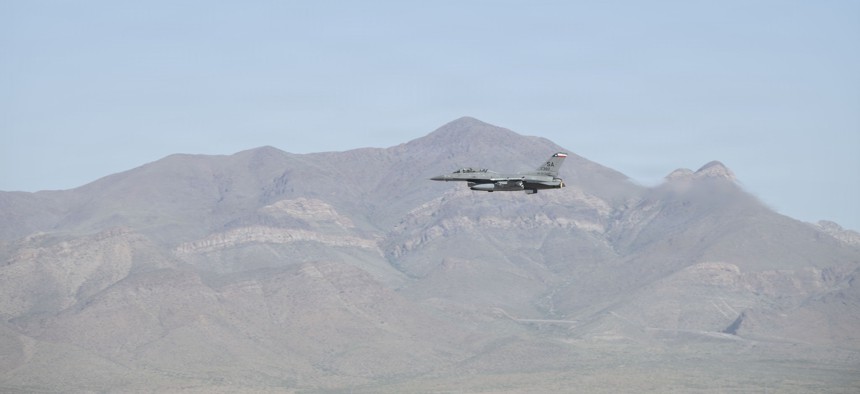
A 149th Fighter Wing F-16 Falcon flies over Fort Bliss, Texas, June 6, 2026. Tech. Sgt. Derek Davis / 149th Fighter Wing, Texas Air National Guard


The Army wants to build a better data center. Can they do it?
A call for industry ideas pulled in 200 proposals. The service is moving ahead with data centers, manufacturing upgrades, and more.

The Army got more than 200 responses to a March open-ended call for private-industry ideas on how the service could upgrade its infrastructure with new contracting models and public-private partnerships. Among the 120 that were deemed viable were proposals to build data centers on four Army installations—and officials are now studying the idea.
Aware of the immense controversy surrounding data centers, officials are trying to get ahead of community concerns by requiring the centers to generate their own power and mitigate their water usage, while meeting with local residents to address their questions directly, an official told Defense One.
Six weeks ago, the Army’s deputy undersecretary went down to Fort Bliss, Texas, to hold a listening session with the commander of 1st Armored Division and community members, along with El Paso Water and El Paso Electric, as well as Carlisle, the company that would fund the data center the Army hopes to build on nearly 1,400 unused acres.
“So I think the difference between us, the Army, doing a data center, and say Meta or Google, is we're part of the communities that are there, and we are going to engage with them on a routine and regular basis to look for solutions that work for everyone, right?” said Col. John Oliver, executive officer for Deputy Army Under Secretary Dave Fitzgerald. “Because, yes, we understand that there's been consternation with data centers.”
It’s a solid strategy, according to Darrell M. West, a senior fellow at the Brookings Institution who has been researching the future of data centers. Though pushback against data centers has made headlines recently, some communities have more readily accepted them. Those tend to be places where tech companies made the effort to inform residents about the costs and benefits ahead of time.
“People want to know up-front, you know, where the energy is coming from, how much water is being used, how much the overall cost is going to be, and what the noise levels are,” West said.
They also want to know the benefits, he added, whether it’s new jobs or better internet connectivity in remote areas.
“So if the Army can be transparent about both costs and benefits, that would go a long way to soothing any possible community concern,” he said.
As far as noise, the Army has the benefit of vast real estate that is purposely out of earshot of neighborhoods. A second proposed data center site is at Dugway Proving Ground, Utah, a testing range an hour’s drive from the nearest community. The solicitation also includes Fort Hood, Texas, and Fort Bragg, N.C.
The proposals must include net-zero water usage and a power plan that does not draw on the local energy grid, Oliver said.
Power generation is a major consideration for data centers, and many communities near data centers are being squeezed by higher electricity costs as the grid struggles to keep up with demands.
“There are a few places where the tech companies have quote-unquote ‘solved this problem.’ So for example, Microsoft is building a data center next to the Three Mile Island nuclear plant, and they're going to bring that back online, so you know that's a new energy source, that's really not competing with other community needs,” West said. ”So that's kind of a success story, but that's very idiosyncratic—most communities don't have an unused nuclear power plant sitting next door.”
On the other hand, the Army has been working on ways to be more energy-resilient, with microgrids built or planned for dozens of installations already.
Another idea is to have Carlisle build a new well on Fort Bliss to feed its desalination plant, which is its main source of water, to offset the water used to cool the data center.
“We are encouraging Carlisle to do that, so actually make it net-positive,” he said. “We don't know if that's an engineering solution that we can actually get to yet, but we're actively working toward that as a part of the process.”
New construction also comes with the promise of job creation, but West cautioned being too optimistic.
“I think the jobs issue is one of the best arguments behind data centers, because in the construction phase they really need a wide variety of skilled labor,”he said, including electricians, plumbers, welders and pipefitters. “There’s a whole range of workers who are needed for this, but the problem is almost every one of those kinds of workers are in short supply.”
Longer term, Oliver said, the Army is planning something like a data-center ecosystem, with both a commercial side and a classified military data side, along with the power-generation component.
“Our data centers are not going to be just big buildings that are out in the middle of nowhere that are run by 10 people,” he said. “It becomes kind of a campus that we can work on.”
200 ideas
Beyond the data centers, the Army’s Strategic Capital Initiative is working on dozens of other projects that came out of the RFI.
They started with more than 200 responses to its request for information, Army Secretary Dan Driscoll told reporters May 28, and have since been narrowed down to about 120 that are executable, with about 20 in various stages of execution.
More than 95 percent are from vendors the Army has never worked with, Oliver said, making the SCI an opportunity for not only fresh ideas but fresh partners.
“FedEx came back, a bunch of private capital partners came back that we don't normally work with, like Apollo,” Oliver said. “We got all kinds of mineral processing, manufacturing companies that we've never ever worked with before. We also got industry organizing around themselves, too—they kind of built some consortiums of companies that we'd never thought about.”
Some of the first proposals they approved were to the organic industrial base, Oliver said. Corpus Christi Army Depot in Texas will get a turboshaft engine modernization plant; McAllister Army Ammunition Plant in Oklahoma will get an additive energetics load and assembly packing facility; Red River Army Depot in Texas is going to be a hub for servicing heavy-duty forklifts; and Pine Bluff in Arkansas will enter into some public-private partnerships to manufacture energetics and explosives.
Three weeks ago, a request for proposals on critical mineral refinement went out.
“The next thing we ought to look at is probably energy resilience and dominance, based on the RFIs we got back,” Oliver said. “Let's go after those next, because we know we're going to see increased power load across our installations as we work on this.”
The Army is planning a June 15 RFP for power-generation ideas, he said.
“We're not looking for a specific type of power,” Oliver added. “It could be geothermal, it could be small, modular nuclear. It could be gas turbines. It could be anything.”
Then there are some logistics management ideas to sift through.
“We're probably going to pick an organization or two that kind of help us modernize our supply chain in the next month or so,” Oliver said. “Where we work with them, use some of their current logistics that they already have set up, distribution to help us manage supply, and they come on post and, and help us manage our supply warehouses on post.”
“And then we'll see how it goes after the summer,” he added, referring to a hundred other ideas the service is reviewing.
Help us report on the future of national security. Contact Meghann Myers: mmyers@defenseone.com, meghannmyers.55 on Signal.
NEXT STORY: House vote puts Section 702 on brink of lapse amid fight over acting spy chief