

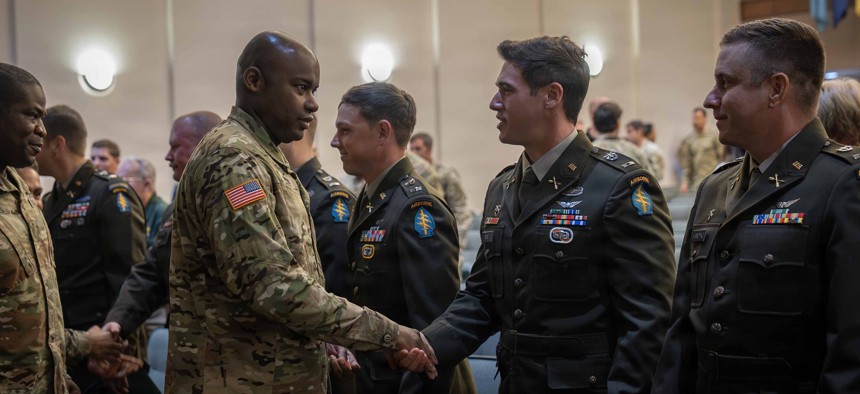
Lt. Gen. Steven M. Marks, Vice Commander of U.S. Special Operations Command, meets with the first 390A warrant officers at the U.S. Army John F. Kennedy Special Warfare Center and School on Fort Bragg, N.C., on Oct. 2, 2026. U.S. Army / Maj. George Wasickanin



The real job of the Army’s new ‘robotics technicians’ is constant adaptation
The age of battlefield autonomy demands more than just drone pilots and mechanics, Special Forces’ training chief says.

You likely have a picture of the future of drone-assisted warfare: a soldier in a trench or a bunker, eyes enveloped in a virtual reality headset, hands clasping a controller, attention on targets below the drone he steers. But the reality of robot-assisted soldiering has already moved elsewhere, according to the military leaders who are training elite forces for future conflict.
On Oct. 2, 10 warrant officers became the Army’s first robotics technicians under the new 390A military occupational specialty. On Tuesday, Maj. Gen. Jason Slider, who commands the U.S. Army John F. Kennedy Special Warfare Center and School at Fort Bragg, described how their jobs will go far beyond remotely piloting or maintaining a drone or ground robot.
“It's important that it's not a pilot. We're not building a pilot. What we're building is a soldier that can adapt a piece of robotic kit to the mission, to the enemy, to the terrain,” Slider said at a Defense One event on the sidelines of the AUSA annual conference.
He described this as one of the most important lessons to emerge from Ukraine in terms of designing doctrine and training for the age of battlefield autonomy.
“We looked at the Nagorno-Karabakh, at Ukraine, and we're studying the ongoing conflicts in the Middle East,” he said. Militaries that “solely focus on pilots quickly lose the advantage to an adversary or an enemy force that can adapt that piece of tech to the mission.”
Adaptation was key to Azerbaijan's 2020 victory over Armenia in Nagorno-Karabakh. A 2021 report from the Center for Army Lessons Learned describes an Azerbaijani tactic in which “remotely piloted Soviet-era AN-2 biplanes flew at low altitudes as decoys to force the Armenians to respond against the perceived threat,” a use of robotics to surprise and confuse the enemy, not just drop bombs on them.
The United States used a similar tactic in the Middle East at the outset of Operation Epic Fury earlier this year, swarming Iranian forces with cheap drones modeled after the Shahed drones that Iran was using against U.S. forces. Both cases show the importance of deploying robotics, autonomy, and semiautonomy in ways the enemy had not yet predicted.
Chief Warrant Officer 5 Michael Updike, one of the architects of the 390A program, said at the Defense One event that the robotics technician military specialty will include aspects of intelligence analysis, command and control, communications, software development under extremely difficult and disconnected conditions, and even acquisition.
“What it encompasses is different pillars of not only software engineering and mechanical engineering but your data science, understanding research and development,” Updike said. “They have to do all that innovation in the field without…large-language models that are connected to the internet.”
The job will also entail rapidly inventing new capabilities on the ground, much as Ukrainian forces have done, and working with contractors who can do so as well.
During the first phase of the 19-week 390A training course, a group of students improved hardware and software to allow drones under electromagnetic attack to communicate with one another in a mesh network.
“They took a high-definition, $1,000 camera, put it on this quadcopter. They were being jammed in frequencies but they were using a mesh network. So, even though one node was taken out, they had multiple nodes where they could still have communications with the quadcopter or the unmanned drone to be able to still accomplish that mission,” Updike said.
To teach the skills of constant adaptation, Slider said, much of the course is designed to “drive failure” and force reconsideration. That’s something that the course architects themselves had to do when f, the students began, in Slider’s words, “outpacing the curriculum” four weeks in. They were too good at drone warfare, which meant that the course wasn’t hard enough. So Slider worked with academics, sources, and international partners to make the course more difficult, adding additional weeks of training.
“The problems that they were able to solve during the culminating exercise were much closer to the need that the operational force was communicating to us,” the general said.
The 390A program won’t be limited to Fort Bragg. This week, acting Army Secretary Adam Telle said, “Traditionally, historically, those types of [military occupational specialty] might live at — with the special forces and never be proliferated throughout the Army.”
Telle said that his office was working with the office responsible for special operations and low-intensity conflict to expand the specialty but did not provide further details.