

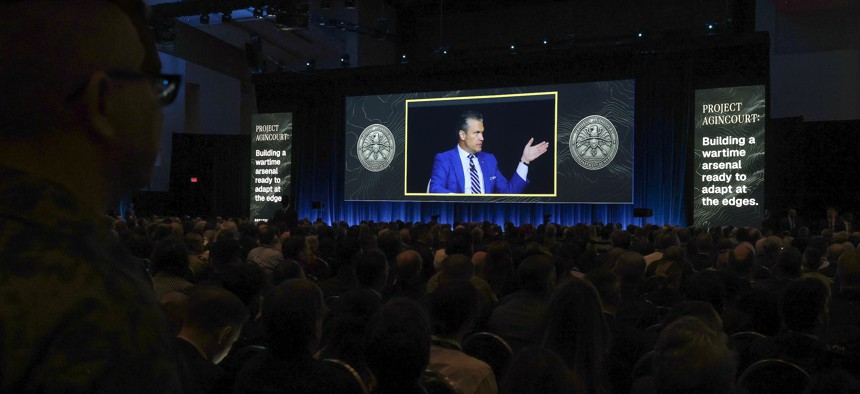
Defense Secretary Pete Hegseth speaks during the U.S. Army's 2026 annual meeting in Washington, D.C., on October 14, 2026. Kevin Dietsch/Getty Images



Hegseth, service secretaries discuss ‘generational change’ of Autonomous Warfare Command
Each of the services will also stand up a component command, defense secretary said.
Defense Secretary Pete Hegseth’s vision for the planned Autonomous Warfare Command over the next two years “is that we're still iterating, we're still adapting, we're still learning, and we're moving faster and faster because we're doing it. We understand how to do it better with each iteration.”
Hegseth sat down to discuss the Defense Department’s efforts to advance its autonomous capabilities with the service secretaries and the Pentagon’s top civilian for special operations during a panel Wednesday at AUSA’s annual meeting in Washington, D.C., but the discussion offered few details on what the forthcoming AUTOWARCOM, scheduled to activate by Oct. 1, 2027, will look like and how it will accomplish its mission.
The secretary, who has ordered cuts to and flag officer positions across the military services, was asked why a four-star combatant command is the correct vehicle to speed up acquisition and fielding of autonomous systems. He said that sometimes a general is the best person to get the job done.
“Let's put rank where we need it to ensure we can drive change quickly,” Hegseth said. “We're going to use rank to drive change with the right people in those positions, but not just legacy formations and commands which have gathered over time and haven't led to battlefield efforts.”
He did not say whether a search is on for commander candidates and what kind of experience he’s looking for.
The Army on Tuesday announced it would rename its Futures and Concepts Command, headed by Lt. Gen. Mac McCurry, to Futures and Autonomy Command, which will be the service’s component command nested under AUTOWARCOM.
The other services haven’t made any announcements about their own forthcoming autonomy commands. The Navy did not immediately respond to a query from Defense One on its plans. The Air Force referred questions to Hegseth’s office.
Much of the discussion focused on the services’ current use of unmanned platforms, as distinct from autonomous systems, which generally function without a human operator.
Hegseth said that AUTOWARCOM would deal not just with procurement, but also with training and doctrine around unmanned systems.
Two of the speakers mentioned an Army effort to open up its test ranges to private companies that make “drone, counter-drone, and long-ranges fires solutions.” Announced in August, the Army Permissive Test Range Expansion effort includes a website that promises a response within four weeks to companies that apply to use the ranges.
“Before, we kept these test ranges to ourselves for our own purposes. We were prioritizing and micromanaging the use of these ranges,” Acting Army Secretary Adam Telle said Wednesday. “To the degree that our bureaucracy is living in the way of our most innovative people from iterating quickly, it's a shame.”
The Army is also working to open “theater innovation labs” outside the United States, said Derrick Anderson, assistant defense secretary for Special Operations and Low-Intensity Conflict. Anderson said the labs, which are being launched in conjunction with U.S. Special Operations Command, meant that “operators sitting here stateside iterating on these autonomous systems” would have a “place to go and iterate” when they go abroad as well.
Anderson added that the Defense Autonomous Warfare Group run by the Defense Innovation Unit will be folded into SOCOM’s new Task Force Autonomous Warfare.
One day before Hegseth took the AUSA spotlight, Army officials had offered some insight into their plans for autonomous warfare on Tuesday, including “appropriate levels of human judgment,” Army Chief Technology Officer Alex Miller said during a panel.
“Things like counter-battery fire, things like air and missile defense, things that happen at a superhuman speed and scale—want to have humans on the loop for decisions, but then we cannot be limited by you know the 20 watts that have up here,” Miller said, pointing to his head. “If we are taking thousands of drones or hundreds of rounds, we can't put that on a human. We want to enable them to be a crew chief for superintelligence and autonomy.”
On Wednesday’s panel, Air Force Secretary Troy Meink said his service is experimenting with autonomous fighter aircraft at Creech Air Force Base in Nevada.
Last year, the Pentagon came under fire for its intentions around autonomous capabilities when AI company Anthropic, then a vendor to the Defense Department, protested the potential use of its models in support of lethal autonomous weapons and mass domestic surveillance.
Currently, artificial intelligence is used in collecting intelligence, identifying battlefield and data management. AUTOWARCOM would ostensibly be an entire combatant command built around autonomous platforms, but none of the senior officials on stage Wednesday identified any of the advancements the department hopes to make in their use.
“It will be a leader in the way we fight going forward, and I think we'll look back and say that was a no-brainer,” Hegseth said. “We should have done it 10 years earlier, but at least we did it.”
Lauren Williams contributed to this report.
Help us report on the future of national security. Contact Meghann Myers: mmyers@defenseone.com, meghannmyers.55 on Signal.
NEXT STORY: Army brings back ‘night court’ audit of programs, shifting more than $100M