

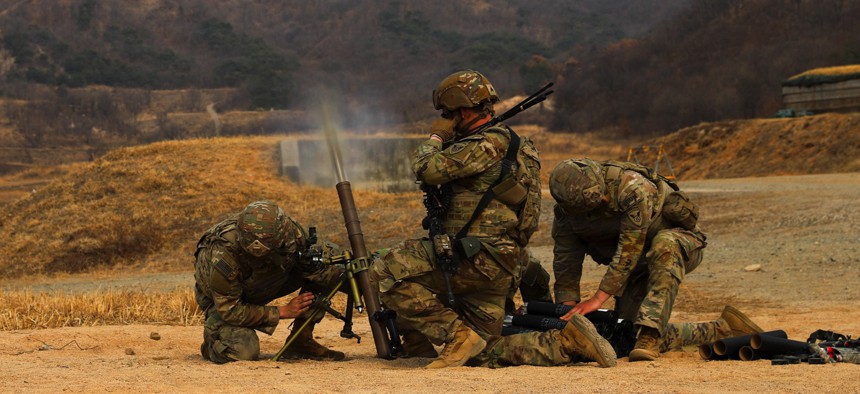
U.S. Army Soldiers assigned to 11th Airborne Division, fire a M224 Mortar during Combined Arms Live-Fire Exercise at Rodriguez Live Fire Complex, South Korea, Mar. 24, 2026. U.S. Army / Sgt. Tyler Wassmer



The Army wants to use bullets, mortars, and artillery to take out small drones
How existing systems are being shaped to shoot at tiny targets.

HUNTSVILLE, Alabama—Army leaders often say they want to stop using million-dollar missiles to shoot down thousand-dollar drones. One of the solutions may be cheap munitions the service already has.
While the Army is leading an interagency task force to source dedicated counter-drone systems, the Capability Program Executive for ammunition and energetics is taking a look at the Army’s existing rounds to make them capable of shooting down much smaller targets.
“We all know how important missiles are to the fight. We see it in the news. But there's also a point where missiles can't get after every munition, every threat, so we need to supplement that with something that we already have within our formations,” Kaitlyn Tani, deputy project manager at Maneuver Ammunition systems, said Wednesday at the AUSA Global Force Symposium.
There has already been demonstrated success in using bullets against drones, she said, particularly ones like the XM121 High Explosive Proximity round, a 30mm bullet that only needs to get near a target to take it out with its blast radius.
There are a handful of other systems that can use this proximity fuze technology and put it into weapon systems that aren’t made to shoot tiny quadcopters in the sky, but could do it with a round that only needs to get close.
“We're taking your Bradley fighting vehicle and [making it] counter-UAS capable by using the armament that is already on the system,” Tani said. “We're taking the infantry soldiers who already have Mk-19s within their squad and providing them with counter-UAS capability.”
There’s also the potential to take some larger rounds, like indirect fire munitions designed to be launched at coordinates rather than targeted using the sight of a gun, and strapping them onto drones.
“So we're definitely looking at all of our legacy munitions,” said Col. Vinson Morris, project manager for Close Combat Systems.
To do that, Morris said, they have to tweak the rounds to use them with a UAS, as they’re designed to be fired from a ground-based launcher that does the propelling toward a target.
“We see the first iteration of this potentially being a legacy mortar or legacy artillery [round] dropped from a UAS,” he said.
Help us report on the future of national security. Contact Meghann Myers: mmyers@defenseone.com, meghannmyers.55 on Signal.
NEXT STORY: The real danger of military AI isn’t killer robots; it’s worse human judgement