

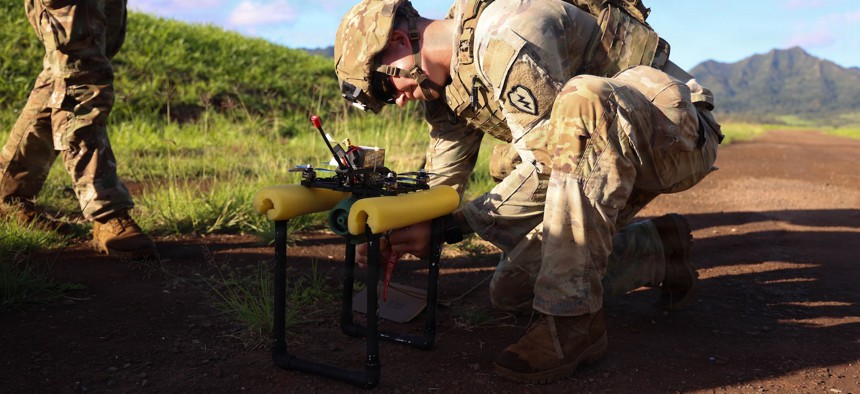
Soldiers assigned to the 25th Infantry Division prepares a first-person view kill drone for flight during training at Schofield Barracks, Hawaii, Sept. 11, 2026. U.S. Army / Pvt. Kahtia Babb

Army’s new command plans to streamline autonomous warfare acquisition
Experts weigh in on what it will take to be successful.

The Army is bringing futures back.
The service announced the creation of Futures and Autonomous Systems Command on Friday, a day after Defense Secretary Pete Hegseth announced the creation of a new combatant command for autonomous warfare in a speech to troops.
"Secretary Hegseth made it clear: We are done with the bureaucratic inertia holding back modernization,” acting Army Secretary Adam Telle said in a news release.
So how do they cut through bureaucracy with a new bureaucratic organization?
FASCOM will stand up in the wake of last year’s decision to consolidate Army Futures Command and Training and Doctrine Command, part of a multi-year effort by the service to reduce its general officer ranks. Hegseth has since taken the idea military-wide.
The difference is that FASCOM will be led by an acquisition executive, where Futures Command had four-star generals with infantry backgrounds at the helm during its short tenure. Though the command endeavoured to fix the Army’s broken requirements process, ultimately the final decisions and acquisitions were made at the Pentagon, creating a disconnect that FASCOM won’t have to deal with.
“So maybe this is kind of Futures Command 2.0, right?” John G. Ferrari, a senior fellow at the American Enterprise Institute and retired two-star general, told Defense One.
Except this time, rather than a standalone four-star command with no joint equivalent, FASCOM could nest under the new Autonomous Warfare Command as a service component.
“I think their theory of the case is that you have too many disparate organizations within the Pentagon working this, and that they're working in some cases counter to each other,” Ferrari said, referring to the Defense Innovation Unit, various service PAEs and the recently created Defense Autonomous Warfare Group.
A combatant command “gives a single military leader the authority, the responsibility, and the resources to drive this,” he said. “So I think it's an admission that the current organizational structure isn't going to deliver in a timely manner.”
It’s also a more permanent solution than another working group or special unit.
“I think what they're trying to do is create an enduring organization that will drive this thing into the future, for the future, and outlast them,” Ferrari said. “Because regardless of who wins the next presidential election, it won't be this president, and so there'll likely be changes…the thing that endures are these combatant commands.”
What we talk about when we talk about autonomy
The Defense Department’s push toward autonomous warfare is not about robot drones finding, fixing, and deploying their weapons at will—at least not yet.
The war in Ukraine is a test bed for autonomous operations, with Ukrainian troops using artificial intelligence to identify targets and help guide a weapon to the target. On the Russian side, according to Center for Strategic and International Studies fellow Kateryna Bondar, there are some indications that fully autonomous drones have attacked civilian targets.
“We can just infer this indirectly, because analysis of those systems show that they don't have any connection or communication system…and also they carry NVIDIA chips, which are able to process AI models on board, and also just observations how they behave,” she said.
And they’re not very accurate, she added, something that the U.S. military isn’t inclined to experiment with.
“So I would say that autonomy that is being deployed right now, it's not some super sophisticated technology, AI-enabled full autonomy, or anything like that,” Bondar said. “It's more a function that assists the human operator in getting the drone to a place where the target is, and then actually engaging it.”
Ukrainians are also using AI-assisted analysis to gather intelligence, but humans still do the decision-making.
“Now they're trying to train agents which can perform as humans, and this is, I think, a turning point where we can actually get to autonomous,” she said. “And I would also call it a weapon system because, if this agent is able to act and activate whatever effectors we have—be it missiles, be it drones, whatever it can employ—then the decision-making system and this agent can actually be called a weapon system.”
FASCOM would bring together the Army’s existing transformation efforts with regard to unmanned systems, with a new push to prioritize autonomy.
Telle’s memo calls on the service’s operations chief to figure out what kind of manning existing units will need to incorporate autonomous capabilities and designate a Portfolio Acquisition Executive for autonomy.
Someone with an operational background should be in charge, Ferrari argued, though the PAEs were recently reorganized from a mix of officers and civilians to all civilians in charge, with uniformed deputies.
“If it's just led by an acquisition executive, then you're going to have the same problem that the Army always has, which is an acquisition executive's leading something, not a warfighter,” he said.
There are, though, some battlefield lessons the U.S. military can incorporate, Bondar said, to be able to work with the bureaucracy of a new command without making new technology acquisition so rigid.
“There's a lot of conversation about feedback loop, and it actually makes sense because…when every commander or every unit, whoever is buying drones, has the direct phone number of the manufacturer, they can immediately call and say what should be improved, what didn't work,” she said. “Because for them, giving this feedback, it's not some sort of obligation or part of procedure—they really feel this need because their lives depend on this, and the lives of their people.”
The Army has its own version of this approach, once called Transformation-in-Contact and now dubbed Continuous Transformation, in which they invite vendors out to field exercises to get live feedback on their products.
The key to bringing it all together will be the funding, Ferrari said, which would have to come from this year’s proposed reconciliation bill. Otherwise, the service will be forced to wait until fiscal year 2028 to get into a budget.
The service is expected to provide more details about FASCOM’s genesis at the upcoming AUSA annual symposium in Washington D.C., which begins Oct. 12.
Help us report on the future of national security. Contact Meghann Myers: mmyers@defenseone.com, meghannmyers.55 on Signal.
NEXT STORY: GenAI.mil saw more than 2 million users in one week, top DOD official says