

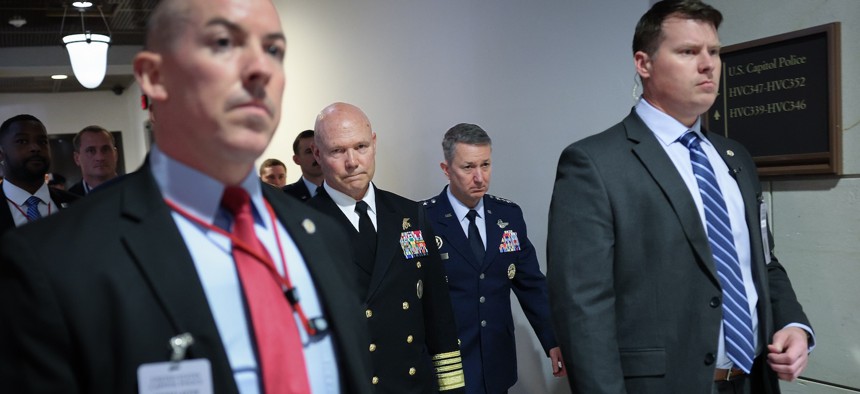
Adm. Frank Bradley (2nd L), escorted by Chairman of the Joint Chiefs of Staff Gen. Dan Caine (2nd R), departs a closed door classified meeting with lawmakers on Capitol Hill on December 4, 2025. Win McNamee / Getty Images



Legal experts fail to see justification for continued U.S. military strikes on drug boats.
Partisan lines were drawn after Thursday's briefing on the Hill about the Sept. 2 strike.

Legal experts aren’t buying explanations for the U.S. military’s strikes on alleged drug-runners at sea and fear Congress could be swayed by what they say are the Trump administration’s murky legal justifications for continued action.
Hours after a classified briefing for Congress on Thursday regarding a Sept. 2 strike that killed two survivors on a Venezuelan drug boat, legal experts speaking at the Center For A New American Security said the administration has failed to make a case using domestic, military, and international law that would support the continued targeting of boats in the Caribbean Sea.
“There really has been no satisfactory answer as to what armed attack has been conducted against the United States that would amount to bringing us into an armed conflict with these cartels, let alone these particular individuals,” said Chimène Keitner, an international law professor at the University of California Davis.
A Washington Post report last month detailing the second strike in the Sept. 2 mission prompted members of Congress to begin asking for serious oversight of the military’s attacks on alleged drug-runners. Lawmaker’s reactions fell mostly along partisan lines when they watched video of the strike Thursday. But legal professors said lawmakers need to realize that the Trump administration’s designation of certain cartel organizations as narco-terrorism groups and stating the U.S. is in an “armed conflict” with them does not provide a lawful justification for the strikes.
“None of that authorizes, under either domestic law or international law, killing people who are in the process of allegedly transporting drugs,” Keitner said. “I think one of the traps that the public and Congress are falling into is sort of accepting the factual premises that we’re sort of inferring underlie all of these actions.”
Adding to legal concerns is Defense Secretary Pete Hegseth’s culling of top military lawyers and advisors this year. And former Judge Advocates General fear the Trump administration is ignoring the advice of those who survived the workforce purges, Defense One previously reported.
The disregard for JAGs makes it hard to support the administration’s legal justifications, said Matthew Waxman, the former deputy assistant defense secretary for detainee affairs and a current law professor at Columbia University.
“I'm somebody who comes at this having worked at the Defense Department, generally, very deferential, very inclined to give the U.S. military, the Department of Defense, a lot of leeway and benefit of the doubt,” Waxman said. “I just, I can't, in this case because of the way leadership has been exercised when it comes to lawyering.”
Two days after the Sept. 2 strike, President Donald Trump sent a letter to Congress, in accordance with the War Powers Resolution to offer justification for the operation. While that started a 60-day clock meant to prevent an undeclared conflict, a legal official for the administration reportedly told lawmakers they believe the strikes do not meet the legal definitions of hostilities and would not seek more time—or Congressional approval—for the continued action.
“On the one hand, they’re saying it’s an armed conflict. On the other hand, they’re saying it’s not really hostilities here. That’s among the many tensions in the administration’s legal theory,” Waxman said. “It’s yet another reason why I think we’re having to make some educated guesswork here, and the administration certainly isn’t doing a good job of articulating and defending the legal rationale.”
Reactions to video of the Sept. 2 strikes differed among lawmakers on Thursday. Sen. Tom Cotton, an Arkansas Republican and chairman of the Senate Intelligence Committee, told reporters on Capitol Hill they were “righteous strikes,” and defended the military’s actions.
“The first strike, the second strike, and the third and the fourth strike on Sept. 2 were entirely lawful and needful, and they were exactly what we would expect our military commanders to do,” Cotton said.
But Sen. Jack Reed, a Rhode Island Democrat and the ranking member of the Senate Armed Services Committee, said in a press release he was “deeply disturbed” by the footage.
“This briefing confirmed my worst fears about the nature of the Trump Administration’s military activities, and demonstrates exactly why the Senate Armed Services Committee has repeatedly requested—and been denied—fundamental information, documents, and facts about this operation,” Reed said. “This must and will be the only beginning of our investigation into this incident.”
Keinter, upon seeing the mixed reactions, said the “Congress can't just sort of create a war by calling it one in terms of the international law of armed conflict,” and said she fears it could potentially escalate to one with another country.
“I'm disappointed that some of the reactions, it seems, coming out of the briefing, have been along partisan lines,” Keinter said. “I do not think this is or should be a partisan issue.”