

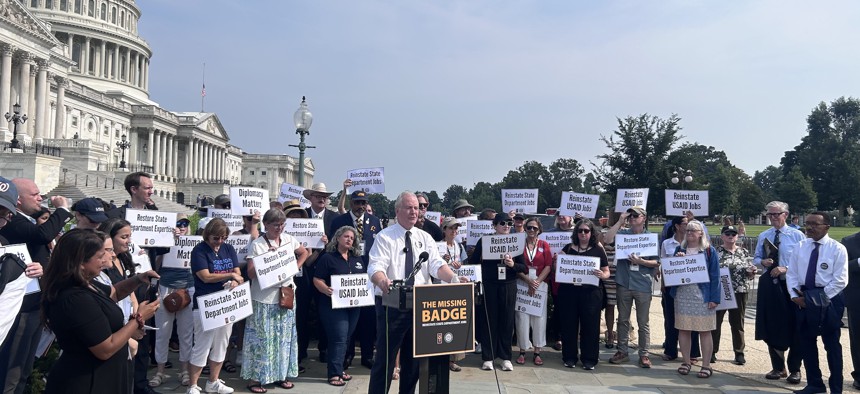
Sen. Chris Van Hollen, D-Md., speaks at a press conference on Thursday in front of the Capitol Building against layoffs at the State Department. Sean Michael Newhouse / GovExec



A year after State layoffs, ex-feds say US is paying the price in Iran and Ebola crises
New legislation would enable foreign service officers pushed out by the Trump administration to rejoin the department without retaking the Foreign Service Officer Test.

To Megan Fotheringham, a small, circular plaque represents what the United States lost when the Trump administration shuttered the U.S. Agency for International Development last year.
The plaque "was given to a USAID foreign service advisor in 1976 after the first recognized Ebola outbreak was contained in Zaire. For me, it represents 50 years of U.S. commitment to stop Ebola at its source before it reaches our shores,” Fotheringham, who served as the deputy director in USAID's Office of Infectious Disease, told a crowd assembled before the U.S. Capitol on Thursday. “This plaque was on my desk during what became USAID's last Ebola response effort. When I was allowed back in my office for 15 minutes to collect my things, this was the very first thing that I grabbed because it is just symbolic of everything that was being lost.”
There’s currently an Ebola outbreak in Central Africa, and public health experts have argued that the Trump administration’s decision to fold USAID into the State Department, which pushed out nearly all USAID employees, has hindered response efforts.
Fotheringham was one of several former federal employees who relatd their experiences at the event recognizing the one-year anniversary of the layoff of some 1,350 people at the State Department. Speakers, including union officials and members of Congress, contended that the staff reductions are damaging the United States' global standing.
The layoffs were "unfair to individuals who had built up experience and careers over a period of time. It disrupted their lives in a way that they should never have had to experience and hurt their families,” said Sen. Chris Van Hollen, D-Md. “But they would be the first to tell you that, most of all, what it did was hurt our country. It hurt our capacity to advance our interests and values overseas.”
In particular, speakers cited negotiations to end the war in Iran as a process that is being hampered by there being fewer career foreign affairs staffers.
“Instead of sending someone that's competent that knows how to write an [a memorandum of understanding], they sent two real estate developers — who have no idea what diplomacy is about — to write an MOU,” said House Foreign Affairs Committee ranking member Gregory Meeks, D-N.Y.
Special envoy Steve Witkoff and Trump’s son-in-law Jared Kushner, both of whom are real estate developers, are spearheading the peace negotiations with Iran. Hostilities recently resumed in that war after the collapse of a ceasefire.
While the Trump administration has argued that cuts to the government workforce in general are necessary to improve efficiency, Maryum Saifee, a former foreign service officer, said that feds with relevant expertise have been ordered not to work.
“When war broke out in Iran, many of us — foreign service officers — [our jobs] were still sitting in limbo. I'm fluent in Arabic. I served in Baghdad. So some of us volunteered to staff the evacuation task force,” she said. “Guess what the department did? They said ‘No thank you.’ So we just sat on the sidelines.”
Additionally, an information panel set up next to the press conference speakers reported that, as result of job cuts at State’s Bureau of Energy Resources, “the office built to weaken Iran’s oil leverage and keep [the Strait of] Hormuz open was shuttered seven months before the conflict that saw gas prices spike.”
In response to a request for comment, the State Department praised career employees’ roles in responding to 2025 Hurricane Melissa in the Caribbean and upholding a ceasefire between Cambodia and Thailand.
"The RIFs have not had any negative impact on our ability to respond to operations, our ability to plan and our ability to execute in service to Americans,” the spokesperson said in a statement to Government Executive. “In fact, we have been able to respond quicker and more effectively, which was the entire point of the reorg — to empower personnel in the field while allowing us to move at the 'speed of relevancy.'"
At Thursday’s press conference, Democratic lawmakers also expressed optimism that laid off State and USAID employees could someday rejoin the federal workforce.
Rep. Don Beyer, D-Va., touted new legislation that would exempt foreign service officers who were involuntarily separated or retired between Jan. 20, 2025, and Jan. 31, 2030, from having to take any written or oral test if they want to rejoin.
“There’s no reason you have to take the [Foreign Service Officer Test] again when you come back in,” Beyer said. “But I’m sure you’d pass it.”
If you have a tip that can contribute to our reporting, Sean Michael Newhouse can be reached securely at seanthenewsboy.45 on Signal.
NEXT STORY: Ukraine will build 5M drones in 2026. NATO must learn how: deputy commander