

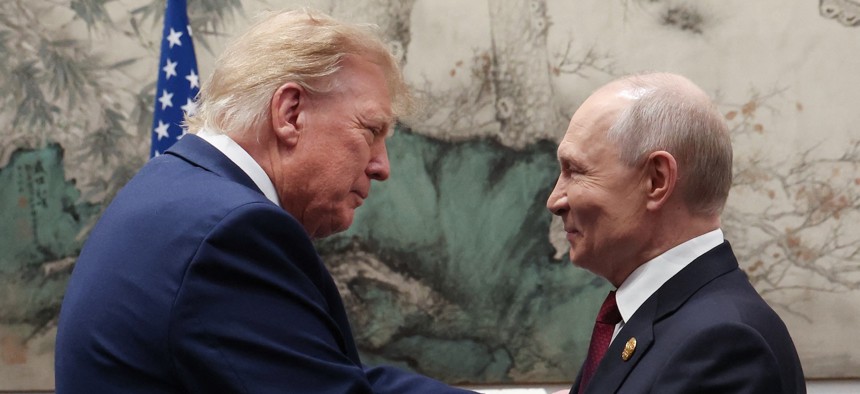
In this pool photograph distributed by the Russian state agency Sputnik, Russia's President Vladimir Putin and U.S. President Donald Trump shake hands during a meeting on the sidelines of the Asia-Pacific Economic Cooperation Summit in Shenzhen, China, on November 19, 2026. Vyacheslav PROKOFYEV / POOL / AFP via Getty Images


Europeans, with Ukraine’s help, brace for more Russian attacks
Meanwhile, Trump greets Putin as “my friend” and downplays Russian missiles in Poland.
IZMIR, Turkey—Vladimir Putin would “love to end the war,” as Donald Trump asserted on Friday, but European NATO members and Ukrainians are working to make sure Russia’s invasion of Ukraine doesn’t end on Moscow’s terms.
In several meetings this week, officials described plans to support their beleaguered European neighbor—and to draw upon the experience to modernize allied militaries and erect new defenses against Russian aggression.
In Berlin on Thursday, the leaders of Germany, France, and Britain reaffirmed NATO’s pledge to provide 70 billion euros’ worth of military equipment, assistance, and training to Ukraine this year—and at least that much in 2027. The European Union has also promised to lend the war-wracked country 60 billion euros for defense and 30 billion for budget support through the next year.
Meanwhile, NATO and Ukrainian officials, along with European arms makers, used an alliance technology conference here to deepen their ties.
Multiple reports suggest Trump is unhappy with the European leaders’ plans to keep funding Ukraine. On Thursday, he phoned them from Air Force One and reportedly questioned their plans to spend more billions. At least one source described the call as a “tirade,” although a U.S. official said that the suggestion that Trump had told leaders to stop funding Ukraine was “not accurate.”
On Thursday, Trump downplayed Russian drone and missile incursions into NATO countries.
“Putin has been landing drones in Poland and a couple of little missiles, by mistake,” he said, hours after warmly greeting the Russian leader as ‘my friend’ and hours before two more Russian missiles and a suspected drone came down in Poland on Friday.
European and NATO officials see the defense of Ukraine as directly tied to their own defense. They see Putin as undeterred in his ambitions to control Ukraine and already waging an unconventional war against them.
“We understand that we are under a very specific kind of a war, which Russia initiated against us, and that we are in phase zero of this war,” Paweł Ksawery Zalewski, secretary of state at Poland’s Ministry of National Defence, said in September. So these acts of incursions of drones of, you know, sabotage and others prepare or can prepare for further operations.”
At this week’s NATO Edge conference here, French Adm. Pierre Vandier described Russian “cyber attacks against our infrastructure, challenging the cohesion of our society.” Vandier, who serves as NATO’s Supreme Allied Commander Transformation, said the attacks seemed to be intended to intimidate European allies.
“I think much of the activity that we're seeing is related to Russian ambitions to discourage us from helping Ukraine, so it's putting us on the string,” he said.
Indeed, Russia’s hybrid attacks are meant to undermine NATO more broadly, said Alik Kasman, chief strategy officer at the Peace Through Strength Institute, a Washington think tank.
“This is how they discredit NATO, and this is one of their objectives too,” Kasman said in a recent interview. “They're going to fly a drone here and there, pretend it's not them, pretend it wasn't intentional, and they're going to see how NATO countries respond, or rather, do not respond.”Vandier said alliance members are responding by spending more on intelligence, surveillance, and reconnaissance to spot incoming drones and missiles.
They are also enlisting civilian institutions to help prepare for and respond to such attac, and are working to figure out how best to“coordinate the military response and the civilian arm,” he said.
Learning from Ukraine’s experience is essential as well, Vandier said.In September, UK defense companies became the first foreign firms allowed to access Avengers Labs, a Ukrainian Defense Ministry platform for training AI models on data collected directly from the battlefield.
Even as the Trump administration lowers sanctions on Russia and Trump calls Putin “my friend,” U.S. envoys are reportedly floating a proposal to add Ukraine to NATO, according to the Wall Street Journal. That would be an outcome Putin has consistently opposed, and it comes with a condition—Ukraine would cede territory to Moscow—that Kyiv has consistently rejected.
Still, French President Emmanuel Macron backed reopening the membership question.
“Faced with the maximalist nature of the Russian position, I believe we need to reopen the question of Ukraine's accession to NATO,” Macron said in Berlin on Thursday, adding that now is not the time to reduce support for Kyiv. “Everyone who has the capacity to provide the means to defend and protect Ukrainian citizens must do so now,” he said.
On Friday, Russian Deputy Foreign Minister Sergei Ryabkov called any prospect of Ukraine joining NATO “unacceptable to us.”