

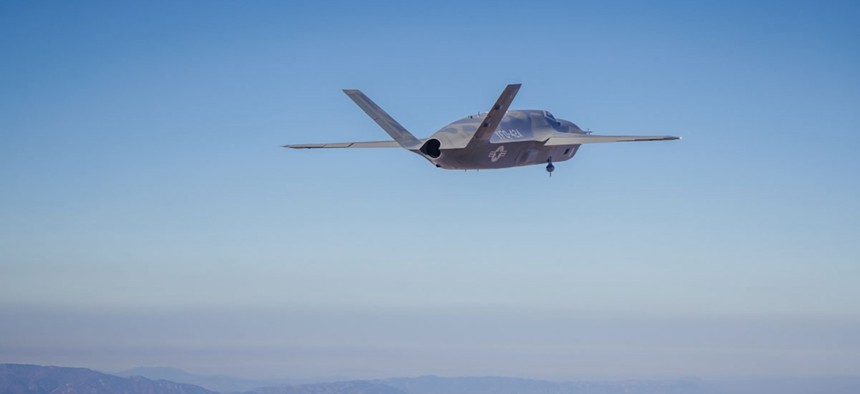
Courtesy General Atomics



Marines will use Air Force-tailored drone to help develop its robot wingman
General Atomics joins a CCA effort highlighted as a top priority in the Corps’ new aviation plan.

The Marines have tapped one of the companies competing to build the Air Force’s drone wingman to help develop its own Corps-specific Collaborative Combat Aircraft program, a key element of its new aviation plan.
Nearly two years after the Air Force chose General Atomics Aeronautical Systems Inc. to compete for its robot wingman concept, the Marine Corps is paying the company to supply a YFQ-42A to use as a testbed for CCA concepts and gear, the company said in a Tuesday announcement.
The work will be evaluated as part of the Marine Corps Air-Ground Task Force Uncrewed Expeditionary Tactical Aircraft, or MUX TACAIR, CCA program—one of the top priorities of the 2026 Marine Aviation Plan, which was also released on Tuesday.
The Marines’ CCA effort is meant to ”increase the survivability and lethality” of the service’s F-35B jets “across a wide range of developing threat environments,” the plan said.
GA isn’t the only company involved in the Marines’ CCA program. Last month, the Corps selected Northrop Grumman and Kratos to develop the CCA itself. Northrop was tapped to develop a mission kit and open-architecture software for Kratos’s existing VX-58 Valkyrie.
The Marines’ 2026 request for $58 million in CCA-related funding was signed into law in the latest National Defense Authorization Act, adding to the $275 million in reconciliation funding approved in July.
General Atomics didn’t say how much they would receive for their work, but did say it involves “rapid development of autonomy” for a kit focused on kinetic and non-kinetic effects “for use in expeditionary operations.”
“The YFQ-42A successfully conducted its maiden flight in August 2025, validating a ‘genus/species’ concept for rapid, modular, and low-cost uncrewed fighter aircraft development,” the announcement said. “This approach enables a common core aircraft design that can be rapidly adapted for different mission sets and service requirements.”