

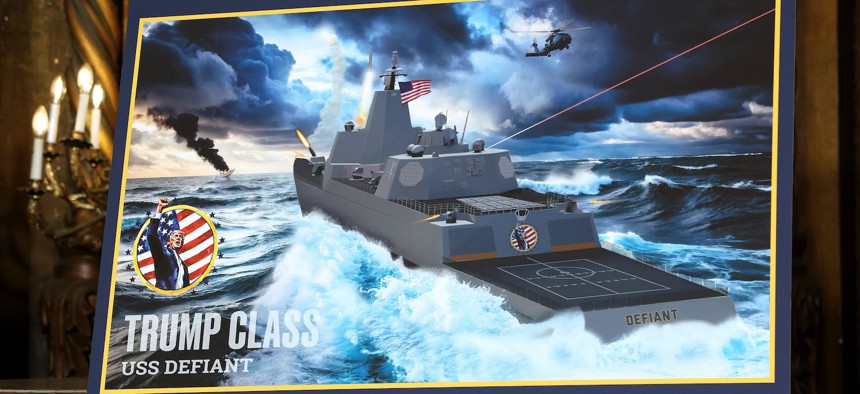
An artist rendering of the newly announced “Trump-class” battleship is displayed as President Donald Trump announces the new ship class at his Mar-a-Lago estate, Dec. 22, 2025 in Palm Beach, Florida. Getty Images / Tasos Katopodis



Trump’s ‘battleship’ could be most expensive US warship in history
Congressional researchers wonder whether BBG(X)’s cost and risks were properly analyzed before its rollout.

The first Trump-class “battleship” ordered up by the White House could cost as much as $22 billion, and could cut into the Navy’s plans for next-generation destroyers, Congressional researchers said Thursday.
An early analysis by the Congressional Budget Office indicates that the BBG(X) could cost between $15 billion and $22 billion, depending on weight and other decisions, CBO analyst Eric Labs said during a presentation at the Surface Navy Association symposium outside Washington, D.C.
“You're talking about a lead ship in the range of $18 to $19 billion for the 35,000-ton displacement, north of $20 billion if the displacement ends up being higher,” Labs said.
That would make the BBG(X), which Trump announced in December, one of the most expensive ships in U.S. history—more than the $13 billion aircraft carrier Ford, which came in 30 percent over budget.
Labs speculated that subsequent Trump-class warships could cost somewhere between $10 billion and $15 billion, depending on the size of the vessels and under ideal labor conditions. In his presentation, he noted that the U.S. shipbuilding workforce, which has not grown since 1990, is too small to handle even the Navy’s current plans.
“There's a lot of reasons to think that those numbers are not going to be correct. I think it's a starting point,” Labs said. “There are a number of factors that are going to play in that lead me to conclude that the ship might be more expensive than what I've said so far … and there's reasons to think why they could be less expensive.”
The vessel is pitched as a cornerstone of the president’s “Golden Fleet,” announced after the Navy cancelled its Constellation frigate program in November and subsequent launched a new frigate effort.
Congressional researchers also wonder what the battleship program means for the Navy’s next-generation guided missile destroyer, or DDG(X), program. Navy officials have suggested that the former will replace the latter: “The battleship took the DDG(X) concept and it's put that on steroids, under the assumption that the counter-targeting efforts of the Navy will protect it and make it survivable,” Chief of Naval Operations Adm. Daryl Caudle said on Wednesday.
But what happens if a future administration cancels a giant warship that many naval experts have called impractical?
“I think it's worth asking the question if at some point, for some reason, there's a change of heart on the battleship program a few years from now, then what will be the impact of the time loss on the DDG(X),” Ronald O’Rourke, a naval affairs analyst for the Congressional Research Service, said during Thursday’s presentation
The DDG(X) and the Constellation frigate programs have been under heavy scrutiny for inaccurate cost estimates and running behind schedule. To avoid similar pitfalls, O’Rourke said, Congress should also consider whether the starts of both the BBG(X) and the frigate programs have received sufficient analysis—particularly since their announcement caught some service officials off guard.
“It's at least worth asking the question and understanding whether the program came first and the analysis came later or not,” he said.