

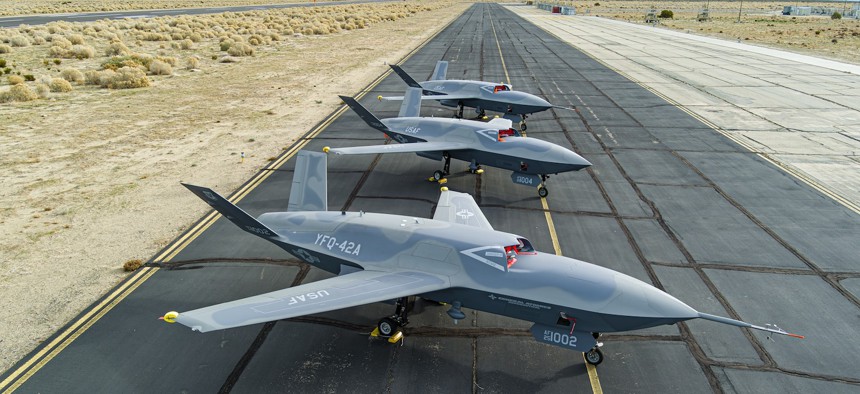
YFQ-42 aircraft sit on the flightline at a California test location as part of the Air Force’s Collaborative Combat Aircraft flight test campaign. U.S. Air Force

Flight tests validate mix-and-match approach to robot-wingman autonomy
The Air Force is using the A-GRA framework on its collaborative combat aircraft.

The Air Force is using a framework to test autonomy on its drone wingman prototypes, showing that multiple companies can supply hardware and software for its future collaborative combat aircraft.
Using the government-owned Autonomy Government Reference Architecture, or A-GRA, the service has integrated RTX Collins software with General Atomics YFQ-42 aircraft and Shield AI’s technology on Anduril's YFQ-44 CCA, according to a Thursday news release.
“By proving the architecture functions effectively across different airframes and mission autonomy from different vendors, the Air Force is demonstrating that mission software can be decoupled from specific vehicle hardware, breaking down barriers for technology integration and fostering a more competitive and innovative ecosystem,” the service said in the news release.
Col. Timothy Helfrich, the Air Force’s portfolio acquisition executive for fighters and advanced aircraft, said breaking the hardware and software out of a single company’s hands aligns with the Defense Department’s latest National Defense Strategy—which calls for “clearing away outdated policies, practices, regulations, and other obstacles” that hinder rapid weapons production.
“Verifying A-GRA across multiple partners is critical to our acquisition strategy,” Helfrich said in the news release. “It proves that we are not locked into a single solution or a single vendor. We are instead building a competitive ecosystem where the best algorithms can be deployed rapidly to the warfighter on any A-GRA compliant platform, regardless of the vendor providing the algorithm.”
The framework has been around since at least 2024. “A-GRA avoids vendor lock, enables rapid iteration, is extensible to other platforms, and underpins interoperability,” a briefing slide said.
The Air Force issued contracts to Anduril and General Atomics in 2024 for the first increment of the service’s CCA competition. In December, the service announced that Northrop’s Project Talon CCA, designated YFQ-48A, could also compete in Increment 1 and the next round of contracts.
Anduril and General Atomics both notched their first semi-autonomous CCA flights last year, while Northrop plans to fly its drone wingman in 2026.
General Atomics quickly boasted on Thursday that it had logged another semi-autonomous flight on its YFQ-42 drone wingman with RTX Collins’ autonomy software onboard. A photo accompanying a news release showed three General Atomics CCAs on a runway. In November, the company had released photos showcasing just two of its prototypes.
“We are excited to collaborate with Collins to deliver enhanced autonomous mission solutions,” David R. Alexander, president of GA-ASI, said in the news release. “The integration of Sidekick with our YFQ-42A demonstrates our commitment to innovation and operational excellence in unmanned aircraft technology.”
Anduril and Shield AI have not had a joint CCA flight together yet. But Jason Levin, Anduril’s senior vice president of engineering, said in an emailed statement that the company will hit that milestone “very soon.”
“Integrating mission autonomy into the CCA program represents a meaningful step towards fielding a real operational capability by the end of the decade,” Levin said in the statement.