

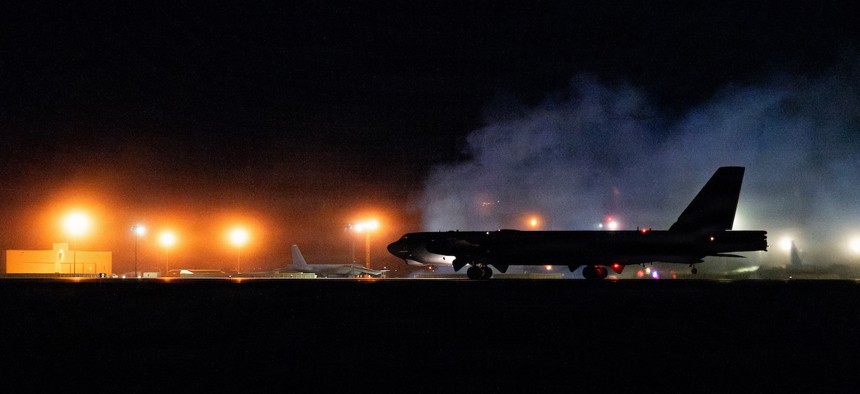
A U.S. Air Force B-52H Stratofortress bomber taxis for takeoff in support of Operation Epic Fury, March 2, 2026. U.S. Air Force

B-1, B-52 bombers join Trump’s war on Iran
Modernized 20th-century aircraft are still crucial for the conflicts of today and tomorrow, aviation experts say.

Decades-old B-1 and B-52 bombers have hit hundreds of Iranian military targets this week, and experts say it underscores the need to retire the former and modernize the latter for future conflicts against Russia and China.
The two venerable aircraft are the latest additions to the list of platforms used in Operation Epic Fury, according to a CENTCOM fact sheet released this week. Gen. Dan Caine, the Joint Chiefs chairman, told reporters Wednesday that the U.S. military has hit “over 2,000 targets,” and said Iranian ballistic missile shots had decreased by 86 percent since the first day of the war.
“Our B-2 bombers and B-1 bombers have executed uncontested surgical strikes against multiple missile facilities deep inside Iran,” Adm. Brad Cooper, the CENTCOM commander, said in a Tuesday night video, adding that “a B-52 bomber force struck ballistic missile and command and control posts.”
The B-1, which has been in service since the mid-1980s, was initially developed as a replacement for the mid-century B-52 bomber. Now, following initial stealth bombing runs from B-2 Spirit stealth bombers and the destruction of Iran’s anti-air defenses in the early days of the war, both are seeing heavy use in the Trump administration's bombing missions over Iran.
“The B-52 Stratofortress has been utilized in every major conflict since 1965,” CENTCOM said Thursday on X. “During the first 100 hours of Operation Epic Fury, B-52s struck Iranian ballistic missile and command and control posts.” Additionally, the command said Monday on X that B-1 Lancers “struck deep inside Iran” to target more missile sites.
Air Force officials said they’re retiring B-1s and B-2s by the 2030s to make way for the new B-21 stealth bomber. Ongoing modernization efforts to the B-52’s radar and engines will extend the Cold War-era bomber’s service life to its 100th birthday.
Even with the legacy bombers’ renewed use in Operation Epic Fury, those modernization and retirement timelines are still “absolutely reasonable,” said Mark Gunzinger, the Mitchell Institute’s director of future concepts and capability assessments. The B-21 and upgraded B-52 will be a necessity in European or Pacific theaters, he added.
“As far as the modernization, Iran is not a peer adversary in any way, shape or form. For example, you achieve your air superiority probably in a space of 24 to 48 hours,” Gunzinger said. “[That’s] not going to be the case with China, or even if we should have to defeat Russian aggression in Europe at some future date.”
Test engines for the B-52 are expected to be delivered next year, Defense One reported last month. Other aspects of modernization efforts have faced headwinds, including F130 engine integration problems tied to Boeing, and skyrocketing radar upgrade costs that triggered a breach of the Nunn-McCurdy Act last year.
Gunzinger said modernizing the B-52 is still an ideal option.
“If the Air Force didn't have B-52s, still very long-range standoff weapons platforms, it would probably have to buy a new one, and that would be even more expensive than upgrading the current force,” Gunzinger said.
The Air Force’s total bomber inventory “has reached an all-time low of 141 aircraft,” Gunzinger wrote in a Mitchell Institute report last month. The majority of those—76—are B-52s, 46 are B-1s, and only 19 are B-2s. The report said the U.S. needs 200 B-21 bombers to be competitive with China. Gunzinger added that the financial and manpower constraints of keeping the B-1 in operation will hinder the rollout of the B-21.
“The size of our bomber force, its smallest ever in the U.S. Air Force's history, and the crew ratios, for example, on our bomber fleet, essentially talking one crew per combat capable aircraft, and when you're talking about flying 33-, 35-, or 36-hour sorties, well, those air crews just can't turn around and fly another one a day or two later,” Gunzinger said. “So, they also don't have enough air crews, maintainers, and infrastructure to bring the B-21 online and maintain the B-1 as operationally ready and fully crewed.”