

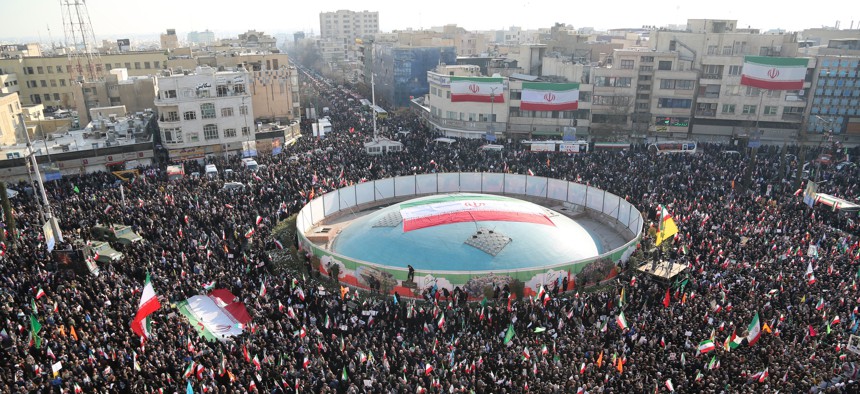
People gathered at Tehran's Enghelab Square on January 12, 2026, after a government call to rally against recent protests across the country. Alexander KAZAKOV / POOL / AFP via Getty Images


Bombing Iran would shore up its regime
External attacks stir up nationalism and redirect public anger outward, a “rally-around-the-flag” effect long documented by political scientists.
President Donald Trump has escalated his threats to use military force amid Iran’s violent crackdowns on protests, which have killed as many as 20,000 Iranians. In recent days, he has called for regime change in the Islamic Republic and ordered the Abraham Lincoln carrier group to the Middle East, its arrival expected later this month.
But attacks on Iran would undermine the very protestors Trump purports to defend. Worse, it would expose U.S. forces in the region to an Iranian counterattack that Tehran has signaled would be much harsher than last summer’s response to U.S. strikes on Iranian nuclear sites.
U.S. military force would be counterproductive to creating favorable political change in Iran. Trump’s threats risk discrediting the protestors as foreign stooges, which makes it easier for the regime to justify harsh measures to repress them. Israel claimed to be involved in the uprisings, and the regime has used those claims to tarnish the legitimacy of all Iranian protesters. The perception of foreign sponsorship could both delegitimize the movement and fracture the broad social coalition that gives such uprisings power.
Moreover, bombs usually stiffen a government’s grip on power, not loosen it. That’s especially true in countries that have long suffered from foreign meddling, such as Iran, where the U.S.-backed ouster of Mohammed Mosaddegh in 1953 remains a source of anger, and where the war launched in 1980 by Iraq’s Saddam Hussein solidified support for the new Islamist regime. External attacks stir up nationalism and redirect public anger outward, creating “rally-around-the-flag” effects that political scientists have documented for decades. The world witnessed this very dynamic last summer when Israel’s attack on Iran destroyed the influence of regime moderates.
In a rare case where airpower alone toppled a regime—NATO’s 2011 intervention to remove Moammar Gaddafi in Libya—it took five months of heavy bombing, an eternity by Trumpian standards. The action wrecked Libya as a functioning state and prompted a migration crisis that saw hundreds of thousands of Libyans flee the country. No plausible theory of change explains how U.S. airpower would produce a post-Islamic Republic Iran that is stable, let alone aligned with U.S. interests.
Worse, Trump’s saber-rattling creates a dangerous moral hazard for the most cynical anti-regime elements, who may seek escalation in hopes of attracting U.S. intervention. If Washington advertises that dramatic repression might trigger U.S. strikes, some factions may decide to provoke precisely that outcome.
The Kosovo case in the late 1990s illustrates the tragedy. NATO signaled that they would not tolerate Serbian repression, which emboldened elements of the Kosovo Liberation Army to intensify their attacks. Once NATO bombing began in March 1999, Slobodan Milošević escalated dramatically, launching mass expulsions and ethnic cleansing on a scale far larger than before the intervention. Atrocities rose alongside external coercion, not in spite of it, and the same could happen in Iran today.
Setting aside the interests of Iranian protesters, the strategic case against attacking Iran is overwhelming. Iran poses no threat to the U.S. homeland. To the contrary, its leadership wants a deal with the U.S. to limit its nuclear activities in exchange for sanctions relief. Iran’s continued openness to negotiations, even after the United States bombed three major Iranian nuclear facilities at Israel’s request, is noteworthy.
Iran has not behaved aggressively towards the U.S. but has promised “severe” retaliation if attacked. That threat is highly credible. After the June 2025 intervention, Iran’s retaliation against the U.S. base in Qatar was deliberately limited and telegraphed in advance to avoid American casualties. Such a measured outcome is exceedingly unlikely in this context.
Iranian hardliners have since criticized the regime’s restraint as a mistake that signaled weakness and would invite future U.S. attacks. Hitting Iran again would vindicate that view, creating immense pressure on the Supreme Leader to reestablish deterrence by inflicting real pain on U.S. forces. Domestically, the regime would lose even more legitimacy by impotently absorbing U.S. attacks without fighting back. Its inability to protect Iran from Israeli and U.S. assaults last summer is a major grievance among ordinary Iranians.
The stakes for Tehran are also higher. President Trump has threatened the leadership itself, not just its nuclear program, which makes the conflict existential for the regime. Before, the Iranian government could gamble that deescalation might spare the country from U.S.-spurred regime collapse. By threatening just that, Mr. Trump has made the Iranian regime a cornered animal whose best bet for survival may be inflicting pain on the U.S. troops in the region, hoping Trump will conclude that interference in Iranian domestic politics isn’t worth the cost.
The U.S. has some 30,000 troops in the region who would be exposed to Iranian counterstrikes. If Iran sought to cause casualties, they could easily strike the 2,000 U.S. personnel in Iraq and 1,000 in Syria who are stationed at vulnerable, lightly defended outposts, without the missile defense capabilities of larger U.S. bases. Iran-allied militias have repeatedly harassed American installations across the region, proving they can. Iranian missile strikes on two U.S. bases in Iraq following Mr. Trump’s assassination of Qassem Soleimani in 2020 left dozens of U.S. soldiers with traumatic brain injuries, even though the attacks were interpreted as de-escalatory.
However repugnant the Iranian regime is, and however much sympathy the American public may feel for Iranian protesters, the U.S.’s role cannot be to socially engineer the domestic politics of foreign states. That’s doubly so when the downside risks are so great: yet another military entanglement that drains U.S. strength, with no strategic rationale or end-date, in a chaotic region Washington has longed to escape.
The United States has powerful tools, but history warns against wielding them recklessly. Striking Iran to topple its regime would not make America safer. Much more likely, it would deepen the chaos, endanger U.S. troops, and strengthen the forces Mr. Trump claims to oppose.
Rosemary Kelanic is the Director of the Middle East Program at Defense Priorities.