


'Mission ahead, heavens above'
Welcome to Fictional Intelligence, the first of a monthly series that explores the future through short stories.
The next conflict may be decided by who controls space. But who controls space may be decided back on planet Earth.
Even as low-cost, AI-infused constellations proliferate, the center of gravity for modern space warfare remains the terrestrial networks that bind them: ground stations, uplink nodes, undersea cables, and more. As China expands its space-control networks on a global scale—a focus of its grand strategy—its new infrastructure in South America, Asia, and Africa also means new vulnerabilities. That may give small teams of U.S. special operators a strategic and possibly decisive role in future combat.
The following is a “useful fiction,” designed to promote reflection about the future of space, technology, and special operations. Written in support of U.S. Special Operations Command and Joint Special Operations University, the story blends a fictionalized narrative scenario with non-fiction research.
NEUQUÉN PROVINCE, Argentina—Col. Scot Shieh’s career in Air Force Special Operations had taken him across the full spectrum of SOCOM’s missions, from flying close air support for a Marine Raider unit in East Africa to one particularly cold deep insertion of a JSOC team above the Arctic Circle. Yet he never expected that his first command of a full special operations task force would be about controlling outer space.
The thought left him unable to suppress a smile, the only part of his face showing underneath his helmet. Then the expression returned to a frown at the downside of command. It pained the pilot in him that his seat for TF Jupiter was not in the cockpit of the tiltrotor, but stuck in the back, crammed among enough communications relays, servers, and sensor-fusion gear to fill a CONEX.
Moving down from his commander’s virtual reality combat helmet, Shieh wore a conforming ballistic vest that flexed with his movements over a black thermal shirt and form-fitting black pants fitted with “pincher” auto-tourniquets cued to integrated bio-sensors. It was a look that his family back in Providence, Rhode Island, never would have imagined, but they were partly to blame. One hot summer weekend, his father had taken him and his brother out to see a Blue Angels demonstration flight over nearby Newport. Between the dazzling aerobatics and a stop for ice cream at Newport Creamery on the way home, it had been about as perfect a day as a 3rd-grader could imagine. Immediately after they’d come home, he had marched upstairs to his room and memorialized the outing with a blue-and-yellow-crayon drawing of the jets. Stubborn then as now, he’d decided to join the Air Force that very day after his annoying older brother made fun of him for a big “ARE FORS” scrawled on the jets’ wings. What did his brother know? The Navy had ships; the Air Force had planes. Shieh was an experienced joint force commander now, but he still thought he had that right.
Sitting to his left was Sgt. Maj. Viola Rodrigo, who wore much of the same kit. She’d served in the Ranger Regiment’s Regimental Reconnaissance Company for most of her career, meaning her familiarity with raiding missions was an asset in the air and would be even more so on the ground. Unlike Shieh, her viewscreen was flipped up. She cared less about the data displayed in the flying tactical operations center than how Shieh and the TOC team flying with him responded. Plus, as the unit’s senior NCO, a part of her knew that she could tell just as fast as –– or faster than –– any mission-assist AI when something critical was about to happen.
The tiltrotor hung in the air, almost weightless, when it crested the jagged Andean ridgeline and then dipped low to follow the rocky terrain toward the Espacio Lejano Station. The view through the windows showed them flying at head height off the ground, but Shieh’s eyes stayed focused on what was displayed on the command helmet’s lens. Its settings allowed him to shift back and forth between augmented and virtual reality with an exaggerated blink. Then gaze-tracking software would allow him to select which feed he wanted to focus on. He quickly checked the status of the various components of TF Jupiter, then ensured that they had maintained cohesion with the other SOCOM missions set to simultaneously hit targets around the world, from Kourou in French Guiana to Biak in Indonesia and Malinda, Kenya. In many ways, it was a graphical rendering of what they had called back in training the “compound security dilemma”: how Command & Control Area of Responsibility/Theater of OPs had to be non-linear, non-contiguous, and trans-theater, involving simultaneous ops at multiple echelons.
<<Be aware, there are two additional Sharp Claw platoons detected at the airfield’s southern perimeter>>, Shieh’s tactical AI messaged in a pop-up hanging in the air in front of him.
Rodrigo had already brought her visor back down, the NCO’s sixth sense kicking in, and her and Shieh’s views automatically shifted to the tactical map. It now showed a pair of red icons on the 3-D rendering of the target, representing two units of small machine-gun-armed wheeled robots. There was no need to message the rest of the TF Jupiter; the command network AI automatically updated the tactical displays of all. But it would be most essential for the SOCOM advance force element that would be the first to deal with what it meant. Just beyond the red icons Shieh tracked the movements of the four American commandos who had inserted into the area via civilian vehicles a day ago. Moving ever closer was the main U.S. assault force, comprising two C-17s racing toward their objective: the 2,000-meter runway built by the People’s Liberation Army at the Espacio Lejano Station. The first aircraft held two Ranger assault platoons and the second carried a combined force of a Ranger security element and Space Force and intelligence agency personnel.
The tiltrotor dropped again, seemingly in free fall, then the engines surged. The two pilots from the Army’s 160th Special Operations Aviation Regiment seemed to be making this an especially bumpy ride. Like every pilot ever to ride as a passenger, Shieh knew he could have done better.
“Radar started tracking us, sir, but we shook it,” one of the pilots explained in a gentle voice that sounded library-quiet.
The temptation for Shieh in a moment like this was to cue up the pilot’s view; but that was no longer his role in command. Just as he had to trust the Task Force commander’s decisions about how they fit into the overall operation, Shieh had to trust the Night Stalkers and the onboard AI to keep the command tiltrotor in the air. If he was honest, the aircraft’s value to the mission was as much the cloud server as the humans on board. Hugging the ground, it relayed and received signals from eight Tactical Air Launched Network or “Talon” drones that flew around it, surfing spectrum and datalinks like a swarm of mosquitos to ensure the SOCOM officer could link with his troops.
Knowing that Shieh would focus on the new threats, Rodrigo quickly checked the status of the 30-strong Navy SEAL platoon at Kourou, inserting in their own maritime domain. She pushed a feed of visual imagery from the SEAL commander: mostly a gray-blue underwater blur from his helmet cams.
“Check this, sir,” Rodrigo said.
As Shieh tuned in, he wondered how they felt; all those hours of painful training at SEAL Qualification Training and yet now their amphibious combat bots towed them in. He had no doubt they could have done the swim, but the insertion point had been six kilometers out to sea, which made this the smarter option.
A quick message to the SEAL commander –– with whom Shieh attended the Naval War College seven years before –– confirmed that the naval commandos were still synchronized with the rest of TF Jupiter’s simultaneous operations around the world. Just about when the C-17s would be detected, the SEAL team would surface to begin its part of the mission: seizing one of the Long March rockets carrying what intelligence believed to be a cube-sat network for the PLAN carrier task force sortieing from Hainan.
• • •
China’s decades-long growth in global power had brought the kid from Providence to Patagonia, and set the stage for a simmering conflict that had finally turned hot.
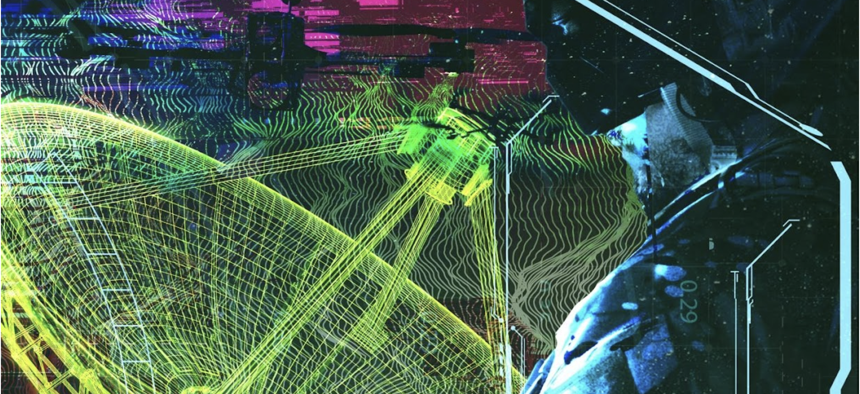
Deep in the desert of Patagonia, the Espacio Lejano Station complex was centered around a massive 35-meter antenna. In 2012, as part of a local economic development push that aligned with China’s growing global ambitions, the Argentine government had leased the complex to the Chinese government for 50 years, tax-exempt, making it Beijing’s first Chinese deep-space Earth station outside China. It had since coordinated communications for everything from Chinese lunar missions to research on Mars. It had also become the PLA’s most important foreign ground station for space operations.
Yet this growth and expansion in interests around the world also created a new strategic opportunity for the U.S. military –– and SOCOM in particular. Belt-and-Road Initiative investments by Chinese government and private-sector interests had bloomed on every continent, which Beijing and the Communist Party used to their advantage in an increasingly zero-sum game against the American military, economy, and even culture. Yet for every new PLA base, billion-yuan investment, or cabal of local politicians entangled in bribes or contracts, a new potential point of vulnerability emerged. The CCP’s global infrastructure had painstakingly been built up over decades. Now, the American war plan was to show how it could be taken away in a matter of hours.
As American conventional forces strode across key chokepoints in the global economy and deployed to defend allies, SOCOM meshed into the effort by taking advantage of its unique capabilities and global presence. The target list ranged from rare-earth mines in Tanzania and Vietnam to ports in Sri Lanka and Djibouti. In some cases, the attacking force would be locals angry at China’s increasingly imperious exploitation of their homelands, now trained and equipped to do something about it by SOCOM’s Jedburgh program. In other settings, it would be unilateral SOCOM operations like TF Jupiter.
The way it was explained to Shieh and the other task force commanders, each of the missions on its own could be misinterpreted as the kind of pinprick or nuisance raids that special forces were often visualized as playing when the big boys finally escalated to all-out conventional war. And yet, in culmination and through coordination, this global raid operational model aspired to have strategic effects. Many were designed not just to take away a PLA capability, but to force third-party nations to decide which side they would be on, and understand that China may have made an infrastructure investment in the past, but it would not be able to protect it any longer.
Of all the task forces, TF Jupiter sought to present China’s leaders with perhaps the clearest strategic dilemma that came with having global ambitions. By seizing the Earth-side satellite control and tracking stations, launch facilities, and fiber networks needed to transmit and coordinate space-based data beyond one’s own region, China’s space prowess would be dealt as heavy a blow as if the entirety of the SOCOM task forces suited up in vacuum suits and fought it out among the stars. SOCOM’s intel and psyops shops had determined that it would have a devastating operational and morale effect on PLA units, who had grown ever more dependent on space-based assets the more advanced they’d become. Even more, the near-instant loss of a national point of pride, built up over 50 years of investment and celebrated constantly in their propaganda, would also have a massive political and psychological impact. Even in a world of AI and quantum space networks, the mind mattered the most.
In many ways, Shieh and his team were playing out the physical version of the ransomware gangs that constantly frayed the cyber networks. Only instead of asking for billions in crypto, his unit was the operational manifestation of a simple demand to Beijing:
If you ever want back what we’ve taken –– end the war. Or else…
• • •
“One minute out, sir,” the pilot said.
The tiltrotor lurched, losing 20 feet of altitude. We must be just a few feet off the hard deck, Shieh thought.
“Sir, we’ve still got a patrol of quads from the PLA base after us, gonna stay bumpy for a bit until we get you on the deck,” the pilot said. Shieh felt the tiltrotor vibrate as it ejected a stream of fist-sized disruptor drones to go after the pursuing PLA quadcopters.
Shieh checked the mission clock and thought of the SEAL platoon just moments from surfacing. Pulses pounding and steady breathing, the naval commandos would be watching similar feeds, only their view came from a wave of lobster-like drones squiggling up the beach to scout and neutralize any nearby patrols.
50 seconds to go.
A gentle flute-like tone sounded in his headset.
<<We’re inside the air defense system>> This was from a Cyber National Mission Force unit working in support of SOCOM. <<Flight path now clear for WRANGLER 21. All PLA radar offline. Sending CMC VIP aircraft protocols to PLA drones in the area>>
Now the first C-17 carrying the Rangers would be safe to land, identified in the Chinese battle network as carrying members of the Chinese Communist Party’s Central Military Commission. It was an old trick, a variation of how Israel had spoofed Syrian air defenses decades earlier.
Shieh worried about the PLA Strategic Support Forces space assets overhead. Between their spy satellites and the commercial Earth trackers used for everything from weather to agricultural data, there was a chance they’d give away the trick. Yet they had a plan for that: in-orbit dazzlers temporarily blinded commercial and government satellite. It was a capability aboard some kind of U.S. Air Force maneuvering space platform that even Shieh didn’t have clearance to get completely briefed on.
• • •
Over the next few minutes, the in-flight TOC was a swirl of managing data inputs as the Army tiltrotor orbited in the area, dipping behind ridgelines and down into riverbeds. This aspect of human cognition and perception was different in the 2030s than it had been for soldiers and airmen a generation ago, who focused on what was in front of them. They also knew there was a risk that the enemy was spoofing the U.S. networks and data at that very moment too. That the very human impulse to confirm whether what one seeing was true or real became even more powerful. It was also why the unit’s AI battle-management system was crucial in mitigating the kind of tunnel vision that came from being able to monitor the most minute details, even down to the number of rounds left in a Ranger’s rifle.
The lead C-17 landed without taking any small-arms fire. Rodrigo silently approved as the two platoons of Rangers ran to the fighting positions that had been suggested by the battlefield AI. Alongside them rolled the two six-wheeled armored battle bots. The soldiers called them Dumbo for the ballistic shields that opened up on each side to provide cover.
As soon as the C-17 was clear, explosions rocked the surrounding PLA base. Some 28 bunkers, APCs, trucks, and a radar site disappeared over the course of two seconds. This was the work of missiles fired from two U.S. submarines off the coast of Chile, which hit the known fixed targets, and strikes by loitering munitions launched by the advance team marking the mobile targets. It was risky to hit the targets after the landing, but it meant the forces were on the ground before the Chinese defenders were fully alert and rendered the runway unusable.
Shieh used standard optical sensors on one of his Talon drones to watch the Rangers move through the smoke and flame toward the main building complex at Espacio Lejano. While the PLA quadcopters and advanced defenses were down, the PLA clearly had anticipated this kind of scenario and fired unguided mortars at the Rangers. This momentarily halted the advance.
Returning to his battle-management view, Shieh watched icons representing three Ranger squads deploy backpack-carried Hatchet kamikaze drones armed with thermobaric warheads. The blue arrow-shaped icons blinked across the display for a moment then winked out, as did the PLA icons representing the mortar pits. He quick-cued the nose-cam footage of one of the drones, confirming that there were uniformed PLA soldiers manning the mortars to ensure no civilian personnel were nearby. This was a no-holds barred global fight but the narrative still mattered, perhaps even more. The AI system already approved the Rangers use of the Hatchets, but as Task Force commander Shieh wanted to verify himself. It was a lesson learned from the PLA recently carrying out an adversarial network attack on the image categorization system of a SOCOM battle box used by a Marine Corps Raider unit deployed near Bagamoyo Port in Tanzania; this hack led to a drone strike on an empty civilian bus erroneously classified as a PLA Sharp Claw unmanned ground vehicle.
A haptic pulse on Shieh’s helmet snapped him out of his distraction –– or diversion –– from overseeing all of TF Jupiter.
“Sharpe, you see the situation in Kourou?” Shieh snapped at the analyst sitting at his right. The tilt-rotor’s engines howled and the aircraft climbed, driving him into the seat. He felt frustrated with himself at getting lost in the Rangers’ counterattack on the mortars.
“Tracking it,” Sharpe responded. “They’re working the problem.”
The Ranger-led force was going to prevail over the PLA defenders; the models assured it and his gut told him the same. The SEALs advancing into the Kourou launch facility, however, had hit stiffer defenses than planned.
Shieh cued up the SEAL task group commander’s helmet cam. From that POV, the 100 meters of concrete ahead of them looked a kilometer long as tracer rounds crisscrossed just a few feet above the ground.
The accompanying map showed that the sneaky bastards had hidden a set of autonomous UGVs in the Kourou facility’s trash burn piles. To reach the launchpad, the SEALs would have to cross open terrain under fire. As Rodriguez also dropped in to monitor the SEALs, her stomach knotted. It had all the echoes of a mission from the past that still haunted the command almost two generations later. During 1989’s Operation JUST CAUSE, a SEAL assault on the airfield in Panama where dictator Manual Noriega kept a getaway jet had gone bad, Four SEALs died and eight were wounded crossing sections of exposed runway.
Yet the benefit of historical analogs is that you can learn from them. Without any instruction from the TOC, the SEALs split into groups of two operators, dispersing behind cover and drawing the defending robots away from the main objective. As they did, the unit’s sniper team deployed to a hide that the AI map had determined was the best fit of cover and angle. With a .50-caliber long-range rifle, the sniper began firing EXACTO guided rounds, one by one, calmly landing hits at predetermined target spots on the rocket’s payload section and nose cone.
The benefit of past hindsight and new technology was that there was no need to rush out in the open to gain the tactical effect they wanted.
• • •
A hard thump rocked Shieh in his seat and he lifted his VR visor. The tilt-rotor had set down just off the eastern edge of the runway. At a tap from Rodrigo, he followed her out of the tilt-rotor. Shieh carried his assault rifle at the ready, but still wore his command VR headset. Rodrigo jogged slightly in front of him and to his left, calling out a smoldering quadcopter and piles of shell casings lest he trip if his attention was elsewhere.
They had landed a quick jog from the main control facility, a four-story glass and steel building that looked out of place in the austere Patagonian setting. During the workup, the planners referred to it as the “Lejano Tower of Pisa.” Up close, you could see that the gleaming building was a cheaply printed structure that leaned to one side, likely from bad engineering. Inside was the real prize: a control room offering direct network access to the entire constellation of PLA satellites and other space systems.
Ahead of them, their AR display layered blue over a bulldozer-like PLA construction vehicle. Shieh wondered if their system was having a glitch, or even worse, had been hacked. Rodriguez answered his unanswered question: “Our guys hotwired it!” The bulldozer, now mobile cover, began to advance with Rangers behind it.
The two ran toward the control building’s entrance. Smoke billowed from second-story windows, but overall the building seemed intact.
Shieh shook hands with Maj. Rannoch, the lead Ranger element’s commander, who quickly briefed him on the situation. The two of them shifted to seemingly stare into the distance, watching as a swarm of seeker drones worked their way through the third floor’s eastern rooms, moving ahead of a squad of Rangers clearing the building.
“Most of the PLA guard force inside surrendered; without their bots they didn’t want to engage. That’s working external, too, but we––”
In mid-word, Rodrigo tackled Shieh and Rannoch, a double clothesline that knocked them down. A moment later, a volley of machine-gun fire raked the building above their heads. She popped up to return fire, automatically cued towards the source with the help of instantaneous inputs to the lens’ AR.
The enemy fire stopped and Rodrigo looked back down at the two. The blank expression on her face showed that she was well used to putting officers in their place, both figuratively and literally.
“Need to be more careful, sirs,” she said, helping them to their feet. Before Shieh could think of an appropriate reply, a message popped up in their visor screens.
“WRANGLER 22’s on approach.”
Soon after, they heard the C-17’s tires chirp on touchdown. A few moments later its engines howled as they reversed thrust, sending the jet rolling backward after its improbably abrupt stop.
A parade of ground- and air-defense systems raced down the jet’s rear ramp, followed by another Ranger platoon and an equal number of personnel from U.S. Space Force and the intelligence community. Among the group were two of NSA’s elite TAO hackers, looking out of place. One looked to weigh almost 300 pounds and the other couldn't be a day older than 18, thought Shieh, but they would be as essential to defending and holding this base against the inevitable PLA counterattack as the special operators.
There was a burst of gunfire in the building above and then silence. Shieh didn’t need the map to tell him that the Ranger squad had secured the building.
He flipped up the lens and took in the scene around them. Dust from the C-17s and smoke from the explosions obscured the night sky’s stars, but Shieh knew they were still there, just on the other side of what was literally a fog of war. Only now, what they had done in the dirt here would create a more massive digital version of that fog for the enemy around the world.
He and Rodrigo moved into the facility’s main entrance. Some sort of mobile-like space sculpture that had once dangled from the ceiling lay in a rat’s nest of crystal and fake marble. The bodies of two dead PLA soldiers were sprawled behind a maroon leather couch that had afforded them no protection.
For all the signs of recent close-quarters combat, the damage was limited. Even the lights were still on and the elevator was operative. The same was evident from the images pushed from the Ranger as they had cleared the rooms. Most importantly, it showed that the control room itself had not been destroyed; the unarmed civilian techs locked inside had decided to surrender to the fearsome Rangers, who had knocked on the glass window of its door with a packet of C-4, the message not needing to be translated.
Shieh allowed himself to smile once more as to what that meant. Not only was he the leader of a SOCOM task force that just met with mission success. He was—at least until the Space Force arrived inside—also technically in command of the world’s largest satellite network.