



The quantum curtain
What if citizens get unbreakable encryption? Welcome to the latest edition of Fictional Intelligence.
Discussions of quantum computing regularly predict the end of digital secrecy, which would have society-altering consequences. But what if the opposite happens? If quantum encryption software becomes available to citizens around the world, digital secrets might become harder to harvest, altering intelligence collection and national security.
Governments have no monopoly on quantum science, meaning that a breakthrough could come as a complete surprise—and that its use and distribution could be shaped by ideological, political, strategic, or economic goals.
The following is a “useful fiction” designed to promote better reflection on the range of future effects of quantum computing on national security. Written in support of NATO’s Allied Command Transformation, the story blends a fictionalized narrative scenario with non-fiction research.
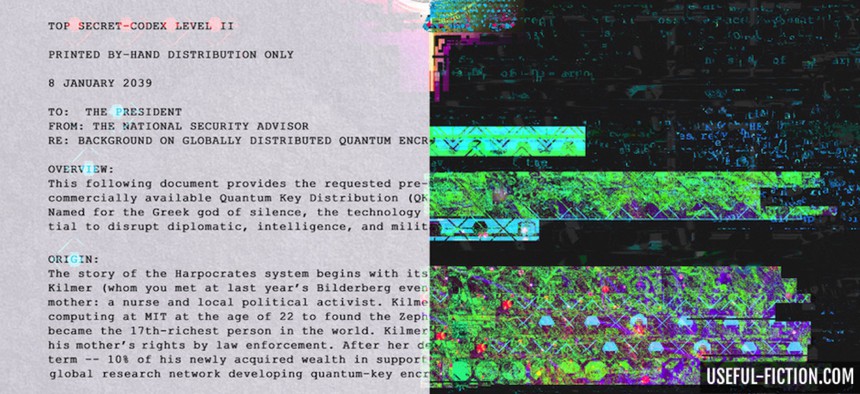
TOP SECRET-CODEX LEVEL II
PRINTED BY-HAND DISTRIBUTION ONLY
8 JANUARY 2033
TO: THE PRESIDENT
FROM: THE NATIONAL SECURITY ADVISOR
RE: BACKGROUND ON GLOBALLY DISTRIBUTED QUANTUM ENCRYPTION BREAKTHROUGH
OVERVIEW:
This following document provides the requested pre-meeting background brief on the rollout of the new, commercially available Quantum Key Distribution (QKD) satellite communications network, Harpocrates. Named for the Greek god of silence, the technology offers users unbreakable encryption, with the potential to disrupt diplomatic, intelligence, and military operations.
ORIGIN:
The story of the Harpocrates system begins with its eccentric original developer and funder. David Kilmer (whom you met at last year’s Bilderberg event) was born in Atlanta, Georgia, the son of a single mother: a nurse and local political activist. Kilmer dropped out of the Ph.D program in quantum computing at MIT at the age of 22 to found the Zephyr Corp. After Zephyr’s successful IPO, Kilmer became the 17th-richest person in the world. Kilmer is a staunch privacy advocate, citing violations of his mother’s rights by law enforcement. After her death in 2029, he vowed to “tithe”—using the religious term — 10 percent of his newly acquired wealth in support of privacy rights through the establishment of a global research network to develop quantum-key encryption.
Financial records show Kilmer’s investment in the project totaled at least $18.6 billion. This funding supported various university projects and contracts with startups in at least 34 countries, supplemented by substantial in-kind support offered by a network of volunteers motivated by the wider global technological justice movement. The scale and flexibility of Kilmer’s distributed network, blending for-profit and pro bono efforts, allowed the program to advance more rapidly than the government and corporate satellite-based QKD efforts we had been tracking.
Over the last two months, Kilmer’s network brought the Harpocrates network of satellites and open-source ground stations online, creating a globally accessible and completely secure means of communications. Kilmer’s decision to release the technical details through various open-source innovation communities means that Harpocrates’ use is spreading more rapidly than expected.
TECHNOLOGY SUMMARY:
The Harpocrates-owned network uses a constellation of 210 CubeSats and an unknown number of easily portable receivers. Additional satellites have been launched by non-state groups and individuals, based on Kilmer’s open-source specifications.
The QKD communications technology underpinning Harpocrates is based on laser-like ground-satellite-ground transmission; in this case, single photons used at optical frequencies that work similarly to laser communications. The receivers, built by Harpocrates or based on their open-source plans, must be temporarily stationary for successful transmission due to the narrowness of the quantum channel being used. Though mounting receivers in vehicles is increasingly prevalent, the vehicles cannot be in motion when communicating with Harpocrates satellites.
CIA and NSA are studying the Harpocrates communications system for exploitable vulnerabilities or hardware/software flaws. It does not appear that there are any backdoors that would allow access to transmitted messages or data. Interception is still possible once information leaves the Harpocrates platform. However, a message in transit has effectively zero probability of intercept. Moreover, if a message is intercepted, its integrity is compromised in a way that is obvious to the sender and recipient. CIA and NSA are working to localize Harpocrates receivers/transmitter units based on their ELINT signatures; however, the system’s designers anticipated this countermeasure.
DISTRIBUTION:
Kilmer posted screenshots of his first quantum-secured communications to his viz feed last week when he revealed Harpocrates to his followers: “Finally have something for those of you ready for a world of no more government surveillance—here’s how to sign up for Harpocrates. Or better yet, join the quantum revolution yourself and get building.”
Due to his often-provocative statements, Kilmer has over 60 million followers. This audience grew as the announcement ricocheted around the world. The viz feed segment received 241,693,376 online impressions and 24,685,219 downloads of the technical plans before it was taken down by the platform host company at the behest of multiple government authorities, including the United States. Simultaneously, the sign-up instructions and technical plans for the system and the CubeSats were released on 3,141 other websites and accounts. The scale, and the number referencing Pi, indicates this was a pre-planned release.
We expect rapid adoption of the Harpocrates encryption system. Kilmer’s decision to make available the system’s technical specifications and the research behind it will streamline adoption and iteration by the public, corporations, and governments, just as a similar approach boosted the spread of open-source Linux software. Even if legal or other forms of pressure (think of the failed OPERATION CASCADE, which we might now want to revisit) are brought to bear on Kilmer, the toothpaste is out of the tube, so to speak.
IMPLICATIONS FOR SELECT NATIONAL SECURITY PRIORITIES:
A comprehensive assessment of the strategic and operational impact of this change is being prepared, with input across federal agencies. In the interim, we will soon face a significant reduction or complete loss of signals intelligence at the scale and quality that much of our assessment and decision-making process has come to rely on.
While no foreign governments have officially adopted the software yet, it is being deployed by numerous semi-official or informal government advisors, most notably those around the Russian president. Indeed, it is likely that once the technical assessment phase is complete, multiple allied leaders under surveillance will also adopt it. Multiple watchlisted terrorists and destructive individuals and groups are also starting to use the Harpocrates satellites, and their own early-stage prototypes, to secure their communications.
These are a few of the near-term national security priorities affected by Harpocrates QKD:
OPERATION CRYSTAL DIVE: SECDEF and CJCS recommend that the operation be placed on hold because Task Force 38 no longer has situational awareness on the movement and predicted location of Siraj Ali. ISIS Afghanistan-Pakistan immediately began using vehicle-mounted Harpocrates receivers; subsequently, NSA and partner intelligence agencies were no longer able to access ISIS-APK communications. TF 38 remains staged at Karshi-Khanabad. HUMINT reporting should establish alternative means to fix Siraj Ali’s location. However, without SIGINT data, both DoD and the IC assess that CRYSTAL DIVE now carries greater risk to U.S. forces. Thus, in addition to the operational pause, JSOC recommends the deployment of an additional squadron of LOMAR (Low-Observable Mobile Armed Raiding) air-ground mobile strike platforms to K2 to support CRYSTAL DIVE. The larger operation, however, means greater risk of blowback from the local regime.
SPRATLY ISLANDS CHINESE S-900s: U.S. Navy and Japanese Maritime Self-Defense Force patrols continue at the 10 nautical-mile maritime exclusion zone established by China around the Spratly Islands. After the zone’s establishment last month, the People’s Liberation Army Navy reduced the number of warships in the area from 18 to 7. However, there are now 86 fishing, commercial, and Chinese People’s Armed Police Force Coast Guard Corps vessels in the waters. Naval Intelligence has a reduced ability to monitor their communications due to the use of Harpocrates systems aboard multiple vessels, which are in turn communicating with ship-to-ship laser-burst transmission fleetwide. The Chinese Coast Guard’s use of Harpocrates is the first by a government’s military or police forces; however, SIGINT reporting indicates it was adopted without official direction. A first shipment of S-900 mobile launchers and sensor systems to Gaven Reefs is expected at 0830 Zulu, with more sites likely within 72 hours. INDOPACOM analysis reports that the S-900s have been split up among the fishing and commercial vessels; U.S. and Japanese forces no longer can identify which vessels are carrying S-900-related cargo. With these distributed air defense systems, it is clear the PLAN is intent on not repeating the mistakes they made in 2032 at Mischief Reef.
BERLIN CLIMATE NEGOTIATIONS: The Berlin Accord negotiations to finalize terms of the Zhang Pledge on vehicle battery sourcing and recycling begin 10 January. The campaign by the coalition of non-governmental groups and environmental organizations to strengthen the U.S. positions on recycling pricing caps and rare earth mineral reserves quotas (Articles 3 and 5) continues to surge on social and viz-media, with physical demonstrations planned in Berlin and other major European cities. HUMINT and SIGINT reporting from a European intelligence service had been monitoring online planning by far-right groups to infiltrate the climate protest crowds and instigate violent clashes in hope of overshadowing the negotiations. The threat from these groups is now significantly higher because they are expected to begin using Harpocrates secure communications. Due to the uncertainty, the German chancellor is considering a secondary location outside Berlin for the negotiations, HUMINT shows. This is due in part to your planned participation on 11 January. The Secret Service is preparing for that likelihood now. As noted, multiple partner states are also evaluating Harpocrates, meaning that we should also prepare for the prospect that we will not have prior access to their negotiating strategies.
RUSSIAN PRESIDENT SUMMIT MEETING: The following 12 January summit meeting in Geneva with President Panov presents new difficulties. While we have a baseline understanding of Russia’s positions on its own airbase in Afghanistan, its recent deployment of the Laika space-based anti-satellite weapons, and China’s interest in banning autonomous long-duration undersea weapons, it will be difficult to ascertain new information. As noted above, several of Panov’s inner circle have already begun to use Harpocrates. This reduces not only our access, but also the ability of several of the oligarchs to subtly signal intent to us through their deliberate use of less-secure communications. CIA HUMINT source VK-BLAND confirms that Russian intelligence is validating the security of Harpocrates for use by the President himself. You should prepare for the possibility that limited intelligence may make this meeting more like the leader summits of the 1960s, nearly 80 years ago.
CONCLUSION:
The Harpocrates QKD satellite-based communications system represents a breakthrough in technology, but also a potential breakpoint in our access to the scale and quality of information that we depend on. I look forward to discussing these points with you tomorrow and highlighting potential courses of action.