

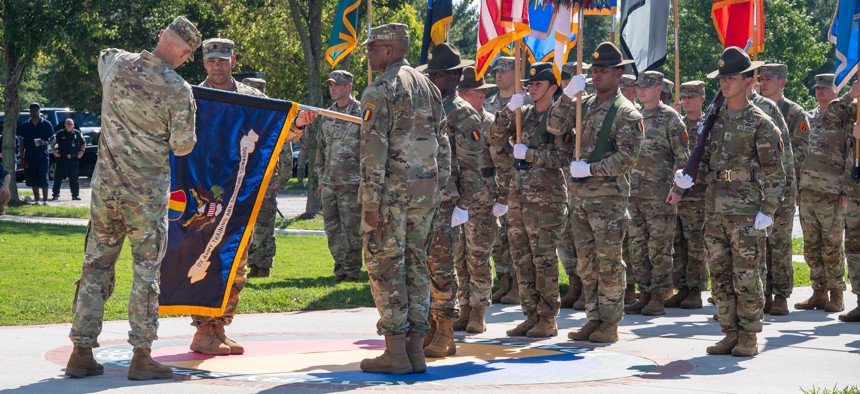
Army Chief of Staff Gen. Randy A. George attached the Superior Unit Award to the colors of the Training and Doctrine Command during a Sept. 26, 2025, ceremony at Fort Eustis, Va., to mark the command's impending deactivation. U.S. Air Force / Tech. Sgt. Cherish Chavez

TRADOC shuts its doors, part of Army effort to shrink the number of generals
Training and doctrine will now be handled by Army Transformation and Training Command.

FORT EUSTIS, Va. – The Army’s Training and Doctrine Command deactivated here Friday, the service’s biggest and most public move so far in a larger effort to downsize the number of general officer positions in the Army.
Chief of Staff Gen. Randy George had been looking to cut 5 percent of senior officer jobs since he took over the service’s top uniformed job two years ago, but the effort went into high gear in May when the Army announced its “transformation initiative," and several days later, Defense Secretary Pete Hegseth ordered the military services to cut 20 percent of three- and four-star jobs and another 10 percent of all general and flag officer jobs.
“Every soldier in our formation has passed through TRADOC establishments, has been trained, developed and impacted by the people in this command, so that they are ready when they get to the unit, their units for what the future holds,” George said during a ceremony heralding the command’s sundown. “They learn what right looks like at TRADOC, and then carry those habits and lessons with them to our fighting formations.”
This may not be the type of ceremony you often see, outgoing TRADOC commander Gen. Gary Brito said Friday, but “it’s happening because of important change, and necessary change, in our Army.”
The Army had already been quietly closing up one- and two-star offices and suggesting larger commands for the same, in some cases simply by not selecting replacements as those generals retired, when Defense Secretary Pete Hegseth ordered the rest of the services to follow suit in May.
“There are general-officer billets across the Army that Gen. George, in collaboration with the secretary and staff, has determined are not essential for the Army,” said Col. Dave Butler, George’s spokesman, told Defense One in December.
TRADOC, which stood up in 1973, will fold into Army Futures Command, the service’s youngest four-star command, to merge Army acquisitions efforts with training and combat doctrine development at the new Army Transformation and Training Command. Headquarters will be in the existing AFC space in Austin, Texas, with the old TRADOC office in Virginia still housing the bulk of its staff.
“We are going to combine some headquarters as we look to the future. TRADOC is going to merge into AFC so that we have one headquarters that can oversee the design, build, doctrine, and training,” George told reporters after the May 1 announcement. “We know we have to advance in how we're going to train individual soldiers right now on the tactical change, how we're doing things.”
The creation of AFC as a four-star command, in 2018, took Army modernization efforts out of their existing home base in TRADOC, so the TRADOC inactivation is effectively a homecoming for the two commands.
The merger follows questions throughout the service and the larger defense community in recent years about the necessity of a standalone modernization command, and whether AFC lived up to its expectations of streamlining the development of major programs.
The Army also plans to condense U.S. Army North and South Commands into Western Hemisphere Command, George added, under Fort Bragg, N.C.-based Army Forces Command.
Though the Pentagon has ordered the services to slash general and admiral jobs – the Army is currently authorized 219 of them – Hegseth’s May memo did not lay down a timeline for the effort, nor any sort of reporting requirements for the services’ decisions.
The Pentagon declined to offer any details on the status of that effort.