

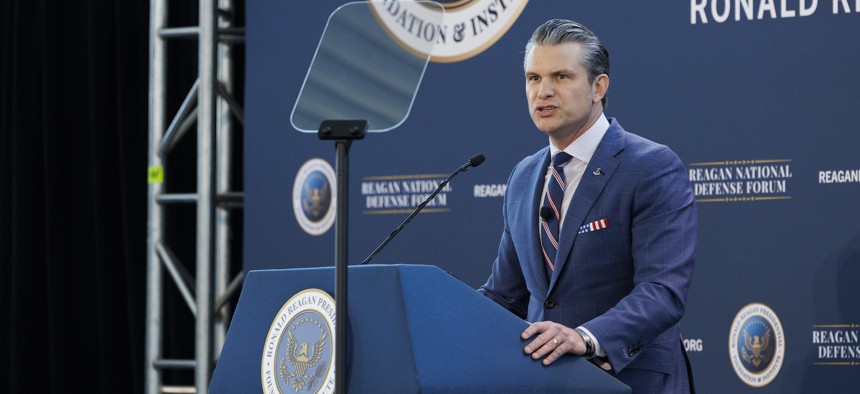
Defense Secretary Pete Hegseth speaks at the Reagan National Defense Forum on Dec. 6, 2025, at the Ronald Reagan Presidential Library in Simi Valley, California. Caylo Seals / Getty Images



Hegseth hints at higher defense budgets as OMB says another reconciliation bill is possible
Analysts had warned that the $156 billion reconciliation bill might lead to efforts unsustainable without more money.

SIMI VALLEY, California—Last summer’s $156 billion one-time boost for defense spending through the reconciliation bill is likely “only just the beginning,” the defense secretary said on Saturday.
“The President has said, and continues to say, he's committed to rebuilding the military, and that requires spending, and substantial spending,” Pete Hegseth said during his keynote address at the Reagan National Defense Forum Saturday. “Just this week, and I was with some of you, was there in the Oval [Office] having these very discussions about FY26 and FY27. And all I can say today is the President is committed to ensuring that our services, our great companies, our industries, have what is needed.”
That funding, he said, will be key to “supercharging” the defense industry—one of the Pentagon’s four “lines of effort,” along with homeland defense, pushing allies to increase defense spending, and deterring China without engaging in conflict.
“We received a historic boost in funding last year, and believe that is only just the beginning,” Hegseth said, alluding to the $156 billion boost from budget reconciliation on top of the DOD’s proposed budget for 2026. “We need a revived defense industrial base. We need those capabilities. We need them yesterday. And so, resource-wise, I think this room will be encouraged by what we'll see soon—but I don't want to get too ahead.”
U.S. defense spending has risen in recent years from $812.1 billion in fiscal year 2017 to $870.7 billion in fiscal year 2021 to $895.2 billion in 2025, according to a Center for Strategic and International Studies analysis. But defense hawks argue that inflation tempers any real growth in national security spending.
Hegseth added that budget and resource concerns are “what keeps me up,” along with military operations.
His comments come just days after the White House released its National Security Strategy, which put some emphasis on defense production.
“We want the world’s most robust industrial base. American national power depends on a strong industrial sector capable of meeting both peacetime and wartime production demands,” the document states. “That requires not only direct defense industrial production capacity but also defense-related production capacity.”
Some analysts had noted that the one-time reconciliation boost could lead the Pentagon to launch programs that would be unsustainable without further spending.
The White House is considering asking for a second reconciliation bill next year, Office of Management and Budget Director Russell Vought said Saturday at the event.
The reconciliation funding, much of which is marked for use during 2026, “allowed us to get all of these priorities—Golden Dome, shipbuilding, nuclear modernization—in a mandatory account that now has certainty. So, that's not subject to the highs and lows of the appropriations process,” Vought said. “Have we made a decision yet on another reconciliation bill? No, we have not. We will make sure that we continue to grow. There will not be a hole there. But I think it is a paradigm shift that we're excited about.”