

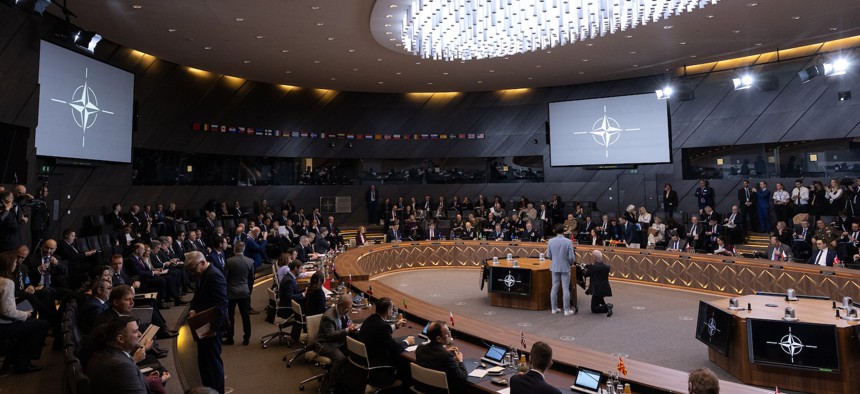
Delegates attend a meeting at NATO headquarters during the NATO Foreign Affairs Ministers' meeting, December 3, 2025 in Brussels, Belgium. Omar Havana / Getty Images


NATO retains ‘open-door policy’ despite US opposition to a ‘perpetually expanding alliance’
A top alliance official noted that NATO members are not agreed on how far it might expand.

Countries looking to join NATO are still welcome to apply, a top alliance official said Wednesday in tacit repudiation of the Trump administration’s recent declaration that the group must not be a “perpetually expanding alliance.”
NATO has an open-door policy, the alliance’s parliamentary secretary general, Benedetta Berti, told reporters Wednesday at an event hosted by the Project for Media and National Security. That was reaffirmed as recently as June’s summit, but the new U.S. national security strategy calls for “ending the perception, and preventing the reality, of NATO as a perpetually expanding alliance.”
However, Berti added, “there is no consensus for moving forward with the accession of new members,” to include Ukraine.
Berti was in Washington, D.C., this week for NATO’s Parliamentary Assembly Transatlantic Forum, where officials discussed both the new NSS and the Trump administration’s recent attempt at a ceasefire between Russia and Ukraine, which alliance officials roundly denounced.
“What we would underline, and I've heard this from the secretary general, is that, of course, from the NATO perspective, the job for today is for the alliance to continue to support Ukraine so it can defend itself today, to continue to work with Ukraine for the long-term transformation of its armed forces, and really to, through military support, to contribute to ensure that it can negotiate from a position of strength,” Berti said.
As for the rest of the NSS—which, among other things, warns that immigrants threaten to bring about Europe’s “civilizational erasure”—Berti said NATO is keeping its focus on its commitment to increase its defense capabilities, a demand from the Trump administration that the organization is working to meet.
“It's in line, very much in line, with what all 32 NATO allies agreed on the at the summit … and that is essentially a recognition that the post-Cold War peace dividend level of defense spending that we saw from Europe was simply not adequate to the current threat assessment that we have, including because of Russia against Ukraine, but not exclusively,” Berti said.
So NATO is not necessarily recalibrating its relationship with the U.S., she said, but focusing on how the administration’s positions in the NSS will affect NATO. From discussions at the parliamentary summit, she added, it’s clear that different member countries have different reactions to the administration’s particular interest in Europe’s cultural health.
“From our organization, we really just focus on, how do we actually forward in implementing what, to me, is really the most important question from a security perspective, and that is a more credible European core,” she said.
Help us report on the future of national security. Contact Meghann Myers: mmyers@defenseone.com, meghannmyers.55 on Signal.
NEXT STORY: ‘Make Europe Great Again’ and more from a longer version of the National Security Strategy