

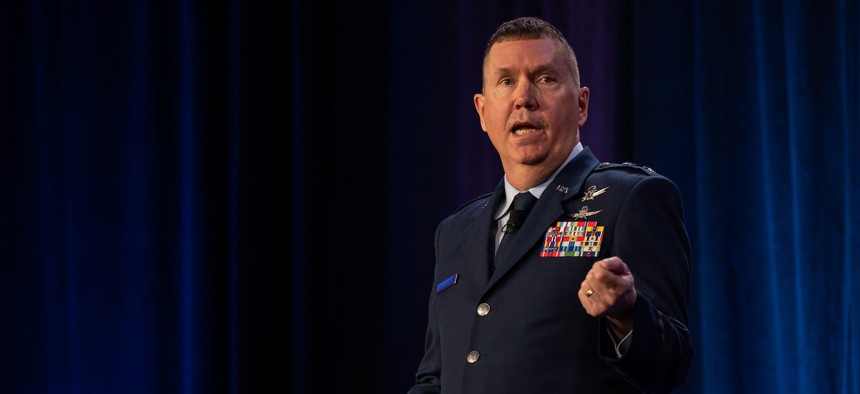
Maj. Gen. Shawn N. Bratton gives remarks in Colorado Springs, Colorado, April 19, 2023. U.S. Space Force / Ethan Johnson


Space Force probably needs twice as many guardians, vice chief says
The service’s budget and constellation have doubled since its founding, Gen. Shawn Bratton noted.

The number of operational U.S. military satellites has nearly doubled since the Space Force was created in 2019. Now its leaders want to double the size of the service itself.
The Space Force, which consists of about 10,000 guardians and 5,000 civilians, is adding about 500 troops a year—but that’s not enough, Gen. Shawn Bratton, the vice chief of space operations, during an Intelligence and National Security Alliance event late Wednesday evening.
“We’ve got to pick up the pace. We need to grow on the military side, probably around 1,000 a year, something like that, for the next decade,” Bratton said. “I think we really need to double the size.”
That’s because the newest branch of the service has seen the number of satellites under its control grow from 225 at its founding to 515 today, according to the American Enterprise Institute’s global space data navigator, while its budget has grown from $15 billion in 2020 to $39.9 billion in 2026—which includes a big bump from reconciliation funds.
Bratton said he needs more personnel to handle the growth.
“I'm super optimistic about ‘27 and we'll see how that comes out. It's less about budget though,” he said. “Do I have enough operators to fly all that stuff? Do I have enough infrastructure to base it somewhere? Do I have enough intelligence squadrons to develop the intelligence to make operators useful at their job?”
Some of the new personnel are working with the Pentagon’s combatant commands, where the Space Force has been catching up with its elder siblings in establishing service components to help the warfighting commanders. This week, the service and U.S. Southern Command held a ceremony designating the new Space Forces-Southern, which followed the creation of components in Indo-Pacific Command, Central Command, Africa Command, and European Command. It also established subordinate units focused on Japan and Korea.
Service officials also have aspirations to stand up a Space Force Special Operations component command, although Congress and defense experts have expressed skepticism over the plans. Earlier this month, Joint Chiefs Chairman Gen. Dan Caine noted that space operations and U.S. Space Command played a role in the recent special operations mission to capture Venezuela President Nicolás Maduro.
“We do a lot with the special ops community,” Bratton said during a question-and-answer session. “They understand what they need, and they know how to ask for it, and they have a pretty good understanding of what our capabilities are.”
Bratton was asked about a longstanding cultural divide between the service’s operators and acquisition experts, a situation that has provoked actions by both Congress and service leaders. The vice chief, a career operator, highlighted recent statements by Gen. Chance Saltzman, the chief of space operations, and called reforms to the officer training program a much-needed improvement.
“This is just by sheer force of will, the CSO driving the service to deliver this,” Bratton said. “The operators have to be involved in acquisitions, not just understand it, have to be involved in it. The acquirers have to have operational experience.”