

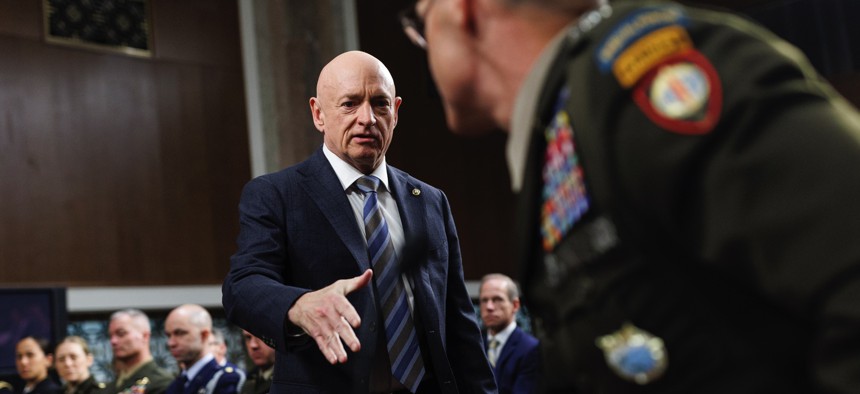
Sen. Mark Kelly, D-AZ, greets U.S. Army Lt. General Joshua Rudd during a Senate Armed Services Committee Confirmation Hearing on Capitol Hill on January 15, 2026, in Washington, D.C. Tom Brenner/Getty Images


Sen. Kelly’s lawyers say Pentagon is attempting to violate his constitutional rights
In a court filing, they say that DOJ erred in asserting that retired military officers can be punished for speaking out against DOD policies.
Arizona Democratic Sen. Mark Kelly’s lawyers on Monday urged a federal judge to block the Defense Department from downgrading his retirement rank as a Navy captain and his pay for telling U.S. troops they aren’t required to follow illegal orders.
Paul J. Fishman wrote in a 35-page filing that Defense Secretary Pete Hegseth’s attempt to punish Kelly for appearing in the video alongside other members of Congress violates several constitutional rights.
“As a decorated combat veteran and member of the Senate Armed Services Committee, Senator Kelly is deeply committed to the necessity of good order and discipline in the armed forces,” Fishman wrote. “He asks this Court to reinforce, not degrade, those principles.
“His speech—simply reminding servicemembers of their fundamental obligation not to follow unlawful orders— promotes good order. And discipline does not demand silence —particularly from those no longer serving on active duty.”
Fishman firmly rejected the Department of Justice’s assertion in a brief filed last week that the federal court system has no authority over the Defense Department’s actions in this instance.
“Defendants begin from the premise that questions of ‘military discipline’ lie beyond judicial review,” Fishman wrote. “Their claim that this Court is ‘not permitted to address’ Senator Kelly’s challenge disregards reams of precedent reviewing military disciplinary actions and demands an untenable level of deference.”
Senior Judge Richard J. Leon, who was nominated to the bench by President George W. Bush, had scheduled a hearing on the issue for Wednesday, but postponed that until Feb. 3 due to the snowstorm.
Hegseth pursues penalties
Defense Secretary Pete Hegseth announced earlier this month that he had started the process to downgrade Kelly’s retirement rank and pay, writing in a social media post that his “status as a sitting United States Senator does not exempt him from accountability, and further violations could result in further action.”
The Defense Department letter of censure to Kelly alleged that his participation in the video undermined the military chain of command, counseled disobedience, created confusion about duty, brought discredit upon the Armed Forces and included conduct unbecoming of an officer.
The video at the center of the debate featured Kelly, Michigan Sen. Elissa Slotkin, Colorado Rep. Jason Crow, Pennsylvania Reps. Chris Deluzio and Chrissy Houlahan, and New Hampshire Rep. Maggie Goodlander, all Democrats with backgrounds in the military or intelligence community.
They said that Americans in those institutions “can” and “must refuse illegal orders.”
“No one has to carry out orders that violate the law or our Constitution. We know this is hard and that it’s a difficult time to be a public servant,” they said. “But whether you’re serving in the CIA, in the Army, or Navy, or the Air Force, your vigilance is critical.”
Kelly lawyer’s arguments
Fishman wrote in his brief that the Trump administration is asking the court to “embrace a novel rule” regarding the First Amendment: “that retired military veterans have no constitutional protection for their speech whenever the Secretary of Defense—in his sole discretion and without even identifying all of the speech at issue—concludes that it ‘risks undermining military discipline and good order.’”
The Justice Department's brief from last week, he wrote, erroneously argued that retired military officers can legally face punishment for speaking out against Defense Department policies they oppose.
“From Alexander Hamilton denouncing President Adams’s fitness to command during the Quasi-War, to modern episodes in which retired generals publicly called for Secretary Rumsfeld’s resignation over the Iraq War, retired officers have long participated forcefully in public debate over military policy,” Fishman wrote.
“The same is true today: retired servicemembers, including Members of Congress, have openly criticized presidential decisions ranging from the Afghanistan withdrawal to vaccination requirements,” he added. “Many continue to serve with distinction as legislators, governors, and federal judges. Yet against that backdrop, Defendants assert the power to limit the First Amendment rights of more than two million retired servicemembers, all without judicial review.”
This story was originally published by Stateline.