

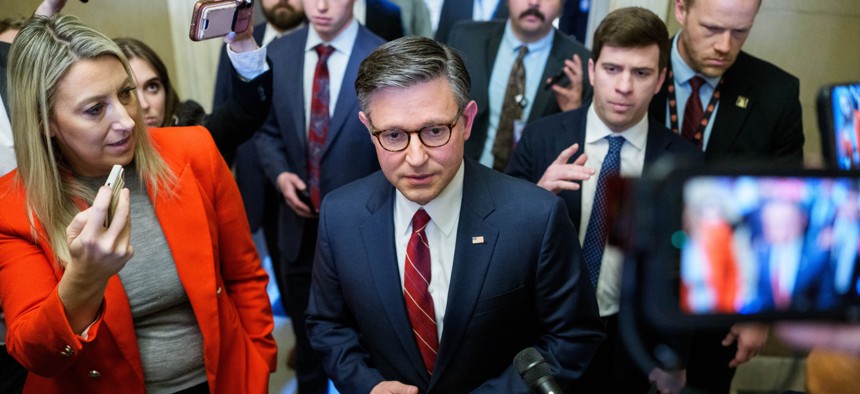
Speaker of the House Mike Johnson, R-La., speaks with reporters following a rules vote on funding the U.S. government at the U.S. Capitol Feb. 3, 2026 in Washington, D.C. Aaron Schwartz / Getty Images


Partial shutdown ends less than four days after it began
Negotiations continue over Homeland Security funding, but DOD and every other federal agency are now funded through September.

Federal agencies are set to reopen after the House on Tuesday approved a spending package funding those forced to close their doors over the weekend, ending the shutdown less than four days after it began.
All but the Homeland Security Department, which will be funded on a stopgap basis through Feb. 13, will now receive their full fiscal 2026 appropriation. Employees across a slew of agencies impacted by partial shutdown were sent home on furlough on Monday, but will now return to work—most likely on Wednesday.
The departments of Defense, Labor, Health and Human Services, Education, Transportation, Housing and Urban Development, State and Treasury, as well as other related agencies, such as the Office of Personnel Management and the General Services Administration, experienced a funding lapse that began Saturday morning. The Senate approved the spending package on Friday, but the House was on recess and could not act until it returned on Monday.
House Democrats declined to provide the votes for an expedited consideration of the bill, leading the partial shutdown to go on for one more day. A procedural vote on Tuesday appeared as though it might fail and derail efforts to reopen the government, but a few Republican holdouts ultimately opted to move the package forward.
Ultimately most Democrats voted against the final bill and most Republicans supported it.
The Office of Management and Budget on Friday informed agencies a funding lapse would occur and they should initiate shutdown procedures, even as the White House agency expressed hope the partial government closure would be short-lived. Agencies took varying approaches over the weekend and on Monday, leading to some confusion over exactly how employees should proceed.
Agencies such as the Internal Revenue Service and much of DHS remained open, either due to alternative funding streams or the nature of their work. The Federal Aviation Administration, HUD and HHS and other agencies cumulatively sent tens of thousands of employees home on furlough.
Employees from several agencies told Government Executive they had been told to expect to report to work on Wednesday if the House acted on Tuesday afternoon. Lawmakers included in the bill language guaranteeing furloughed workers will receive back pay.
Many of the agencies now funded through September will experience minor cuts to their budgets relative to fiscal 2025, but will avoid the significantly more drastic cuts proposed by President Trump. Government Executive’s analysis of the bills contained in the spending package can be found here, here and here.
Lawmakers will next turn to finding a path forward on full-year funding for DHS, though leaders have already expressed pessimism about reaching a solution before the Feb. 13 deadline. Senate Minority Leader Chuck Schumer, D-N.Y., has laid out his caucus’ demands for changes at DHS, including the removal of masks by DHS law enforcement personnel, mandated use of body cameras, a requirement for third-party warrants to enter homes, the end of roving patrols in metropolitan areas by Immigration and Customs Enforcement and more uniform restrictions on use of force by federal agents.
House Speaker Mike Johnson, R-La., has called some of those requests non-starters.
Share your experience with us: Eric Katz: ekatz@govexec.com, Signal: erickatz.28
NEXT STORY: White House initiates shutdown process as Congress hopes to keep duration minimal