

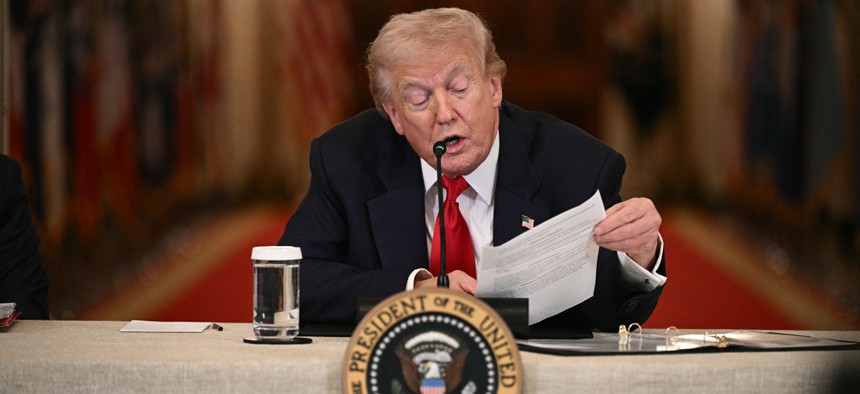
President Donald Trump speaks during a roundtable in the East Room of the White House in Washington, DC, on March 6, 2026 Brendan SMIALOWSKI / AFP via Getty Images



Trump's new cyber strategy calls for tougher responses to threats
Released Friday afternoon, the new strategy is notably shorter than those issued by Biden and the first Trump administration.

The White House's new national cybersecurity strategy calls for responding more directly to threats and securing critical U.S. technologies.
As described in a seven-page document released on Friday afternoon, the strategy has six pillars: shape adversary behavior; promote common-sense regulation; modernize and secure federal government networks; secure critical infrastructure; sustain superiority in critical and emerging technologies; and build cyber talent and capacity.
In a signed introduction to the document, President Donald Trump wrote that his strategy “calls for unprecedented coordination across government and the private sector to invest in the best technologies and continue world-class innovation, and to make the most of America’s cyber capabilities for both offensive and defensive missions.”
This includes a more gloves-off approach to cyber threats, aligning the White House’s stated goal of more forcefully responding to organizations who target U.S. networks.
“Unlike other Administrations, the Trump Administration will not tinker at the edges and apply partial measures and ambiguous strategies that neglect the growing number and severity of cyber threats,” the strategy said. “President Trump will continue to address threats in cyberspace directly.”
The strategy mentioned cyber forces' contributions to the administration's efforts “to obliterate Iran’s nuclear infrastructure” and its January operation that captured Venezuelan leader Nicolás Maduro.
The document said the White House would pursue its more offensive-focused cyber strategy by, in part, moving to “unleash the private sector by creating incentives to identify and disrupt adversary networks and scale our national capabilities.” It also detailed plans for a more global response to threats.
“Defending cyberspace and safeguarding freedom is a collective effort — the distribution of cost and responsibility must be fair across the U.S. and allies who share our democratic values,” the document said. “We will work together to create real risk for adversaries who seek to harm us, and impose consequences on those who do act against us.”
The strategy also called for efforts to maintain U.S. leadership in the development of artificial intelligence tools, to promote quantum computing and post-quantum cryptography, and to support “the security of cryptocurrencies and blockchain technologies.”
It said the administration “will work to adopt AI-powered cybersecurity solutions to defend federal networks and deter intrusions at scale,” as well as “remove barriers to entry so that the government can buy and use the best technology.”
The new strategy is noticeably shorter than previous versions of such documents. The one issued in 2018 during Trump’s first term was 40 pages, while the document issued by then-President Joe Biden in 2023 was 39 pages. Both outlined several objectives under each pillar.
Along with the new strategy, the White House issued an executive order meant to fight “cybercrime, fraud, and predatory schemes.” That order, in part, directs the attorney general to provide recommendations for the creation of a “Victims Restoration Program” to compensate fraud victims with money seized from or forfeited by fraudsters.
Several U.S. companies voiced support for the administration’s stated goal of working more closely with industry and its promotion of domestic AI development.
"President Trump's cybersecurity strategy is a significant shift — one that empowers the private sector to partner with the administration to defend American systems and deliver a robust, collective response to nation-state hackers,” Trellix Chief Public Policy Officer Tom Gann said in a statement. “From shaping adversary behavior to modernizing federal cybersecurity and driving innovation, this is a holistic approach to a growing threat, and the private sector is ready to be a meaningful partner in that effort.”
Bill Wright, the global head of government affairs at Elastic, said that “redirecting resources from paperwork to AI-powered security capabilities is the only way to keep pace with modern threats and adversaries who operate at great speed,” and added that “this strategy appears to recognize that fundamental truth.”
Not all of the early feedback, however, was positive.
Rep. Bennie Thompson, D-Miss., the ranking member of the Homeland Security Committee, called the strategy "impressively underachieving, even by the abysmal standards this Administration has set for itself.”
“Completely lacking is even the most basic blueprint for how the Administration will go about achieving any of its cybersecurity goals — an objective possibly hamstrung by the hemorrhage in cyber talent across all Federal agencies since Trump took office,” Thompson said.
Nextgov/FCW Cybersecurity Reporter David DiMolfetta contributed to this report.