

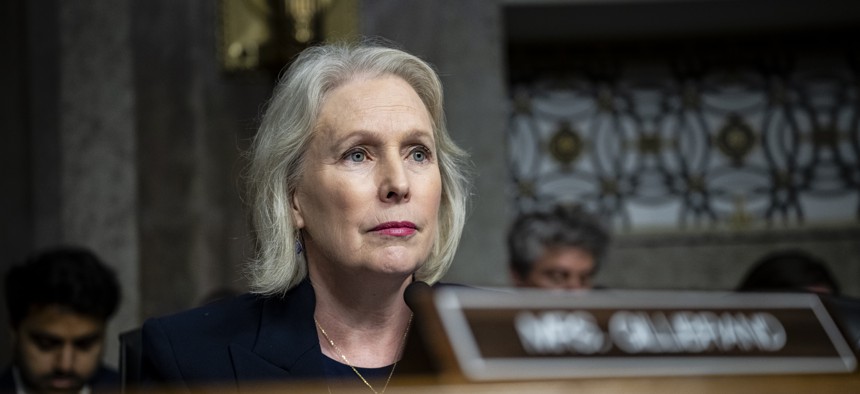
Sen. Kirsten Gillibrand (D-NY) during a Senate Armed Services Committee hearing on April 30, 2026 in the Dirksen Senate Office Building in Washington, D.C. Graeme Sloan/Getty Images



Push for new Cyber Force service branch narrowly fails in the Senate
Sen. Kirsten Gillibrand’s amendment aimed to place a new service under the Army.

An effort to create a new cyber-focused military service under the Army narrowly failed in the Senate, but the lawmaker who proposed it isn’t backing down.
Last month, Defense One exclusively reported that Sen. Kirsten Gillibrand, D-N.Y., was spearheading a markup amendment to the National Defense Authorization Act that would create a Cyber Force. The effort ultimately failed by a vote of 14-13, with four Democrats and 10 Republicans swatting the amendment down. Nine Democrats and four Republicans voted in favor.
“We remain optimistic about Cyber Force and the Senator will continue to push for its creation,” a Gillibrand spokesperson said.
While the Senate Armed Service Committee’s version of the National Defense Authorization Act sidelined the creation of a Cyber Force, it does scrutinize various Pentagon policy changes meant to strengthen U.S. Cyber Command, the current cyber-focused combatant command.
The committee’s version of the NDAA “directs an independent review of whether CYBERCOM is adequately organized and resourced to meet its expanding authorities and responsibilities” and also calls for “an independent study on the roles, responsibilities, authorities, and resourcing of the Principal Cyber Advisors of the military departments.”
The push to establish a Cyber Force under the Army, similar to how the the Space Force and Marine Corps sit under the Air Force and Navy, was in tandem with a new think tank report examining the perceived cost, time, and benefits of setting up a new cyber-focused service branch.
Joshua Stiefel, a former House Armed Services Committee staffer, co-chaired the Center For Strategic and International Studies and the Foundation for Defense of Democracies’ Commission on Cyber Force Generation. The findings, released earlier this month, said the creation of the service “would address longstanding structural challenges and build the Cyber Force the United States needs for this critical domain of warfare.”
Stiefel told reporters earlier this month that the findings were released at a pivotal moment where it seems CYBERCOM has been given a significant amount of authority, but concerns over how the military handles its cyber-focused troops still persist.
“What's interesting is that as someone who was in the legislative process for almost seven years, we tried, I tried, my colleagues tried everything and it seems as if we've reached that breaking point where there isn't any more authority to give to address this problem that doesn't start to begin to chip away or take away from the service chiefs,” Stiefel said. “And that dilemma means we're at this precipice.”