

GarryKillian/Getty Images


US military used new 'non-kinetic' cell to guide cyber ops during Maduro capture
The unit is part of a broader push to better integrate cyber, EW, and other non-destructive effects into missions, leaders told lawmakers on Wednesday.

A new “non-kinetic effects cell” has helped push cyber operations to the forefront of specialized U.S. military missions such as the capture of Venezuela's leader in the capital of Caracas, a top official told lawmakers Wednesday.
The cell is “designed to integrate, coordinate and synchronize all of our non-kinetics into the planning, and then, of course, the execution of any operation globally,” Joint Staff Deputy Director for Global Operations Brig. Gen. R. Ryan Messer told the Senate Armed Services Committee’s cybersecurity panel.
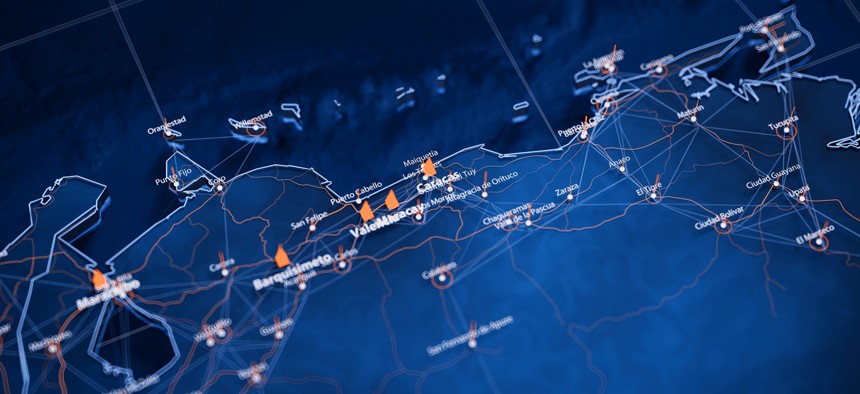
Non-kinetic effects are military actions—think cyber operations, electronic warfare and influence campaigns—that influence or disrupt an adversary’s systems without using physical force or causing direct destruction. The operation that apprehended Venezuelan President Nicolás Maduro included cyber effects that targeted radar, internet, and the city’s power grid, causing a temporary blackout.
U.S. spy agencies stood up crisis action teams that provided intelligence to Special Operations Command and Southern Command throughout the operation, a U.S. official with knowledge of the matter has told Nextgov/FCW. The NSA oversaw geolocation support to gather intelligence that aided the operation and monitored other signals that help operators determine if a foreign adversary orders troop movements or seeks to activate radar, the official said.
The cell is just part of the effort to better integrate cyber and other non-kinetic tools into U.S. military operations.
“The reality is that we’ve now pulled cyber operators to the forefront,” Messer said.
Other leaders talked about “Cyber Command 2.0,” a two-month-old effort to increase the hiring and improve the retention of skilled military cyber specialists.
A scaled-back version of a broader restructuring effort initially planned for the 15-year-old command, the approach focuses on better recruiting and managing cyber personnel across the armed forces, improving access to specialized training through partnerships with industry and universities, and speeding up the development of new cyber tools and techniques.
“Our intent as part of CyberCom 2.0 is, if you’re a young person — a hacker — and you want to come serve your country, when you show up at your recruiting station, we want you to be administered a cyber aptitude test,” said Lt. Gen. William Hartman, acting director of Cyber Command and the NSA. “If you score well on that test, we would like you to be offered a contract to become a cyber operator” and enter a pipeline to join CyberCom.
“I would tell you not just Absolute Resolve, but Midnight Hammer and a number of other operations, we've really graduated to the point where we're treating a cyber capability just like we would a kinetic capability,” Hartman added, referring respectively to the Venezuela operation and a U.S. bombing run last year that targeted key nuclear sites in Iran.
Katie Sutton, the Pentagon’s cyber policy chief, highlighted the CyberCom 2.0-backed Cyber Innovation Warfare Center, which is meant to quickly design and deploy various cyber tools, including new software and tactics used to disrupt adversary networks and defend U.S. military systems. The private sector would play a major role in this.
“It’s not just about acquiring a tool or a technology, there’s a lot of non-material aspects that will need to be successful,” Sutton said. “It’ll be our tie to industry. It ties our operational force directly to industry to allow this to happen at the speed at which we’re seeing the capabilities come out.”
The 2.0 model, initially endorsed during the Biden administration, then accelerated under Defense Secretary Pete Hegseth, albeit with various rewrites and examinations penned over the last year. Many of the initiatives in the 2.0 framework are expected to be fully integrated later this decade or in the early 2030s.