

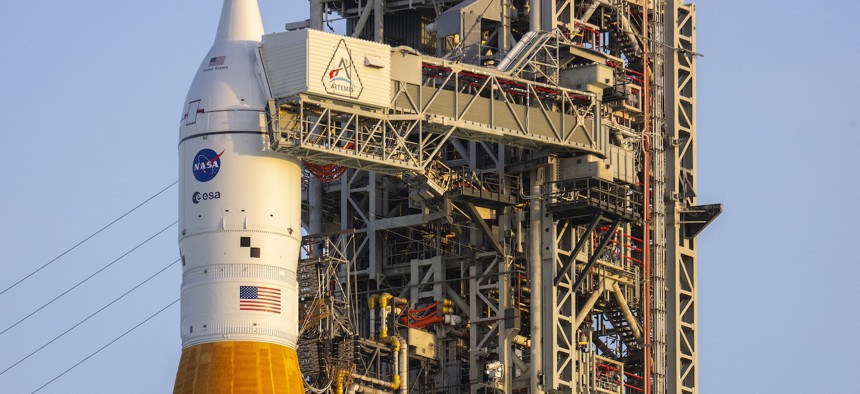
NASA's Artemis II Space Launch System rocket and Orion spacecraft rest on Launch Pad 39B at Kennedy Space Center in Cape Canaveral, Fla., on March 31, 2026, ahead of the crewed lunar mission. Jim WATSON / AFP via Getty Images



From launch to recovery: Here’s how Space Force is backing NASA’s Artemis II mission
The service is stepping up to support NASA’s first crewed moon mission since 1972.

Space Force guardians are supporting NASA’s first crewed launch to the moon in more than 50 years by forecasting the weather and monitoring security, and, in an emergency, would make the call to abort Wednesday night’s historic mission.
The service’s Space Launch Delta 45 is tracking by weather and rocket safety conditions for NASA’s launch out of Florida’s Kennedy Space Center. There will be 28 crew members in the mission control center, in contrast to the four or five members used for a typical launch, service officials told reporters during a roundtable Monday.
Boeing’s Space Launch System rocket doesn’t have an autonomous flight safety system, which would automatically stop the mission in an emergency. That means more eyes are needed to monitor key data on the rocket and in the skies.
“When you don't have an autonomous flight safety system, you have to call up multiple range assets and resources for that function,” said Lt. Col. Gregory Allen, 1st Range Operations Squadron commander. “So that is exactly why we have so many personnel on console for this.”
The last Apollo mission in 1972 marked the last crewed mission to the moon. The Space Force, since it was created in 2019, has taken on a major role in rocket launches and oversees military and U.S. government missions from Florida’s Cape Canaveral and California's Vandenberg Space Force Base. Additionally, the 1st Air Force’s Detachment 3, the only Defense Department unit tasked with rescue and recovery of commercial space crews, has four helicopters ready at Patrick Space Force Base in case the crew needs to abort the mission.
Service officials told reporters that airmen and guardians are ready for Wednesday’s launch and opened an emergency operations center manned with first responders, bomb technicians, and others they can “surge” if needed, said Col. Chris Bulson, the deputy commander for installation support.
“SLD 45 has a robust team of folks on standby for this particular mission that are well versed with the SLS rocket, the systems on board, and have great teamwork with our detachment three partners to assist them should a recovery be necessary,” Bulson said.
Given the large public crowds for the event, Space Launch Delta 45 is also preparing for more security patrols and more people to manage crowds on land as well as boaters watching from the ocean, he added.
The Delta’s 45th Weather Squadron has forecasted favorable conditions for Wednesday’s launch. Unlike the National Weather Service or the National Oceanic and Atmospheric Administration, the Space Force’s squadron uses guardians who focus on specific factors and local weather that would affect crews, missions, and launch vehicles and pads.
They also monitor last-minute winds and conditions in case the Artemis II crew needs to abort mid-flight, Col. Douglas Oltmer, the weather squadron commander, told reporters.
“If the winds are too strong on shore, and they do have to abort en route, they will need to land over the water for the emergency,” Oltmer said. “So that's one of the things we're forecasting for on our end as well.”
The squadron’s weather forecasting doesn’t stop once the crews enter outer space. The Space Force has a team alongside the 1st Air Force’s Detachment 3 aboard the Navy’s USS John Murtha transport that will monitor recovery conditions for the crew when they splash down in the Pacific Ocean after their 10-day journey. The four astronauts are scheduled to launch from Kennedy Space Center sometime after 6:24 p.m. on Wednesday, and are scheduled to return off the coast of California on April 10.
“With Artemis, we started back in November, providing all the support all the way to day of launch, all the way until they recover, and then we actually forecast to bring the capsule all the way back across the country from the West Coast,” Oltmer said. “It's probably one of the coolest jobs an Air Force meteorologist can have here.”