

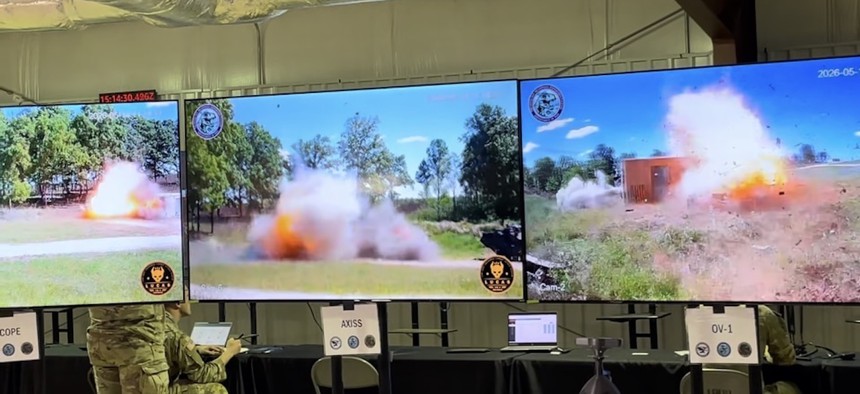
A low-flying LUCAS drone crashes through a cement structure during a May T-REX demonstration at Camp Atterbury, Ind. Defense One / Patrick Tucker



How the Pentagon plans to spend $50 billion on drone warfare
As new drone startups proliferate, Pentagon and military leaders outline their priorities for building “drone dominance."

CAMP ATTERBURY, Indiana—A countdown began as a gaggle of defense officials, soldiers, drone makers, and reporters watched screens in a windowless operations center. Suddenly, a LUCAS drone appeared, moving at rocket speed and showing off a new low-level capability before it crashed through a cement structure on the test range. It was a vivid demonstration of just how quickly the FLM-136 drone is evolving—and of how swiftly Pentagon leaders want to spend the $50 billion they have requested this year for drone development and production.
The path to spend that money quickly and well is paved with steps that Pentagon leaders have already taken. They have expanded the list of drones that unit commanders can easily buy, Emil Michael, defense undersecretary for research and engineering, said at the SOF Week event in Tampa last week.
“What was happening is we had this highly distributed drone sort of purchasing that all happened in small blocks, all in about the department, which has some goodness to that, because units can experiment on their own. But they had to buy from this small Blue List that never grew. Very hard for a vendor to get on that blue list,” he said.
That will enable larger purchases of existing drones, Michael’s deputy James Mazol told reporters at Camp Atterbury as he described the Defense Autonomous Warfare Group’s plans to spend the $50 billion—more than 200 times its 2026 budget and more than the GDP of many nations.
“Some of it is actually buying platforms en masse. Now there's a lot of actual platforms that can be part of that, that exist and just need to be scaled up”—meaning produced in larger quantities, Mazol said.
But the money will also go to bring in new companies, help them develop their systems, and bulk up their production.
Autonomous surface vessel maker Saronic is a “good example of that,” said Mazol. “They have an unmanned surface vessel that has gone through…all this experimentation. They've built this body of evidence. And, you know, they're helping the Navy procure that in large quantities.”
Meanwhile, defense officials are looking to Ukraine to foster new technology.
In March, when the Pentagon held “Gauntlet 1” of its Drone Dominance trials, the top performers included Ukrainian Defense Drones and a partnership of Ukraine’s SkyFall and a UK company—both examples of the sort of defense startup that can move quickly from launching to actually filling Pentagon orders.
The technology readiness experiment, or T-REX, was one of a series of rapid joint-service prototyping events begun in 2023. It also debuted a number of small startups like SplashOne Robotics, who are looking to partner with Ukraine. SplashOne showed off a fixed-wing drone that shoots at other unmanned aerial vehicles using autonomous targeting software called SMAEGOL (SMall AEronautical Gun, Optics, and LASER) that can detect and aim at threats faster than a human can see them. Founder Jeff Wright said they “have game” against a variety of Russian one-way-attackers–the SuperCam 350, Orlan10, Molynia and even hard-to-hit Geran-2 drones.
And more Pentagon commands are building up their ability to experiment with and procure drones. U.S. Southern Command has established an autonomous-warfare unit whose initial focus is building a data network to enable more effective use of drones.
“We don't talk about robots at SAWC,” or SOUTHCOM Autonomous Warfare Command, said Gen. Frank Donovan, who leads SOUTHCOM. “We talk about the data environment, the different data layers that we need at the very forward edge so our [special operations forces] and our conventional force teammates…can actually plug into that data network. Whatever robot shows up with the capability, they can leverage it instantaneously.”
Donovan emphasized that he isn’t looking to a single company to create that environment, but instead wants open architectures that can connect many companies’ tools and products.
“We can match the robots to the environment. Whether it swims, it flies, it has feet, whatever it does, we have to make it do what we want it to do when we want to do it,” he said at the SOF Week.
Donovan’s message to vendors was blunt: it doesn’t matter how impressive your drone or counter-drone capability is if you put too many restrictions on how it connects, or the data it gives away.
“If it’s great only if you use it this way, only if you use my service stack, and only if you connect it to this or that, it’s unacceptable across the board.”