

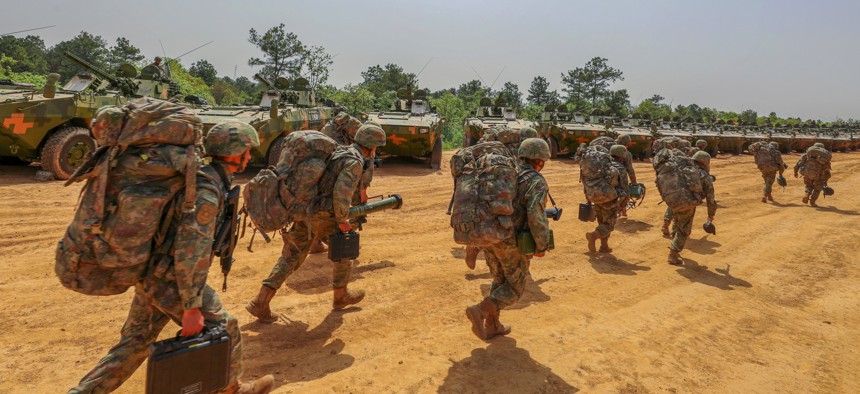
Troops of the People's Liberation Army set up for a live-fire exercise in Fuzhou City, Jiangxi Province, China, on November 9, 2025. CFOTO/Future Publishing via Getty Images


Inside China’s nascent, AI-powered military logistics system
The PLA is already testing technologies that range from widespread sensors to AI-enabled predictive planning, cargo drones, and tracked UGV mules.
兵马未动,粮草先行—"Before the troops and horses move, provisions and fodder must go first”—is the Chinese equivalent of Napoleon’s supposed saying that "An army marches on its stomach," or Omar Bradley’s admonition "Amateurs talk strategy, but professionals talk logistics.” The modern PLA is taking these lessons to heart with a series of efforts to build a smart logistics system of the future, one that can supply its troops under fire in the next war. As described in People’s Daily, the effort incorporates technologies that range from a multi-domain sensing web to an AI-enabled predictive planning that matches resources to cargo drones and tracked UGV mules. The PLA is already testing each in plateau, border, and coastal exercises.
The backbone of the PLA’s push for “smart joint logistics” is the PLA’s Joint Logistic Support Force. Created in 2016, the JLSF runs theater-level joint support centers, depots, and information systems that combine Army, Navy, Air Force, and Rocket Force sustainment into a single network and uses data from units, bases, and civilian contractors to build cross-theater sustainment plans.
The first layer senses demand. The PLA is moving from a system of periodic unit reports to continuous visibility of equipment and stocks. That means automated monitoring of vehicles and power sets, smart depots that track items in real time, and unique item IDs that let logisticians see what is where and in what condition. A recent PLA Air Force logistics guidance describes a goal of automatic sensing of support status and needs, unique codes for key items, and warehouse systems that present a live picture of resources, while the JLSF is developing upgraded facilities that barcode each item and use automated storage to speed issue and receipt.
This model demands a clear picture of every item. Thus, the system also relies on shared stores, unique item IDs, and automated storage and retrieval. The PLA has established a system of public warehouses as the shared backbone for this work. Instead of every unit dragging tents, generators, and office gear to each rotation, bases hold a common pool of camp equipment and mission sets that units draw from on arrival. According to PLA documents, this system is intended to lighten loads, cut costs, and pull idle stocks back into use. By late 2024, prototypes held more than one hundred thousand items and processed nearly eighty thousand loans, ending the need to “move the whole camp.” Xinjiang training bases now let units pre-order tents, camouflage nets, oxygen machines, and other public gear, then collect them on site. In the Liaoyang military sub-district, a public warehouse tags each item with a QR code and lets military and local units query inventories online and request consolidated deliveries. Guidance issued in March calls for the construction of a common database for PLA supplies, with standard inbound lists and common rules that reduce friction between bases and services.
The second layer is AI scheduling and optimization. Once a demand is sensed, the next step is faster matching of needs to storage and transport. So the PLA is developing real-time acquisition of data, rapid transmission, efficient processing, and intelligent decision-making inside the logistics command system. This system is already being tested. According to the PLA Daily, field units in Tibet can submit orders online through the “Xueyu” delivery app to a centralized platform that aggregates requests in real time and distributes supplies through a coordinated plan, enabling dynamic dispatch, priority rules, and more efficient use of scarce trucks, aircraft, and warehouse space.
The PLA is also wiring civilian companies into what looks like a future shared smart store. In 2017, the PLA Air Force Logistics Department signed a five-year agreement with several major logistics firms covering transport, warehouse management, procurement, information fusion, and research projects, aiming to build a logistics system that can “fight in wartime, respond in emergencies, and serve in peacetime.” In 2021, JD Logistics noted that it already handles more than sixty percent of orders on the PLA’s online procurement mall and is helping pre-code supplies for quality and maintenance tracking, while SF and Deppon bring heavy freight, cold chain, and multimodal reach that far exceeds what military trucks can do alone. These links let the PLA treat civilian fleets and warehouses as extra nodes in the network, giving them more options when they aggregate orders, allocate stock, and route loads under time pressure.
The third and final layer in the chain is autonomous last-mile delivery. The PLA has practiced unmanned resupply at altitude and in coastal units, using cargo drones to move rations and parts when terrain or weather makes roads unreliable. It has also showed a tracked unmanned ground vehicle known as the “Mule-200” to haul ammunition and other loads alongside dismounted troops. These platforms extend reach, lower exposure on predictable routes, and create new ways to push sustainment into hard ground.
A good example of this smart logistics model in action is the PLA’s new “Military Oil Internet-of-Things (IoT) Platform,” which transforms the military’s fuel monitoring from periodic checks to continuous monitoring of receipt, storage, and issue. The idea traces to an earlier plan to build a military supply IoT that accomplishes real-time demand sensing and precise distribution, and applies industrial IoT technology to wartime sustainment. Networked sensors continuously monitor tank conditions and stock levels, and data is captured and uploaded automatically so that depot status is available to commanders in real time. Official coverage frames this as not just a one-off demonstration, but as part of an ongoing five-year warehouse-informatization effort under the JLSF.
The importance of such efforts to the future of the PLA is clear. PLA planners have spent two decades treating logistics as a core problem in a cross-strait invasion. Studies by the China Maritime Studies Institute and National Defense University’s Crossing the Strait project argue that sustainment will shape any campaign against Taiwan and document how the PLA has built ports, sealift, fuel networks, and depots to keep forces supplied under fire. The JLSF’s emerging smart logistics blueprint turns that effort into a joint support web that fuses theater stockpiles, public warehouses, and commercial partners so it can keep feeding forces even as ships are hit, airfields are cratered, and data links are attacked. The JLSF aims to fuse dispersed supply and fuel depots, public warehouses, and civilian fleets into a single picture that senses demand early, pools assets, and pushes supplies forward by drone or UGV when roads are blocked or unpredictable. If it works at scale, frontline units face fewer surprise shortages, commanders get faster options to reroute around damaged nodes, and planners can lean on civilian providers when organic lift is short.
For U.S. and allied planners, two points follow. First, they must update their assumptions of how PLA forces are supplied and sustained, with Beijing pushing sensing, decision support, and last-mile lift into the core of its support system. Second, the PLA’s smart logistics network emerges as a key target. The same shared platforms, data hubs, and civil-military pipelines that make JLSF logistics more responsive in peacetime also create new critical nodes in any war.
NEXT STORY: Pacific Marines modernize, prep for a busy year