

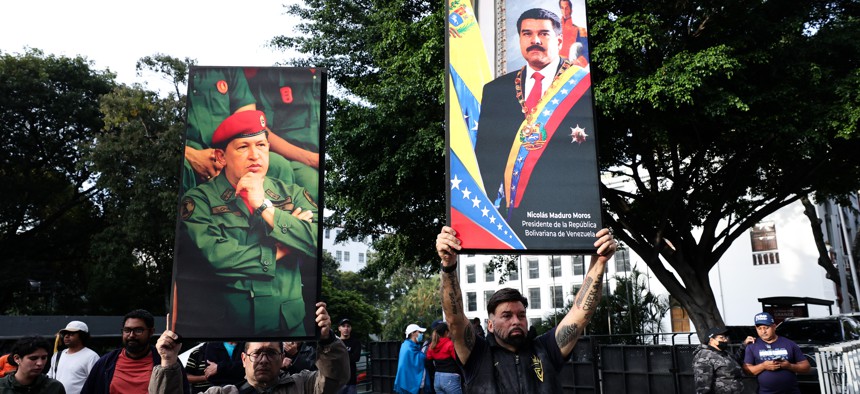
Supporters of Nicolas Maduro and late Hugo Chavez hold posters with their images after explosions and low-flying aircraft were heard on January 03, 2026 in Caracas, Venezuela. Jesus Vargas/Getty Images
US spy agencies contributed to operation that captured Maduro
The CIA helped locate the Venezuelan leader while others monitored electronic communications.
U.S. intelligence agencies supported an overnight operation to capture Venezuelan leader Nicolás Maduro in Caracas, the nation's capital, which also included strikes against several military sites throughout the city.
Multiple U.S. spy offices stood up crisis action teams that provided intelligence to Special Operations Command and Southern Command throughout the operations, according to a U.S. official with knowledge of the matter.
The National Security Agency, which monitors foreign signals and communications, also oversaw geolocation support to gather intelligence used to aid in the operation, said the official, who spoke on the condition of anonymity to communicate sensitive details.
NSA also used its capabilities to conduct indicators and warning support, which monitors communications and signals that help specify if a foreign adversary orders troop movements or intends to activate radar systems, the official added.
Joint chiefs Chairman Gen. Dan Caine said in a press conference that the CIA, NSA, and National Geospatial-Intelligence Agency were involved in the mission. The NGA uses imagery and mapping data to support military activities.
In the months leading up to the operation, U.S. intelligence agencies built a granular portrait of Maduro’s daily life, tracking how he moved, where he lived and traveled, what he ate and wore, and even details about his pets, Caine said.
Multiple reports indicated the CIA aided the Army’s elite Delta Force in tracking and locating Maduro, though Defense One could not independently confirm this by publishing time. For months, the CIA has been conducting covert operations in Caracas, using assets that are among the U.S. intelligence community’s most protected secrets.
Lights in Caracas “were largely turned off due to an expertise that we have,” President Trump said at the Saturday press conference. He did not elaborate on the capabilities and methods that allowed the U.S. to shutter lights in Venezuela’s capital city.
U.S. Cyber Command, which is authorized to carry out offensive cyber operations, participated in the operation, Caine said, though he did not elaborate on what actions the digital combatant command took.
Maduro and his wife are now bound for New York, where he is expected to face narco-terrorism charges. President Donald Trump said the U.S. will run Venezuela for now, and will not rule out having additional U.S. servicemembers on the ground.
The operation drew opposing reactions from the top Republican and Democrat leaders of the Senate Intelligence Committee.
“This is a U.S.-indicted drug trafficker. Such people will never have safe haven no matter where they are or what they call themselves,” said committee Chairman Tom Cotton, R-Ark. in a Saturday appearance on Fox & Friends. “It’s just a reminder to adversaries around the world of what our military is capable of when we have a commander-in-chief with the strength and resolution to deploy that military when necessary to defend vital US national interests,” he later added.
In a statement, Vice Chairman Mark Warner, D-Va., said Maduro is a corrupt authoritarian leader, but the overnight action could give a runway to foreign adversaries who want to take similar actions against their neighbors.
“If the United States asserts the right to use military force to invade and capture foreign leaders it accuses of criminal conduct, what prevents China from claiming the same authority over Taiwan’s leadership?” Warner said. “What stops Vladimir Putin from asserting similar justification to abduct Ukraine’s president? Once this line is crossed, the rules that restrain global chaos begin to collapse, and authoritarian regimes will be the first to exploit it.”