

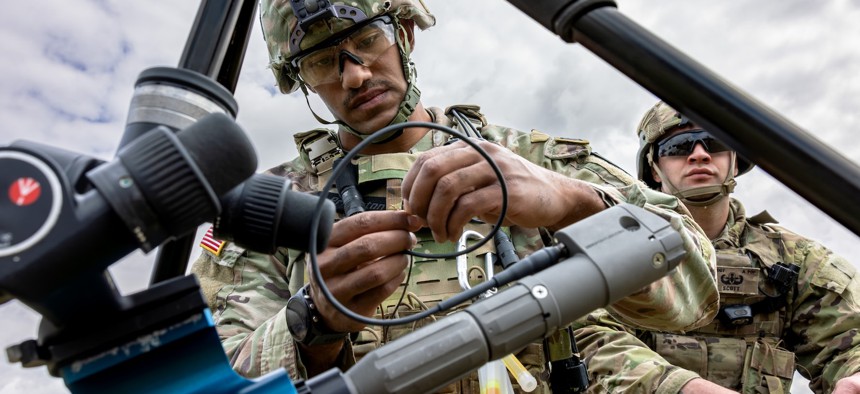
An explosive ordnance disposal soldier assembles a TiTAN disrupter system for unmanned aircraft system training at Balli Airfield, U.S. Army Garrison Bavaria, July 8, 2025. U.S. Army / Sgt. 1st Class Tanisha Karn



Drone threat ‘will far exceed’ that of GWOT’s roadside bombs
“We're making sure that we get them everything they require to protect themselves,” Brig. Gen. Matt Ross said of troops in CENTCOM.

With a timeline for the U.S.’s war with Iran very much up in the air, a task force assigned to improving the U.S.’s ability to down small drones both at home and abroad is eagerly awaiting lessons from the conflict—while moving as quickly as possible to make sure bases around the world are protected from retaliatory drone strikes.
The threat is even bigger than that of the improvised explosive devices that devastated U.S. troops in Iraq and Afghanistan during the Global War on Terror, Brig. Gen. Matt Ross, the head of Joint Interagency Task Force-401, told reporters on Thursday at an industry event hosted by the Army.
“What I can tell you is that the challenge of unmanned systems, the threat posed from unmanned systems, is going to far exceed the threat that we saw from IEDs … where we made some progress, but never really got in front of it,” Ross said.
The U.S. sunk more than $20 billion into the counter-IED fight 20 years ago, and never came up with a good detection system for roadside bombs, but did create a vehicle that at least offered much better protection from them than the unarmored humvees troops had been patrolling in.
“That's a weapon for which there's no commercial application,” Ross said of IEDs, compared with the ubiquity of drones. “And we're going to see proliferation of unmanned systems into our commercial airspace. It's going to be very common in the next few years. And what that means is that our ability to manage that airspace safely—and then protect critical infrastructure that must be protected, whether it's formations or locations—that market is just going to continue to grow over time.”
Ross’s comments came as the Army finished identifying six soldiers who were killed in a one-way drone attack on Sunday in Kuwait. Asked whether the war with Iran is accelerating efforts, he answered generally as to avoid commenting on ongoing operations.
“What it means is that we're paying attention to what's going on, and we're making sure that we get them everything they require to protect themselves, both at home and abroad,” he said. “And so I wouldn't say this is exclusive to the Middle East right now, but we are absolutely thinking about Department of War partners and allies locations globally that could come under threat to make sure that they've got the equipment they need to protect themselves.”
Now the task force is working to get ahead of threat as it continues to grow.
“I believe one of the reasons we stood up JIATF-401, just to surge against this problem, is because we didn't want to wait for a 9/11 event inside the United States to address the threat of unmanned systems,” Ross said. “And what has happened over the past week in the Middle East is, we have elevated the sense of urgency, and it's getting a lot of attention in terms of how we maintain the capability and capacity to deal with the threat of these systems. We knew it was there, and we've been working against the problem. This has just elevated the conversation nationally.”
Making progress
Since JIATF-401 stood up in late summer, the small office has been working with partners from the FBI and Homeland Security to create standards and policies for operating counter-unmanned systems, while getting its online marketplace off the ground.
The site is live—if “clunky,” Ross said. The next step will be to award a contract for a common command-and-control architecture that can operate systems across the military services and other government agencies seamlessly. That’s expected be fielded within months.
The task force is also looking for data-sharing standards.
“We appreciate your collaboration with us as we try to standardize how we're going to send and receive data in what formats,” Ross told an audience of industry representatives during the event.
That’s a key part of any counter-UAS system in the JIATF-401 marketplace, whether it goes to the Defense Department, NATO, or any civilian law-enforcement agency.
“They’ve got to know that it's going to work. I’ve got to know that it's compatible,” he said. “The people don't know that today.”
Ross also wants to overhaul the installation process for these systems, with out-of-the-box functionality that doesn’t require a technician from the vendor to get it running.
“I think an installation ought to be able to order equipment from you and ought to be able to set it up like a Ring doorbell,” he said. “We don't do that today. A lot of systems require additional expertise on that.”
Help us report on the future of national security. Contact Meghann Myers: mmyers@defenseone.com, meghannmyers.55 on Signal.