

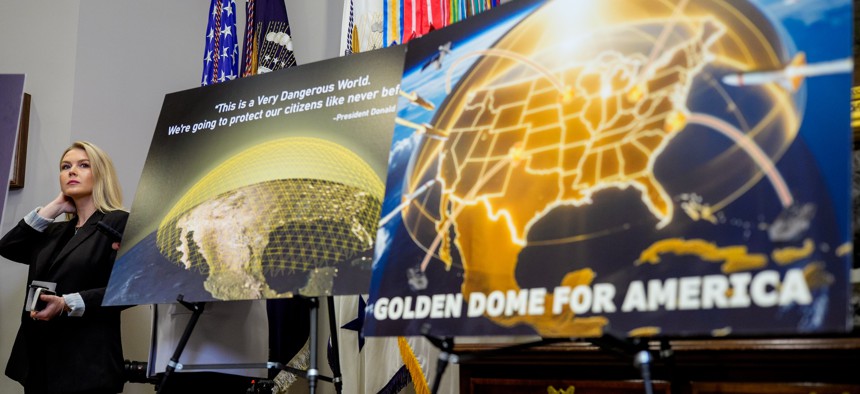
White House press secretary Karoline Leavitt looks on as U.S. President Donald Trump speaks during a press conference in the White House on May 12, 2025. Andrew Harnik/Getty Images


Space Force picks firms to develop Golden Dome’s space-based interceptors
Defense giants and startups vie to create orbital defenses—even as the program’s czar concedes they may be unaffordable.

Twelve companies are now competing to build space-based interceptors for President Donald Trump’s sprawling Golden Dome missile defense shield, the Space Force announced Friday.
In late 2025 and early this year, the Space Force awarded 20 Other Transaction Authority agreements, flexible contracts not bound by certain federal procurement regulations, Space Force Systems Command said in a news release. The awards are worth up to $3.2 billion, and the dozen companies range from well-known prime contractors to smaller and defense players.
They include Anduril, Booz Allen Hamilton, General Dynamics, GITAI USA Inc, Lockheed Martin, Northrop Grumman, Quindar Inc, Raytheon, Sci-Tec Inc, SpaceX, True Anomaly Inc, and Turion Space Corp., according to a Space Force press release and a Space Systems Command spokesperson.
"Adversary capabilities are advancing rapidly, and our acquisition strategies must move even faster to counter the growing speed and maneuverability of modern missile threats," Col. Bryon McClain, the space combat power program executive office, said in a press release. He added the Other Transaction Authority Agreements “attracted both traditional and non-traditional vendors, while harnessing American innovation, and ensuring continuous competition.”
The service’s space-based interceptor program is focused on fielding low Earth orbit satellites that can take down a variety of missiles in the “boost, midcourse, and glide” phases of their trajectory, the service said in the news release.
Last week, Space Force Gen. Michael Guetlein, the Golden Dome czar, told Congress that development of space-based interceptors that would take down a missile in its initial launch phase could be too expensive for the project’s proposed $185 billion budget, and may not make the final architecture.
Developing the technology is only the start. To provide the kind of comprehensive missile-defense coverage promised by President Trump, Golden Dome would need not just thousands of satellites, but tens or even hundreds of thousands, MIT physicists and others have argued.
Still, the Space Force remains optimistic that it can demonstrate Golden Dome’s ability to stop a variety of missiles before the end of Trump’s term.
“With the commitment and collaboration of these industry partners, the Space Force will demonstrate an initial capability in 2028,” McClain said.
Yesterday, Defense Department officials and military leaders joined Guetlein at Joint Expeditionary Base Little Creek-Fort Story in Virginia, to discuss the missile defense project in an event limited to only a few media outlets. Despite a lack of public details about Golden Dome-related spending and architecture, officials claimed “ahead of schedule and on budget,” according to a Pentagon press release.
“We are moving with purpose and urgency to forge a shield that is layered, integrated, and automated,” Guetlein said. “The progress on display today is tangible proof that this is not a future concept, but a reality we must build now."
Almost none of the $17.5 billion in the 2027 budget request for Golden Dome would come from the Defense Department’s baseline spending, with the administration choosing to bet on yet-to-be-approved reconciliation funds instead. Rep. Mike Rogers, the chairman of the House Armed Services Committee, told Space Symposium attendees in Colorado Springs earlier this month that additional reconciliation spending wasn’t a guarantee.
Office of Management and Budget projections show Golden Dome funds being folded into the baseline budget in future years, with a $14.7 billion estimate in 2028 which is projected to rise to $16 billion by 2031.