

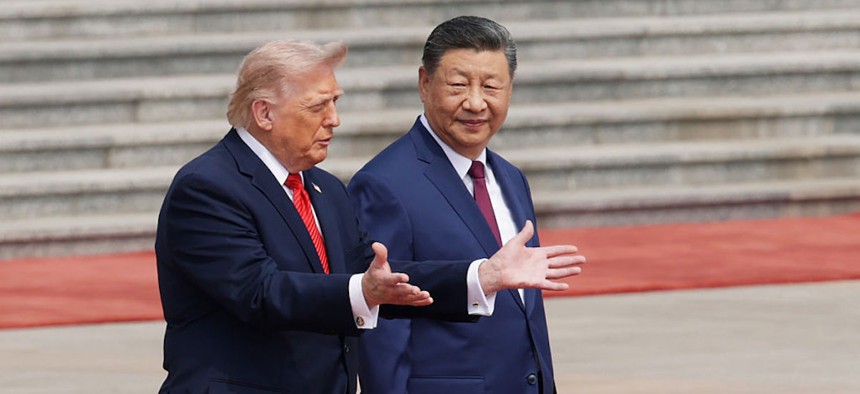
U.S. President Donald Trump and Chinese President Xi Jinping attend a welcome ceremony at the Great Hall of the People on May 14, 2026 in Beijing, China. Alex Wong/Getty Images



Trump says he and Xi talked US, Chinese cyberattacks, spying
The president seemed to suggest that the Chinese leader tacitly confirmed actions that lower officials routinely deny.

President Donald Trump said on Friday that he and Chinese President Xi Jinping discussed cyberattacks and espionage activities carried out by both nations during their bilateral meeting this week.
Speaking to reporters aboard Air Force One during his return flight to the United States, Trump, when asked if he raised the topics in their discussions, said, “I did. And he talked about attacks that we did in China. Y’know, what they do, we do too.”
“They’re talking about the spying. Well, we do it too,” he said. “We spy like hell on them too.”
“I told him, ‘We do a lot of stuff to you that you don’t know about and you’re doing things to us that we probably do know about,’” Trump added.
The president didn’t describe specific cyber campaigns that were discussed. China has made waves in recent years for its sweeping intrusions into telecommunications systems, government agencies and other infrastructure in the U.S. and around the world.
U.S. officials say the Volt Typhoon group has burrowed into critical infrastructure systems, such as power grids and water treatment plants, to be able to disrupt or sabotage them if China invades Taiwan.
Asked about these intrusions, Trump said, “Well, you don’t know that. I mean, I’d like to see it, but it’s very possible that they do.”
The remarks offer a rare public acknowledgment of U.S. clandestine efforts to monitor Chinese officials and networks. Intelligence agencies such as the NSA and CIA use covert tools, capabilities, and secret partnerships to track foreign adversaries.
CIA officials have said they have used video campaigns to recruit Chinese officials as intelligence assets.
Trump’s remarks also reveal a notable diplomatic posture on the issue, particularly given how difficult cyber operations can be to publicly attribute or verify.
Chinese officials routinely deny allegations of hacking and espionage, though Trump’s description of his conversation with Xi appeared to suggest some acknowledgment from Beijing that it has sought to infiltrate U.S. computer networks and recruit American assets of its own.
The White House and the Chinese embassy in Washington did not immediately respond to a request for comment.
Suspected Chinese spies sought out a former senior State Department officer late last year, requesting they draft an assessment of U.S. policy priorities in Venezuela in exchange for payment, Nextgov/FCW reported in January. Such recruitment efforts have resurfaced amid a wave of departures from the federal government over the last year, as the administration has pursued various measures to shrink the federal workforce.
In Trump’s second term, U.S. officials have been seeking a more hardened approach against foreign hackers and cybercriminal groups. In doing so, they have created a budding market for offensive cyber capabilities that government and industry are still grappling with. Offensive cyber operations would be among the tools the administration plans to use against groups deemed threats to the United States, according to a counterterrorism strategy released earlier this month.