

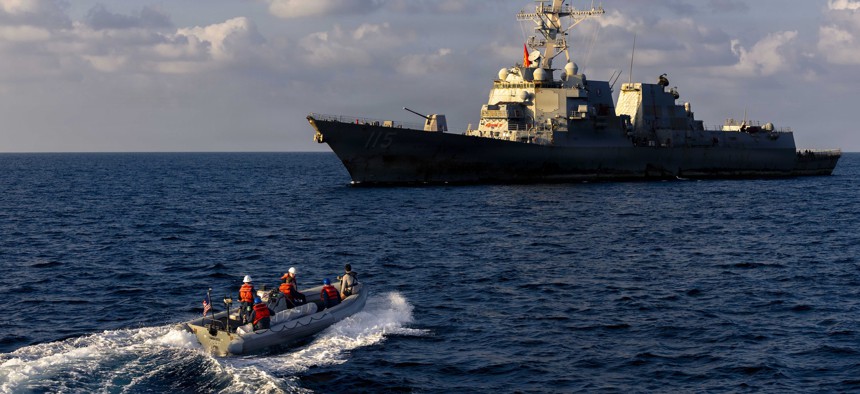
A Navy boat heads toward the U.S. destroyer Rafael Peralta, in the U.S. Central Command area of responsibility in October 2026. The Peralta is homeported in Yokosuka, Japan, . U.S. Navy

The war on Iran is stripping the western Pacific of US naval forces
“It’s really a big problem. It’s a problem for credibility. It’s a problem for our allies in the Far East,” one expert said.

Half of the U.S. Navy’s Japan-based destroyers are currently supporting the war on Iran, belying Trump-administration strategy documents that called the Pacific theater a top priority and undermining relations with Western Pacific allies.
Five of the 10 destroyers homeported in Yokosuka, along with the Yokosuka-based aircraft carrier George Washington, are deployed to U.S. Central Command’s area of responsibility to help fight a war of choice. Navy officials have told the crews of at least some of those destroyers they won’t return home until 2027.
“It’s really a big problem. It’s a problem for credibility. It’s a problem for our allies in the Far East…who, in a lot of cases, have been planning months in advance for carrier visits and for carrier battle group visits,” said Ralph Cossa, chairman and WSD-Handa chair in peace studies for the Honolulu-based Pacific Forum. And aircraft carriers deploy with several other types of ships, he pointed out.
“That’s all assets that normally would be in the Pacific, that normally would be showing the flag, that normally would be reminding our allies of our commitment. And they’re nowhere to be found.”
This is not what is prescribed by the National Security Strategy, which was released less than a year ago. “Preventing conflict requires a vigilant posture in the Indo-Pacific,” the NSS says. “The days in which the Middle East dominated American foreign policy in both long-term planning and day-to-day execution are thankfully over.” This was echoed in January by the National Defense Strategy, which declared that its top priorities were the U.S. homeland and deterring China.
But five weeks later, President Trump launched a war against Iran. And although Operation Epic Fury officially concluded in June, the Pentagon is keeping a large force in the region, making occasional attacks, and waiting to see whether Trump will order more.
U.S. Pacific Command officials pushed back on the suggestion that they are scaling back the China-deterrence mission.
“Our commitment to the security of the Indo-Pacific and to our allies and partners remains steadfast,” a PACOM spokesperson said, adding that the command “remains focused on deterring aggression and maintaining the readiness required to execute our assigned missions. We continually assess operational requirements and coordinate with the Department of War to ensure our forces have the capabilities and support necessary to meet them.”
Highlighting the recent Keen Sword military exercise, which included participation from the California-based Theodore Roosevelt carrier strike group, the spokesperson said “continuous training and exercises across the Indo-Pacific strengthen readiness and interoperability, while demonstrating our ability to respond to regional contingencies.”
Last week, at the TechNet Indo-Pacific conference in Honolulu, PACOM’s deputy commander, Lt. Gen. George Rowell, underscored that message in a keynote speech.
“Our mandate at U.S. Pacific Command is very clear: deterrence is our highest duty, and our guiding framework is to establish denial defense in the first island chain. We aim to prove that military aggressions will be infeasible, escalation will be catastrophic, and the costs of conflict far outweigh any gains.”
But, said Katherine Kuzminski, vice president of studies at the Center for a New American Security, sending so many of the U.S. Navy warships that are earmarked for patrolling the Pacific to the Middle East—and keeping them there for much longer than traditional Navy deployments—indicates “that our operations currently are not aligning with the administration’s stated national security strategy and national defense strategy, and that makes it really difficult at the service level or at the combatant command level to determine what the requirements are going to be.”
The military must be ready to respond, Kuzminski said, so “if there was some sort of incident that happens in the Indo-Pacific, we would want to be able to shift all of our resources there. But right now we’re kind of treating the [U.S. Central Command area of responsibility] in that way when we’ve committed to not be bogged down in the CENTCOM AOR.”
It’s not the first time the U.S. pivoted on the Pacific.
In 2012, under President Barack Obama, the Pentagon called for a “rebalance to the Indo-Pacific region,” including moving more troops and ships to the area. In 2016, then-Defense Secretary Ash Carter said the rebalance was not transient, but “enduring.” One year later, during the first Trump administration, a State Department official declared the rebalance officially dead.
Chinese president Xi Jinping has reportedly told his military to be prepared to take Taiwan by 2027. Cossa, like other experts, said he doesn’t believe “for a minute” that the Chinese will actually attack Taiwan next year, “but certainly, part of deterrence is convincing Xi that the U.S. has a commitment in this area and that we are going to respond. And when we have a third of our operational fleet out in the Middle East, that just sends the wrong signal.”
Keeping 7th Fleet sailors in the U.S. Navy Central region “for a year is going to be really poor for morale aboard ship and at home,” a Navy officer and expert on Pacific security told Defense One. “Trying to hide the cost by pulling [7th Fleet] away from home is just accounting fraud, and is hurting the fleet’s ability to show up for exercises in the Pacific, which will create its own hangover of damaged credibility, and contributes to the perception that the U.S. isn’t living up to its commitments on security in the region. I’ve heard that the fleet has been told to expect a 17 DDG requirement [in the Middle East] until 2029, which is insane. In terms of deterrent capability, most people I know think this is China’s clearest operational window for action against Taiwan, if the military balance were its only consideration.”
The good news from a Chinese standpoint, Cossa said, “is it continues to show how unpredictable our president is.”
“At this point, no Chinese planner in their right mind is going to factor the U.S. out. If you’re doing war gaming and practicing for an invasion, you have to factor the U.S. in.”
The question is, he said, “what do they think we can do if we’re there?”