

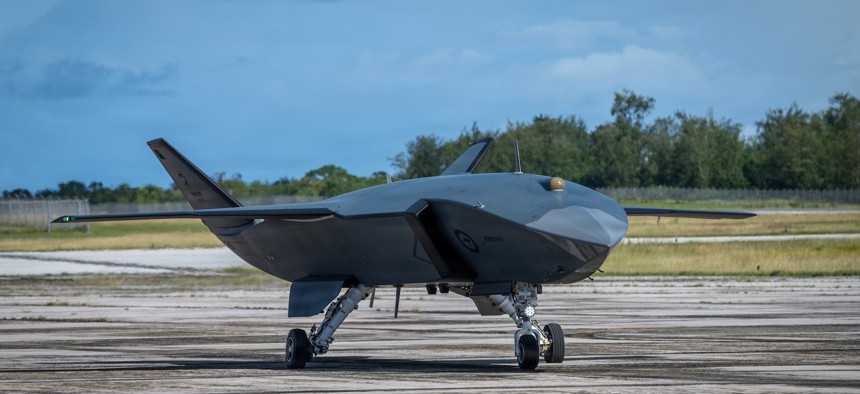
Boeing Defence Australia’s MQ-28 Ghost Bat, a production-representative test aircraft, prepares for a taxi test during Exercise Valiant Shield 2026 in the Northern Mariana Islands, June 21, 2026. U.S. Air Force / Senior Airman Adrien Tran



An Australian CCA flew in a Pacific exercise. Boeing exec says it’s an important ‘first step’
One Boeing CCA didn’t win the first U.S. competition, but another just joined a major exercise.

FARNBOROUGH, UK—The first robot wingman to fly with U.S. aircraft in a major multi-national exercise wasn’t among the ones that the Air Force picked for initial-production contracts last month. Instead, it was the MQ-28 Ghost Bat, which is being developed by Boeing for the Australian Royal Air Force—and a company exec hinted that its CCA could have more exercises in its future.
The Ghost Bat, which made its airshow debut this week here in England, flew last month alongside U.S. and allied forces in Valiant Shield, a large training exercise in the Pacific’s Northern Mariana Islands. On Tuesday, Glen Ferguson, Boeing Defense Australia’s MQ-28 global programs director, told reporters on Tuesday that was the “first step” in integrating CCAs into the force. More opportunities are likely on the horizon, he said.
“As far as next steps, there’s not too many exercises these days that are single-country exercises, and Valiant Shield wasn’t,” Ferguson said. “Things like Talisman Saber next year— 40,000 people turning up to Australia across the Pacific and Indo region, they’re the opportunities to go and do that. I think you’ll see us, in the Australian Air Force in particular, applying these assets into those exercises as operational capabilities to test and develop their tactics.”
Two years ago, the Air Force dropped Boeing from the running for the first increment of its CCA program, which in June issued contracts to Anduril and General Atomics instead. (Boeing didn’t offer its MQ-28 Ghost Bat for that first competition.) Late last year, the service started giving money to companies to develop a second iteration of CCAs. It’s not publicly known whether Boeing is among them, and Ferguson declined to comment on increment two.
This month, Boeing said in a news release that the Ghost Bat had become “the first and only collaborative combat aircraft (CCA) deployed to a multinational, joint operational exercise.” “Having MQ-28 participate in such a significant military training exercise is a first, and this is just the start of demonstrating how advanced human-machine teaming extends the reach and awareness of crewed platforms and enhances joint force operations,” Steve Parker, Boeing Defense, Space and Security’s president and CEO, said in a news release this month.
Ferguson told reporters that Navy Adm. Sam Paparo, the head of U.S. Indo-Pacific Command, was happy to have a CCA flying in the region.
“The feedback from the U.S. government was they were very happy to have a CCA in the Pacific theater,” he said.
In its own press release, the Air Force said the U.S. used Boeing’s CCA appearance to project new capabilities in the Pacific.
"By advancing human-machine teaming, we are increasing our power projection while building a more resilient, capable, and lethal joint force,” U.S. Air Force Maj. Daniel Pesich, the Experimental Operations Unit’s collaborative combat aircraft detachment officer in charge, said in a news release.
Boeing said in a news release that the drone wingman flew alongside F-35s, F-15EX, HC-130, E-3, E-2D, EA-18G, and RC-135 aircraft. U.S. officials have said they plan to field its first 100 operational CCAs by 2029.
Other countries are eager to field their first CCAs, too. In addition to the Royal Australian Air Force’s current Ghost Bat orders, Germany is also eyeing Boeing’s drone wingman.
Germany’s Bundeswehr plans to field its first operational drone wingmen by 2029. Earlier this year, Rheinmetall and Boeing Australia joined together to offer the Ghost Bat as the country’s drone wingman offering. That team expanded last month to include German firms Diehl Defence and Rohde & Schwarz. On Tuesday, HENSOLDT, a German electronics company, announced that it joined Boeing’s Ghost Bat industry team.