

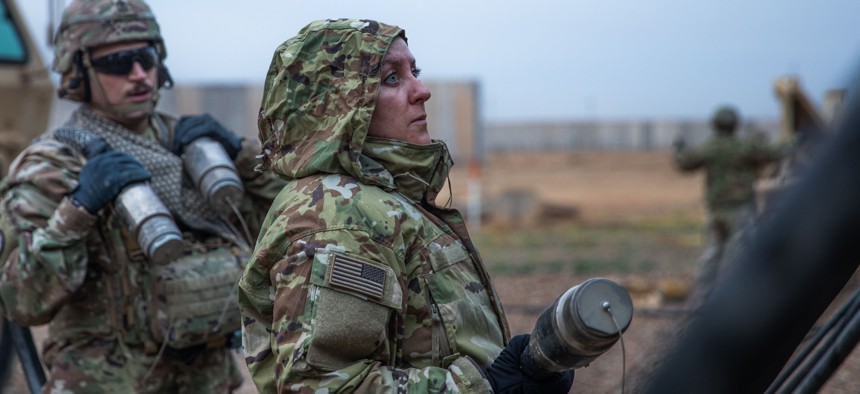
An Army hackathon aims to better connect air-defense systems. In 2025, soldiers of the 31st Air Defense Artillery Brigade trained with Patriot missile batteries in CENTCOM's area of responsibility. U.S. Army / Sgt. Steve Asfall



Software patches from Army hackathon going straight to troops in CENTCOM
Project Jailbreak is helping to get contractors open up their systems to each other.

Engineers from top defense contractors have spent days behind their laptops at Fort Carson, Colo., coding up ways to enable weapons, sensors, and command-and-control systems developed independently to share information.
Dubbed Project Jailbreak, the effort is part of the Army’s first hackathon to integrate its many proprietary software programs. Some of the fixes have already been pushed to deployed troops, according to the Army’s chief technology officer.
“A couple of the software patches have gone forward, luckily…we're still in a lull of action. There hasn't been a ton of incoming, so we haven't used them in an offensive capacity,” Alex Miller said. “Our goal is to push the rest of that forward in the next 30 days.”
Representatives from Anduril, Boeing, General Dynamics, L3Harris, Leidos, Lockheed Martin, Northrop Grumman, Palantir, Perennial Autonomy, and RTX are working on integrating dozens of their products, in a push to cut down on the number of screens it takes to look at the battlefield and either launch missions or respond to threats.
“So if you've been into any joint operation center or tactical operation center, there's screens everywhere, and that is because we, over time, have tried to give as much information visually as possible,” Miller said. “What that has unintentionally done over time is forced our people to be the integration point, which is really rough if you're cold, tired, wet, and hungry. So, if you've been fighting and, you know, 20-hour days and you're getting a little bit of sleep, it just doesn't scale very well.”
The Army is working to eliminate this issue with its next-generation command-and-control platform, which is still in testing and development. But in the meantime, it has endless existing technology that needs to be linked up now.
To do that, service leaders invited major contractors to Fort Carson for a series of hackathon events. The first push was to integrate existing counter-unmanned and air-missile defense systems, tightening defenses against the types of weapons that have targeted U.S. troops in the Middle East during the war in Iran.
“At the end of 30 days, hopefully we've given them more decision space, more space to be able to decide what system, what effector, how they're going to defeat the threats that they're facing every day, based on all of the different capabilities over the years,” said Brent Ingraham, the Army’s assistant secretary for acquisitions, logistics, and technology.
It actually wasn’t that difficult to convince defense industry giants to send engineers to the hackathon on their own dime, officials said, nor to convince them that opening up their proprietary systems to each other is a necessary step in the way the Army is doing development and acquisitions now.
“My perception of this is there had been a first-mover problem…where none of them could take the first step without being certain the others would come,” Army Secretary Dan Driscoll said. “And so once they were certain that the United States Army, as the convener, was requiring everybody—or strongly recommending everybody—to show up, everybody came quickly, and it has unlocked massive momentum.”
Help us report on the future of national security. Contact Meghann Myers: mmyers@defenseone.com, meghannmyers.55 on Signal.
NEXT STORY: Army’s data-merging cell needs a few years to untangle the mess