

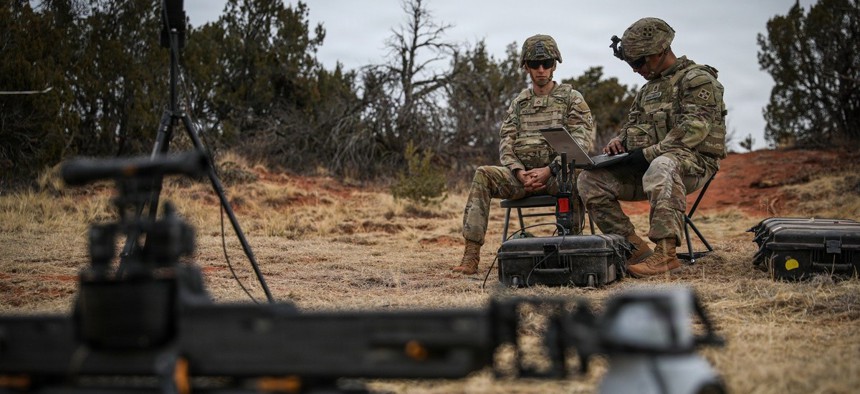
Drone operators with the U.S. Army's 4th Infantry Division use the Lattice system integrated into Next Generation Command and Control during Ivy Sting 4 on Fort Carson, Colorado, Feb. 2, 2026. U.S. Army / Pfc. Thomas Nguyen


Army turns to ‘hackathons’ to better connect dozens of weapons, systems
Nine leading vendors are to attend the first brainstorming session at Fort Carson, Colorado.

The Army is opening a new front in its battle to get contractors to make their weapons and systems easier to connect: “hackathons.”
Later this month, the service will host some of its biggest vendors for the first of a series of one-day brainstorming sessions about how to integrate the command-and-control software for dozens of military systems.
“Right to Integrate,” the service’s name for the effort, will ensure the Army’s battlefield and business systems can better share data and communicate, according to a Tuesday news release.
“We’ve known for a long time that our systems, weapons, and sensors need to talk to each other so that we can dominate the battlefield,” Army Secretary Dan Driscoll said in the release. “The war in Ukraine showed the world that speed matters and an open architecture construct is highly effective in high-intensity warfare. We haven’t been moving fast enough.”
The Ukrainian military requires that its drone, sensors, and weapons platforms all have a common operating system, while the U.S. has long allowed contractors to make custom systems that can’t easily connect to each other.
“We have seen standards come and go in the department for decades, but are still beholden to sub-par implementation, closed and proprietary interfaces, or systems that lack the flexibility to adapt over time,” Alex Miller, the Army’s chief technology officer, said in the release.
The service has tried to turn that around with its next-generation C2 platform, which is being built with an open-architecture approach. The hackathons are meant to help existing platforms deconflict their operating systems to be able to start talking to each other.
Engineers and scientists from Anduril, Boeing, General Dynamics, L3Harris, Leidos, Lockheed Martin, Northrop Grumman, Palantir, Perennial Autonomy, and RTX are all supporting with dozens of pieces of technology and equipment will meet up for the first event later this month at Fort Carson, Colo.
Help us report on the future of national security. Contact Meghann Myers: mmyers@defenseone.com, meghannmyers.55 on Signal.
NEXT STORY: First B-52s to get new engines this year