

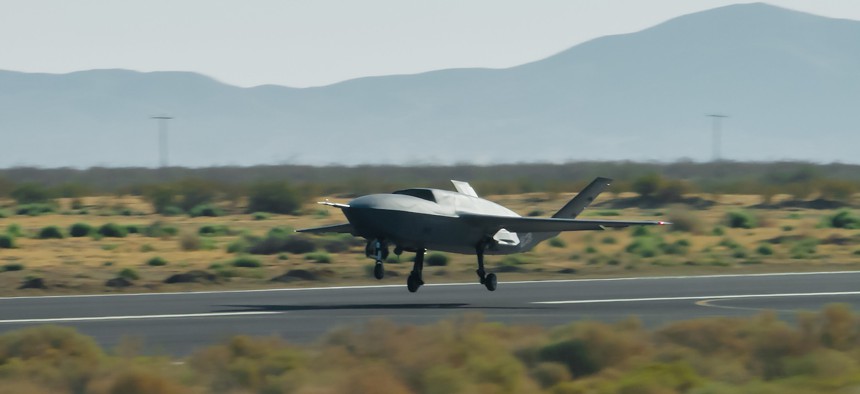
A YFQ-42A Collaborative Combat Aircraft takes off during flight testing at a California test location in 2025. Courtesy / General Atomics

General Atomics resumes drone-wingman flights after mishap
An investigation by the Air Force and the defense contractor led to a software change.

Nearly seven weeks after an autopilot problem crashed a General Atomics collaborative combat aircraft, the company announced Thursday that its drone wingmen are back in the skies.
On April 6, a YFQ-42A “Dark Merlin" crashed at the company airport in California, prompting a joint investigation by the company and the Air Force. General Atomics spokesperson C. Mark Brinkley said flight testing resumed on Wednesday. The company continued ground testing and other evaluations while flight testing was paused. A software problem identified during the investigation has been fixed.
“A thorough safety review isolated the cause to an autopilot miscalculation for the weight and center of gravity of the aircraft, prompting a software remediation,” General Atomics said in a news release. “Following a stringent evaluation, technical authorities endorsed the software changes and YFQ-42A has returned to the air.”
No one was injured in the April 6 crash, but the company said the aircraft was a “total loss”.
It was one of several production-representative CCAs being made for the Air Force’s drone wingman competition. General Atomics is going head-to-head against Anduril and Northrop Grumman for the service’s business. An Increment 1 production decision is expected before the end of September, and the Air Force is requesting nearly $1 billion to buy its first CCAs, 2027 budget documents released last month show.
“It’s been said that you learn more from your setbacks than your successes,” General Atomics President David R. Alexander said in the news release. “We are applying what we’ve learned to our growing fleet of CCAs, as we continue building the most dependable and cost-efficient unmanned fighters in the world.”
Air Force Col. Timothy Helfrich, portfolio acquisition executive for fighters and advanced aircraft, said the incident showed the service’s new willingness to accept risks.
“The USAF and General Atomics response to the YFQ-42 mishap validates our approach to accept acquisition/test risk instead of operational risk allowing us to accelerate the program towards fielding,” he said in an emailed statement. “We pushed the envelope, identified a risk, learned from the data, and have cleared the YFQ-42A to return to flight.”
Helfrich stressed that the crash didn’t pause progress on the CCA program. He said the service’s Experimental Operations Unit at Edwards Air Force Base in California flew several sorties with Anduril’s YFQ-44A Fury aircraft the same week General Atomics paused test flights.
“Despite the pause on one platform, we executed this critical exercise that same week using the YFQ-44A to validate core operational and deployment concepts,” Helfrich said in the statement. “Because of this momentum and our resilient, multi-vendor approach, overall CCA progress never missed a beat as we drive toward delivering advanced capability to the fleet."