

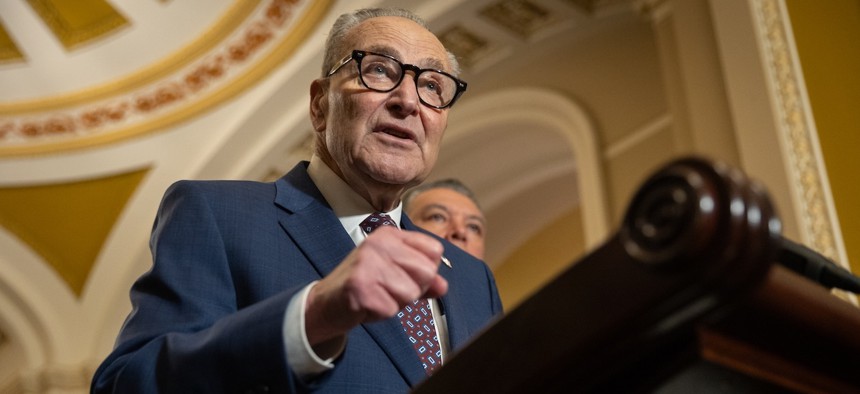
Senate Minority Leader Chuck Schumer, D-N.Y., laid out his caucus’ demands for DHS reforms early on Wednesday. Nathan Posner/Anadolu via Getty Images



Shutdown deal struck after failed Senate vote
Senate Democrats and the White House reached an agreement late Thursday to fund most departments and agencies through Sept. 30 after a previous funding bill was blocked.
Updated at 9:18 p.m. ET
Senate Democrats and the White House came to an agreement late Thursday to fund the vast majority of federal agencies through the end of the fiscal year, and a two-week stopgap measure to fund the Homeland Security Department while continued negotiations take place over reforms at DHS.
Senate leaders worked into the evening to schedule a vote. It is unclear when the House, which is in recess until Monday, will vote on the measure.
“Hopefully, both Republicans and Democrats will give a very much needed Bipartisan “YES” Vote,” President Trump wrote on Truth Social.
The deal came hours after eight Republicans joined all Democrats in defeating a previous measure, which the House had approved with broad bipartisan support. It was set to coast to President Trump’s desk until Border Patrol agents fatally shot Alex Pretti on Jan. 24, leading to demands from Senate Democrats that more restrictions be placed on the Homeland Security Department’s immigration enforcement efforts as part of the agency’s funding bill.
Senate Minority Leader Chuck Schumer, D-N.Y., subsequently laid out his caucus’ demands for DHS reforms, including the removal of masks by DHS law enforcement personnel, mandated use of body cameras, a requirement for third-party warrants to enter homes, the end of roving patrols in metropolitan areas by Immigration and Customs Enforcement and more uniform restrictions on use of force by federal agents. Democrats engaged the White House on those requests and ultimately negotiated a bipartisan path forward.
Lawmakers in both parties had expressed an openness to carving out DHS appropriations and passing the other five spending bills still outstanding. The package funds the departments of Defense, Labor, Health and Human Services, Education, Transportation, Housing and Urban Development, State and Treasury, as well as other related agencies. Under the plan, Congress would approve a stopgap continuing resolution for DHS to allow for negotiations to continue for two weeks.
The failed bill would have almost certainly led to at least a short shutdown, however, as funding those agencies was set to expire first thing Saturday.
With a deal getting signed into law imminent, the Office of Management and Budget could instruct agencies to delay shutdown procedures. OMB pursued such an approach in 2018 when funding briefly expired for agencies but it declared the impasse was merely a “short, technical lapse.” It advised employees to show up to work due to the imminence of a resolution, though the situation created widespread confusion across federal agencies.
Share your news tips with us: Eric Katz: ekatz@govexec.com, Signal: erickatz.28
NEXT STORY: Nominee to lead NSA backs controversial spying law