

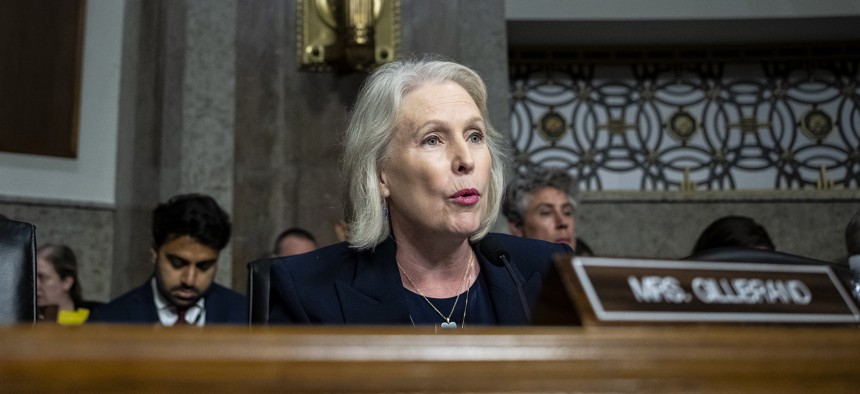
Sen. Kirsten Gillibrand, D-NY, during a Senate Armed Services Committee hearing on April 30, 2026 in the Dirksen Senate Office Building in Washington, D.C. Graeme Sloan/Getty Images



Cyber Force? Senator pushes to create service branch under the Army
Ideas for a cyber service have been floated before. Some experts argue now is the right time.

A new cyber-focused military service branch would sit under the Army if one senator’s proposal comes to fruition.
Sen. Kirsten Gillibrand, D-N.Y., is spearheading a markup amendment to the Senate’s 2027 National Defense Authorization Act that would create a “Cyber Force” as the next armed service branch. The senator’s office confirmed that the amendment proposes to establish the branch under the Army, just as the Space Force and Marine Corps sit under the Air Force and Navy.
Similar provisions are reportedly being floated in the House, according to two people familiar with policy discussions. Earlier this year, Rep. Pat Fallon, R-Texas, told the Center For Strategic and International Studies that a “Cyber Force is inevitable” and “we’re going to get this done.” A Fallon spokesperson did not respond to multiple requests for comment on Friday asking about a potential amendment.
“New and escalating cyber threats on the battlefield demand a change to our current approach. The status quo and years of incremental changes are not meeting the current threat and are insufficient as that threat grows,” Gillibrand told Defense One in an emailed statement. “I believe, and many experts agree, that the creation of a dedicated Cyber Force will ensure the United States is ready to fight and win on the modern battlefield and protect our national security.”
The proposed amendment marks the latest push in a years-long effort. Gillibrand and House lawmakers have backed the idea before. In the 2025 National Defense Authorization Act, lawmakers commissioned the National Academies of Sciences, Engineering, and Medicine to study “alternative organizational models for the cyber forces of the Armed Forces.” Those findings have not been released. Details from the amendments showing what a Cyber Force might look like are not yet public, but think tanks and national security experts have already been pitching their own force designs.
A 2024 Foundation for Defense of Democracies report concluded that a Cyber Force could sit under the Army, muster about 10,000 personnel, and need a budget of around $16.5 billion. In August 2025, the FDD and the Center for Strategic and International Studies announced a commission on Cyber Force Generation. A report from those think tanks is scheduled to be released next month.
One former military official said there would be strengths to a cyber-focused service, but putting it under the Army is a bad idea. They argued that cyber would remain a secondary priority amid the branch’s many missions.
“The Army is the largest service by far,” the former official said. “Manpower-wise, it's like half the department, and it's like, ‘we'll put it under because it'll be easy for the Army to just put in another force.’ It's already hard enough to run the Army as it is.”
Mark Montgomery, a retired Navy rear admiral and an FDD senior fellow who advocates for a Cyber Force, argued that this year is an ideal time to create a new service.
“Timing-wise, you need to do this in the beginning or middle of an administration, not at the end of an administration,” Montgomery said.
The proposed amendment would need to survive multiple Senate and House edits to make the final compromise NDAA.
It’s not clear if the Trump administration would support the latest bipartisan push. Last year, the Pentagon rolled out CYBERCOM 2.0, a series of policy changes aimed at beefing up the recruiting, training, and missions of the existing U.S. Cyber Command.
Katie Sutton, the assistant defense secretary for cyber policy and principal cyber advisor to Defense Secretary Pete Hegseth, defended the Cyber Command reforms during a January Senate hearing, and said a renewed command and a new service could co-exist.
“I think this is a really important debate for us all to be having about the future of the cyber warfighting domain,” Sutton told the Senate Armed Services Committee in January. “I do think one of the most common misconceptions about Cyber Command is that it is a debate between Cyber Command 2.0 and a cyber force, and they are actually separate debates that I believe both need to be had, and we need to look closely at the pros and cons of both.”
Advocates for a separate and independent cyber-focused service branch say it aligns with the Trump administration’s calls for “offensive cyber operations against those planning to kill Americans,” the White House’s new counterterrorism strategy said. It also comes as President Donald Trump and Gen. Dan Caine, the Joint Chiefs chairman, acknowledged the growing role of cyber effects in U.S. military operations in Iran and Venezuela, Defense One and sister publication NextGov/FCW have previously reported.
“The president says, ‘We've got to be more offensive’ but then you got to better generate forces to be offensive, and we don't generate enough forces to do both offensive cyber and defensive cyber operations,” Montgomery said. “A cyber force is clearly necessary.”