

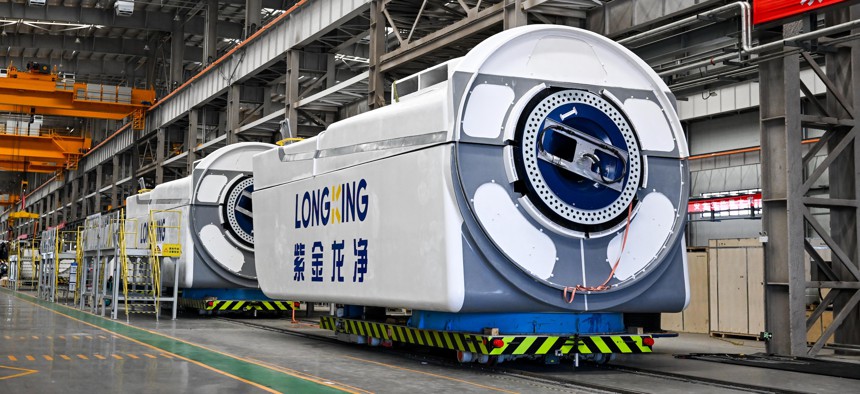
Wind turbine nacelles sit in the Mingyang New Energy Intelligent Manufacturing Industrial Park in the Chinese city of Baotou on July 29, 2025. Li Zhipeng/Xinhua via Getty Images



China is building ‘full-stack’ defense-innovation cities
While the U.S. struggles to add rare-earth factories and drone-test ranges, Beijing is creating them in clusters.
The city of Baotou—long the heart of the rare-earths mining sector that has given China a stranglehold over the modern economy—is now working to establish entire next-generation production chains. In Inner Mongolia’s second-largest city, processed ores flow quickly to factories that make magnets and motors, and onward to production lines that crank out drones, eVTOL aircraft, and even humanoid robots. The result is an industrial powerhouse that other Chinese cities are working to emulate—and that U.S. firms are unable to match.
Beijing views rare earths as not just merely a tool of global influence, but an ignition point for integrated industrial innovation. Their unique qualities enable the creation of magnets and motors that deliver more lift per watt and more torque per kilogram. Across China, local governments now co-locate rare-earth processing zones with component makers and drone and robotics parks, turning mineral hubs into full-stack ecosystems. In Sichuan Province, for example, the city of Mianyang is building on its reputation as a regional base of defense research and development with a major investment in permanent magnet construction. Such clusters reflect the government’s push for “new quality productive forces”: advanced industrial capacity built on secure inputs, dense supply chains, and fast scaling.
Baotou shows the model in its most complete form. City plans lay out a network of bases to support UAV testing, training, and logistics. This effort is anchored by the Rare Earth High-Tech Zone, where the proximity of component makers and downstream integrators speeds iteration and reduces supply-chain friction. Local government messaging describes a full chain that runs from mining and magnet production to motor fabrication and UAV assembly.
Several rare-earth cities are taking aim at a particular market sector: the “low-altitude economy”: products, services, and infrastructure to support activities in airspace below 1,000 meters (3,280 feet). Such activities include delivery, surveillance, tourism, and urban air transport. The Civil Aviation Administration of China expects the sector to be worth up to 2.5 trillion RMB (about $500 billion) within a decade. Already, logistics drones are flying routes that link the mountainous inland province of Jiangxi to major delivery networks serving the Pearl River Delta.
In Jiangxi, the city of Ganzhou has built a permanent-magnet-motor park and connected it to a low-altitude-economy park that provides R&D, manufacturing, operations support, and regulatory frameworks. The aim is to create a municipal-scale ecosystem with local sources of magnets, motors, airframes, and operational support, reducing lead times and accelerating scaling. Another low-altitude ecosystem is rising in Fujian Province, Jiangxi’s neighbor to the east.
Chinese officials often sell the low-altitude economy as a boon to commerce and public services such as delivery, inspection, agriculture, and tourism. Defense-affiliated commentary and local armed forces activity, however, show how localities increasingly treat it as a dual-use resource for national defense.
Some low-altitude-economy parks are now building defense capacity into their tenant mix, using their talent, platforms, and industrial capacity to aid in defense mobilization. One Sichuan park has created a pair of specialized militia units: a reconnaissance platoon built around long-range UAVs and a company that specializes in the rapid repair of airfields. In Jiangsu, a local People’s Armed Forces Department has organized UAV-based reconnaissance units that have deployed for civilian missions such as disaster survey and water rescue—but are organized for use in wartime.
Such militia teams provide structures for training, tasking, and integration during crises. This arrangement narrows the gap between commercial capacity and organized wartime support by keeping platforms, operators, and maintenance ecosystems close to the mobilization system.
And China’s military gains as much as commercial firms do from the rise of full-stack, aviation-focused development-and-production centers. As a RUSI report noted, the production of many battlefield drones is constrained less by the ability to turn out airframes than by the availability of propulsion and actuation components. China is increasingly able to manage those constraints inside a single municipal industrial footprint.
The wide distribution of such clusters, across coastal as well as inland regions, further strengthens the model. It cushions the system against localized shocks such as environmental enforcement, energy constraints, or regional bottlenecks. And it would complicate wartime efforts to disrupt production through targeted strikes or interdiction.
Like Chinese analysis, U.S. discourse increasingly treats permanent magnet motors as a chokepoint in the global supply chain. This has prompted the Pentagon to become the largest partner in MP Materials, which owns the only operational rare earth mine in the United States.
But Baotou’s Rare Earth High-Tech Zone and its imitators show how U.S. policymakers must deepen their understanding and goals beyond current production counts or who owns what mine. While Beijing’s competitors struggle to build rare-earth processing plants, magnet factories, and high-performance motor supply chains, China is doing all of those at once, creating full-stack clusters that will widen its advantage in next-generation technologies.